Every report you commission asks the same question. What does this mean for our business?
The events you read about every week (a country severs relations, a gas market spikes, a central bank holds hawkish) reach specific lines in your book through paths that no tool on your stack currently draws. BearingA composes those paths on your data, at your altitude, in the vocabulary your team uses.
See Your Blind Spot delivers one composition against your data today. Under NDA. No sales call. No follow-up unless you ask.
What we are watching this week, too.
Brent oil: $92-93/bbl, sixth session up. UAE-Iran severance 20 Aug.
European gas (TTF): €65/MWh, up 3% on 20 Aug.
ECB: hawkish hold at 2.25%. September hike almost fully priced.
01
Why this matters
The specific link between event and impact does not compose on your stack.
Every operator in your firm asks it every day. Iran-US severs diplomatic ties on Wednesday. TTF gas spikes on Thursday. The ECB holds hawkish on Friday. And by Monday morning someone on your team is asking what this means for the Q4 plan, for the covenant, for the campaign, for the capex commit. That question is what you do every week. It is the discipline of running a business. On most lines you manage, you have tools that help you answer it. Your finance team runs the numbers on rate scenarios. Your commercial team models campaign impact. Your treasury team looks at currency exposure. You know how to make decisions on the lines you already have instrumented.
The lines that get missed are the ones where the answer needs a specific reading of how an event in the world reaches a specific line in your book. Not commentary on the event. Not a forecast of where the market goes next quarter. The specific link. How Iran-US severance reaches your Q4 subscription retention through household costs. How TTF gas spikes reach your gross margin through freight costs on your bulky products. How the ECB holding hawkish reaches your covenant headroom through your working capital line. Bloomberg tells you the event happened. Your finance model tells you where your covenant sits. Nothing on your stack composes the specific link between the two, on your book, at your altitude, in the vocabulary your team decides in. The question is not whether Bloomberg or your finance team reads well. It is whether the specific link between what they each read gets composed anywhere before your P&L moves. When the answer matters enough to commission specifically, you call in a strategy consultancy. A million dollars in fees. Eight to ten weeks. A deck that arrives after your Q3 decisions are already taken.
BearingA does that specific work at a shape that fits how your decisions actually run. Not a Bloomberg replacement. Not a consulting-firm replacement. A specific tool for the specific job of composing how an event in the world reaches a specific line in your book, sourced at every step, delivered in the language your team already uses to make decisions on that line, in your hands today rather than in October. Every claim we make cites where it comes from (a named study, a named cycle, a named prior case). Not a model output. Real evidence from what has happened before in conditions comparable to now. Every historical comparison names the year, the conditions, and what is different now. Every dollar figure sits inside a range from prior work we have done for operators like you, and we tell you where your number sits inside that range. What differs from the consultancy shape is that you have a first read in your hands today rather than in your inbox in October, a read your team can review this afternoon, pressure-test against your own instincts this week, share with the colleague who owns the specific decision the read touches, sharpen with a follow-on read against different data next week, and use as the starting point for a longer commissioned engagement if the exposure the read surfaces warrants that spend. The eight to ten weeks of a consultancy engagement is not slower delivery of the same value; it is time in which you have nothing to work with while the same operating decisions still need to be taken. See Your Blind Spot delivers the first read against your data today, so from tomorrow morning your team is working on the exposure instead of waiting on it. If the read opens on any desk in your firm and reads the way that desk’s own operating notes read, we have done our job.
02
See your blind spot
The offer · A first read today · Your data · Under NDA
One Bearing read against your data, at your altitude, in your operating vocabulary, in your hands today.
Share the operational context and the data you are comfortable sharing. We compose a read that traces how a current event in the world reaches a specific line in your book, in the vocabulary your team uses to make decisions on that line. We include a comparison prompt you can paste into Claude, ChatGPT, or Gemini to run the same question there. You compare in your own hands what a generic AI produces on its own against what BearingA composed. The difference is either obvious or it is not. NDA first. No sales team receives your data. No follow-up unless you ask.
What we ask you for (three fields)
1
What operational decision are you sharpening?
The plan, budget, portfolio, deal, or campaign you are working against, and the specific line in your book it turns on. Retention rate, gross margin, covenant headroom, valuation, campaign ROI, whichever.
2
What part of your business does it concentrate on?
Category, geography, cohort, channel, product cluster, market, business unit. However you segment.
3
What data are you comfortable sharing, and what raised the question this week?
Attach or describe a campaign file, cohort export, transaction history, or planning snapshot. And tell us what raised the question. A board meeting, a note from your CFO, something on the wire, a client call, an internal review.
The read. A Bearing composition traces the wire from the current event in the world to the specific line in your book, sized in your currency at the altitude your decision travels through, in the vocabulary that altitude uses. Every claim cites a source. Every historical comparison names the year, the conditions, and what is different now. Every row carries a confidence tag: real (math on your own data), read (our read of the current configuration), modeled (benchmark data used where your first-party data has a gap).
The comparison prompt. A naturalistic prompt you paste into Claude, ChatGPT, or Gemini. Same question, same current environment, no proprietary framing. Run it. Compare what a generic AI produces to what BearingA composed. If we do not produce something categorically different, we have not done our job.
What your team does with these, starting tomorrow morning. Review the read with your team this afternoon. Pressure-test it against your own operating instincts this week. Share it with the colleague who owns the specific decision the read touches. Sharpen the question with a follow-on read against different data next week. Use it as the starting point for a longer commissioned engagement if the exposure it surfaces warrants that spend. Every one of these is work you cannot start today because you have nothing composed on your book to work from.
A first read in your hands today.
From intake submission to composed read plus comparison prompt in your download, in the browser you are using right now.
Zero human touch on your data.
The composition engine that runs BearingA’s deployed reads runs your See Your Blind Spot output. Same engine, same discipline. No sales team, no consulting team, nobody at BearingA sees your data unless the composition fails our safety check, in which case one engineer reviews it and we tell you before delivery.
NDA before you upload anything.
Our NDA is standard and mutual. If you prefer to use yours, send it over.
No follow-up unless you ask.
If See Your Blind Spot lands and you want to talk, our contact is on the page. If it does not, we will not chase you.
Designed for operators at global scaled businesses across consumer goods, industrial, services, technology, retail, and hospitality.
If Bearing Financial, Advisory, or Consultancies is a better fit, see the other doors03
See the difference
The same portfolio, read two ways. Your stack on one side. BearingA’s read on the other.
We composed this on Ashford Living, a subscription-commerce operator, against the Iran-US compound in the second week of August 2026. Same enriched portfolio, two reads. What her stack sees on one side. What BearingA composes on the other.
Without BearingA · what her stack sees now
Run the enriched portfolio through a standard marketing-mix model, the analysis Ashford’s team runs today in Measured or Northbeam. It produces:
Channel-to-conversion attribution. Paid Search, Paid Social, Email, Affiliate, Direct, Referral, each attributed its share of conversions across the 10,000 campaigns. The attribution is clean and the model is well-specified for what it measures.
Marginal ROI curves per channel. Each channel’s response curve fitted, the blended return reading healthy at an aggregate ROI near 2.0, the growth spend directed toward the channels the curves rank highest. The curves are concave, the model knows returns diminish, and it optimises against that.
Subscription-tier retention rates as observed. Basic, Standard, and Premium retention measured on trailing data, the tiers treated as stable populations, the tier-upgrade path projected forward on the observed rates.
Campaign-level optimisation recommendations. Reallocate toward the higher-attributed channels, trim the underperformers, scale the winners. Standard plan-optimisation output.
Cohort behaviour treated as stable across the projection window. This is the load-bearing assumption, and it is invisible because it is never stated. The model reads channel-to-conversion within cohort behaviour it holds constant. It does not carry a variable for the cohort’s economic state changing underneath the conversion.
Iran-US does not enter. Not because the analysts judged it irrelevant, but because the measurement substrate has no place to put it. The MMM reads channels and conversions; a geopolitical configuration is not a channel and produces no conversion, so it is structurally outside the model. The stack is not wrong. It is complete for what it measures, and silent on what it does not.
With BearingA · the same portfolio at cohort-position altitude
Read the identical enriched portfolio at cohort-position state altitude, against the five upstream configurations, with the Iran-US resolution-path invariance rendered explicitly. It produces what Side A structurally cannot:
Per-cohort sensitivity against the compound. Each cohort-position carries a sensitivity coefficient against the Iran-US price signals (Brent, DXY, fuel pass-through through landed cost), grounded in the resolved-cycle anchors and the sourced demand mechanism (SOURCE 055, household inflation expectations as the predominant consumption-response driver). The portfolio splits, 50 of 58 cohorts materially sensitive, 8 buffered, along a line the MMM reads as one homogeneous population.
Tier-transmission asymmetry. The subscription-tier mechanic the MMM treats as three stable retention rates, Bearing reads as three different transmission topologies. Standard subscribers carry a downgrade-to-Basic middle state that leads churn; Basic subscribers churn directly with no leading state; Premium subscribers hold. The compression surfaces as a downgrade cadence before it surfaces as the retention-rate change the MMM eventually measures (SOURCE 275).
What the MMM does not see, dated. The Standard middle-income cohorts, the ones the plan’s tier-upgrade growth assumption runs through, are structurally compressed roughly 60 days ahead of the conversion signal that would surface in her stack. The gap is not a modelling difference; it is an altitude difference. Bearing reads cohort state; the MMM reads downstream conversion; the 60 days is the distance between them.
The Q3-Q4 marks at cohort altitude, framed as over-investment prevented. Hold or redirect the growth spend leaning into the compressed Standard middle-income cohort; preserve or lean into the Premium control side. The commercial figure is roughly $5.4M, the compound-caused increment on the growth dollar’s marginal return, on a sourced concave response curve (SOURCE 276) depressed by the compound for exactly the cohorts the spend targets.
The over-investment-prevented framing is what makes this defensible without anyone in the room. The CFO does not have to believe BearingA forecasts better. He has to accept one thing the concave response curve makes near-arithmetic: the marginal growth dollar returns a fraction of the blended average the MMM books, and the compound depresses that marginal return further for a nameable slice of cohorts. The $5.4M is small, specific, and sourced. It is not a claim the marketing is broken; it is a claim that a defined slice of growth spend is committed against a return the compound has already removed, on cohorts the MMM cannot see and BearingA can name.
Ashford Living · Iran-US compound · 19 August 2026
04
Read one first
Actual Bearing reads · Read one first if you want
Before you share data with us, read what a Bearing read actually looks like.
The reads below are real Bearing compositions on events in the world right now, in the vocabulary an operator running her business would use. Not case studies. Not sales collateral. Reads in the form you would receive if you deployed. Open one or two. Check whether the language, the specificity, and the working shown are what you would want reaching your desk.

A CMO read on Iran-US / Hormuz.
Ashford Living, a home-and-lifestyle subscription operator, Q3-Q4 2026 planning. How Brent reaches freight, freight reaches landed cost, landed cost reaches household inflation expectations, and household inflation reaches the middle-income Standard tier’s discretionary line. Sized at $5.4M over-investment on real math from Ashford’s own data, put inside a range from prior work, tagged real / read / modeled per row.
Read the read
A CFO read on gross margin exposure.
How the current cost cascade reaches the gross margin line, with the structural claim that spot signals retrace but absorbed cost effects do not (which is why gross margin does not recover the way input prices do).
Read the read
A political-economic read on European corporate exposure.
How the current political-economic environment in Europe transmits into corporate operating conditions at named-market altitude, with the specific difference between now and the last comparable cycle called out.
Read the read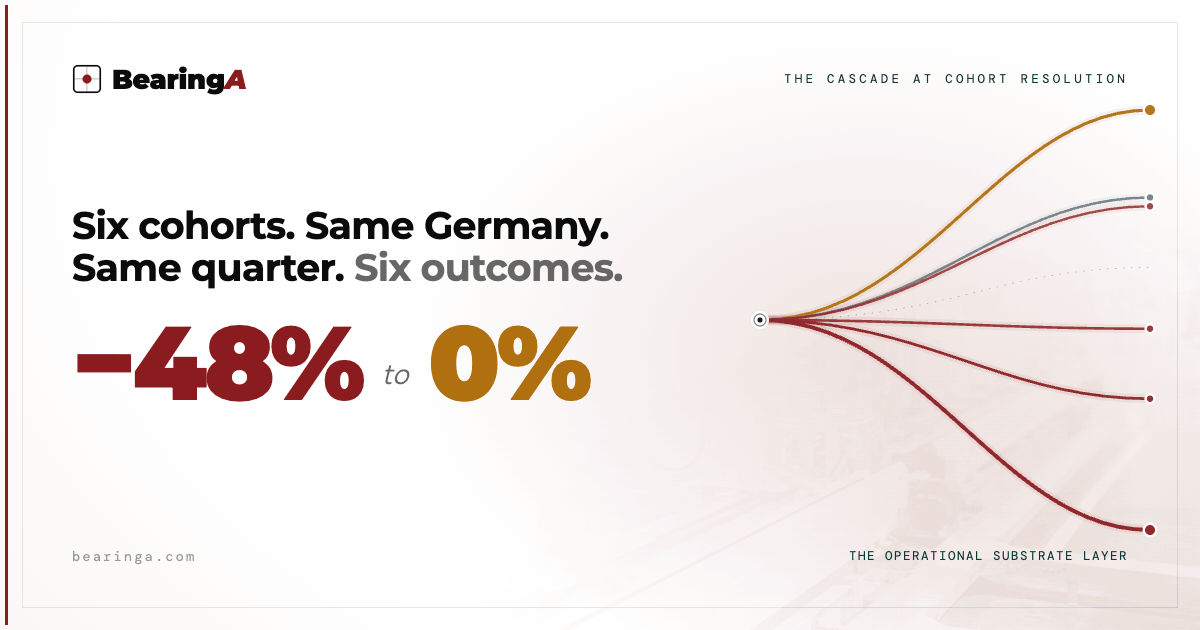
A whole-firm read on a global operator.
IA Company as the shape of a Bearing composition against a scaled operator, every altitude a decision travels through, composed once and rendered per audience.
Read the showcase05
How we know what we know
The working shown
A Bearing read stands on evidence you can check. Historically grounded, empirically bounded, composed in your vocabulary.
Some of what a Bearing read stands on is grounded in the last time similar conditions ran. When Brent held above $95 through Q1 2023, and TTF broke €80/MWh in H2 2022, subscription operators in the middle-income band reported downgrade cadence acceleration 8 to 14 weeks after the CPI peak. Retention print followed 4 to 8 weeks after the downgrade. Compression ran 6 to 11 percent on net revenue retention for the middle-income cohorts specifically. The upper-income cohorts held. This is what was measured on operators like you when the mechanism last ran. Not a model output. A cited study on subscription retention across the 2022-23 cycle. Every historical claim in a Bearing read carries a citation like this.
Some of what a Bearing read stands on is grounded in what we have seen composing before. Prior Bearing reads against subscription-commerce operators through conditions like these produced over-investment figures in the $3.8M to $7.2M range on portfolios of the scale we are seeing in your book (N=4). Prior reads against consumer-goods operators produced margin-compression figures in comparable ranges on their books. When your read composes, you see the range and you see where your book sits inside it. Median, upper end, or outside the pattern. Your book is not the first case we have composed. It is a case inside a growing record.
Nothing in a Bearing read pretends 2026 is 2022 with different numbers on it. The starting condition is different in 2026, and the ways it is different matter. Household savings buffers have thinned against the 2022 baseline. Revolving credit balances carry higher. The ECB rate path constrains what monetary policy can absorb on the household side. The ceiling for compression moved higher against the 2022-23 baseline; what any specific book realises depends on the operator’s savings-buffer exposure on her cohort, her revolver-balance carry, and her concentration on the middle-income band. Books that carry all three above the 2022-23 median are the ones for which the ceiling sits closer to attainment. Every historical comparison in a Bearing read names this specific difference. This is what makes the comparison honest working rather than pattern matching.
What a Bearing read does not do
A Bearing read reads how the current environment reaches your book, at your altitude, in your vocabulary. It does not read your operation. Your competitive pricing power, your brand strength in specific markets, your Standard-to-Basic downgrade cadence by month, your first-party retention economics. These stay with you. The read stops where your operation begins.
06
If you want more than one read
Beyond See Your Blind Spot · Continuous deployment
See Your Blind Spot is one read today. Deployment is the read running continuously on your live book.
Deployment is what a Bearing read becomes when it runs continuously on your book instead of once against a snapshot. The environment moves, your position moves, and the read watches the gap between the two continuously. You learn about a shift before it reaches a number you would otherwise read a quarter late.
A deployed Bearing composes the same underlying read at every altitude your decision travels through, in the vocabulary each altitude uses. The read reaches every desk your decision travels through, in the language that desk works in. Same read, different altitude, no retranslation on your team’s part.
See Your Blind Spot composes against modeled data wherever your first-party data has a gap. When a deployed Bearing runs on your first-party data over time, the modeled layer drops away. The commercial figure, the cohort concentration, the transmission baseline: all of it stops being a well-grounded reading of a book of your shape and becomes a measurement of yours.
What deployment looks like practically
Kickoff.
60 days from contract close to your first defensible Bearing read on your first-party data.
Cadence.
Reads compose at the frequency your decisions run at. Continuous, weekly, monthly, or triggered by a specific event.
Delivery.
Web view, PDF, email alerts, Teams or Slack, or an authenticated API endpoint into your existing dashboards.
Access.
Multi-user within your firm, no per-seat charge.
Pricing.
Two-tier published rate, institutional and retail-operating. The rate applies transparently against the composition volume shape you contract for. Full specification composes in the deployment conversation. No pricing surprises between there and contract.
07
Three paths from here
What’s yours to do next
See your blind spot, read a Bearing composition first, or open a deployment conversation. We will not chase you either way.
A first read against your data today. NDA first. No sales call.
First conversation within four working hours of contact.
See also: About BearingA · Record · Method · Bearing Financial · Advisory · Consultancies