A compound configuration is composing against your position.
The window does not stay open. The read has to hold under drilling.
That is the structural problem BearingA composes for. Not the problem of forecasting. Not the problem of monitoring. The problem of translating compound geopolitical configuration into a defensible operational read, at the speed the decision needs.
You have three alternatives on your desk. You can do it yourself, twelve primary sources at 2am on Sunday. You can ask a standard LLM, and get fluent prose that cites nothing you can verify. You can wait six weeks for a consulting deck. None of them survive the second question.
01 · The alternatives
Three ways to read a compound configuration. Each one fails at a specific point.
Before the method, the alternatives. Naming what they fail at is how we grounded the method the way we did.

Reading it yourself.
You know your position. You have read the sources before. You could compose the substrate in your own head, on a Sunday, if you had the Sunday. You could join the dots the way you always have. But the read that comes out of one person’s head is not defensible when a supervisor asks how it was arrived at. The reasoning lives in a place nobody else can drill into. Your analyst may join the same dots the same way, or she may not. Your board sits three weeks later, and the compound configuration does not wait.

Asking a standard LLM.
The output sounds right. It hedges into “may” and “could” where certainty or bounded uncertainty was needed. It cites “industry data” and “recent reports” with no page number, no filing, no passage the model actually read from. When your CRO asks where the number came from, the answer is that the model said so. When a supervisor’s quant team reviews it, the second question dissolves the read. The problem is not that the LLM is wrong. The problem is that you cannot show your work.

Waiting for a consulting deck.
Six weeks. Then a deck. The reasoning summarised into bullets, the bullets are what you get. The reasoning that produced them stays in the consulting team’s heads, in the working papers you do not receive, in the model on the associate’s laptop. When you present, you are presenting the conclusion. When somebody drills, there is nothing to show. And the six weeks was six weeks the compound configuration was already composing.
02 · Why we grounded it this way
Each choice is a considered response to a specific failure.
The method has three commitments. They are not commitments to virtue. They are what the three alternatives fail at, translated into structural choices we hold ourselves to at construction, not at review.

Every load-bearing claim traces to a named source.
Not “industry data suggests.” A specific corpus reference: annual report page, regulatory filing, central bank survey, named index data. The passage the engine read from, marked as empirical or operational so you know whether you are standing on data or on assumption. This is the answer to the LLM failure and to the consulting-deck failure at the same time. The LLM fails because it substitutes fluency for citation. The consulting deck fails because the citations live in working papers you do not see. The method makes the citation the first thing available, at the front of the reasoning, not behind it.

The trace is drillable at every layer.
The reasoning is where the value sits, so the reasoning is what we give you, at five layers, drillable at each. Source attribution: who said what, when. Composition path: how inputs became claim. Historical grounding: the precedent windows the read composes against. Position calibration: your specific chair, not the room. Confidence articulation: what would move the read. When somebody drills into layer 3, you drill into layer 3 in front of them. This is the answer to the yourself failure and to the deck failure. Reading it yourself keeps the reasoning in your head. The deck summarises it out. The method keeps it legible.
Cannot-be-wrong at construction, not at review.
Where uncertainty is real, we name what is uncertain and we name the bound. “Likely” alone is a hedge. “Likely, given the corpus registers the configured exposure at primary depth and the phase composes at the registered regime” is a bounded claim. When the method drifts, we catalogue the mode in an archive and brief the next build against re-instantiation. This is the answer to the LLM failure at its deepest point. A standard LLM cannot do this because it does not know when it is wrong. A consulting engagement cannot do this at scale because reviewing bad work back into good work does not scale. The discipline has to run structurally, or it does not run.
03 · What becomes possible
What you can do with the method that you cannot do without it.
Speed, depth, and defensibility that do not compose from the three alternatives. Named against the same three failures.

The read composes in the hours the window has.
A compound configuration composing against your position gives you a window that closes. Six weeks is not a window. Twelve primary sources at 2am on Sunday is not a workflow. The corpus is already indexed. The five-layer trace is what the engine produces, not what somebody drafts after the fact. When the decision needs to land next Tuesday, the read is composed in the days the calendar actually has.

The read is at your altitude, not the room’s.
Macro commentary does not defend against a specific question about a specific position. The read names the specific entity, the specific configuration, the specific outcome window, and grounds each in something you can verify. When you walk in, you are not defending a claim about “the current environment.” You are defending a claim about your book, your cohort, your calendar, your counterparty. The altitude of the claim matches the altitude of the decision.

The read survives the second question.
The value of a read is not the answer. It is what happens when somebody pushes back. A read you cannot check is a read you cannot defend. A read grounded in a named source, drillable at every layer, with the bound named where uncertainty is real, is the read that keeps you in the room when the second question arrives. That is what “cannot-be-wrong” means at operational depth.
04 · The receipts are public
Check what we have said. Then decide.
Everything we have composed is on record, and the record is drillable to source. Three specific reads are worth checking.
The Hormuz classification, published before the closure window opened, sorted 240 companies with named commercial exposure to the Strait of Hormuz. When the window closed, the critical-vs-moderate separation held empirically at 36 percentage points. The method’s read of severity was right at the level the method claimed it could be right at.
The IRP_7 25-name reference universe carries the effect-size proof, at d = +2.015 against the benchmark, p < 0.001. The reference universe was declared publicly before the composition. The composition was recorded before the window. The outcome is on record.
The Ukraine flow-model read (published /compound-reads/ukraine-flow-model/) composes 21,501 words against 277 primary sources, drillable to citation at every layer. A Ukrainian defence directorate has been reading it since August.
You can check any of these. You can check all of them. The receipts are what the promise looks like.
The substrate the trace grounds against.
Three grounds the method resolves against — the empirical corpus, the compound configuration, the archetype read whole.
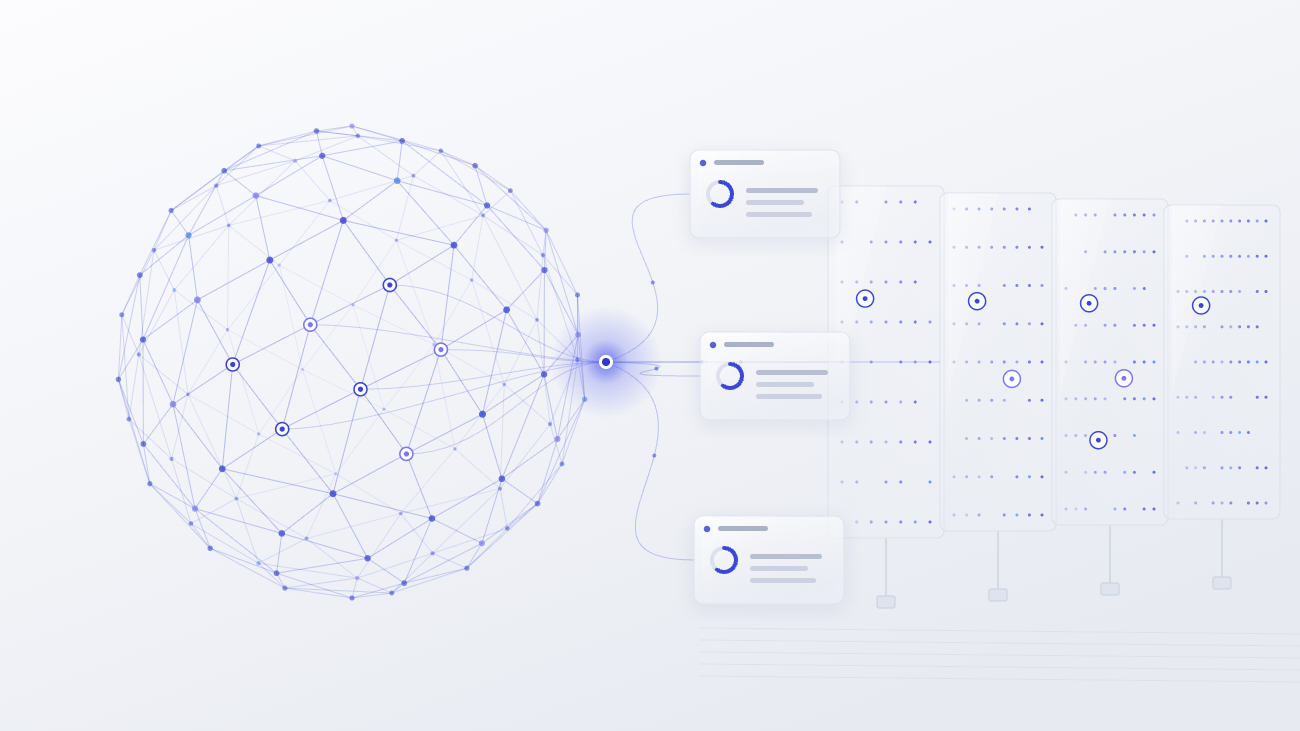
277 sources. Four-tier defensibility.
Every load-bearing claim drillable to primary document. The substrate the trace grounds against.
The empirical record
Twelve years. One configuration. Seven chapters.
The substrate every European industrial chain now operates inside. The compound configuration the trace grounds against.
Russia · Ukraine · the war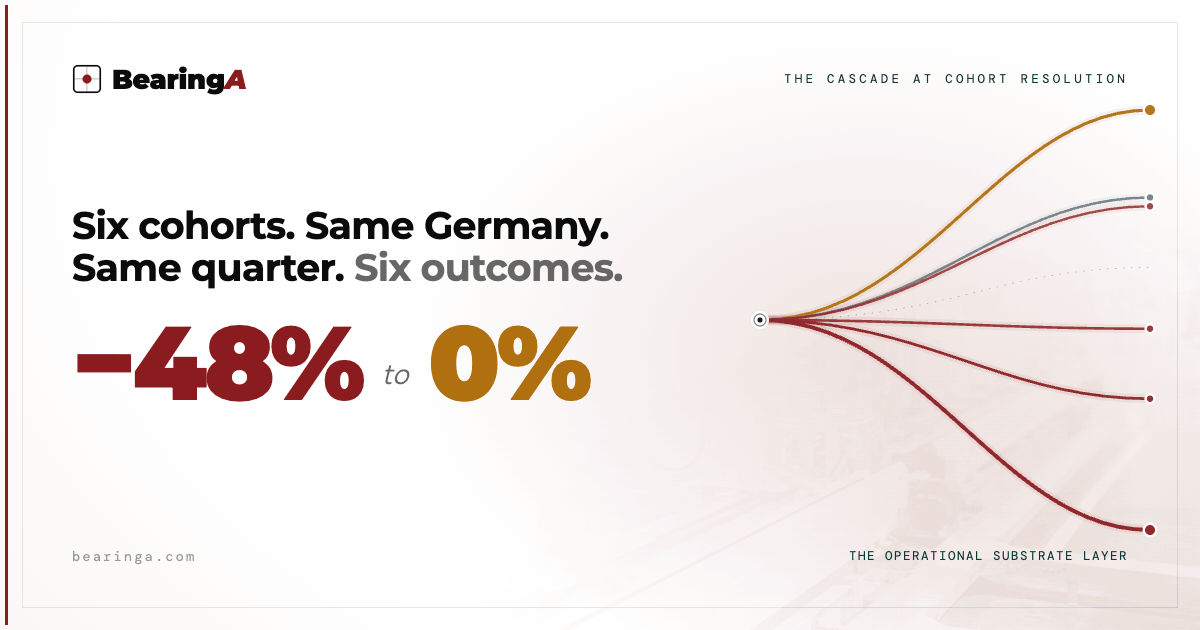
A global industrial automation leader at FY2027 planning.
Six cohorts. Same country. Six different outcomes. The archetype altitude the trace resolves at.
The BearingA demo