The engagement calendar for Q4 is on your screen.
Underneath every engagement on that calendar, the same first phase. Data gathering. Weeks of consultant time. Teams of analysts. The highest-cost, longest-duration phase of the engagement. The phase Lilli or Sage or EYQ or ChatPwC or GENE was supposed to collapse and has only partially.
McKinsey Geopolitics Practice, June 2026 survey of 202 C-suite executives: fewer than one in three consider their firm’s geopolitical risk management mature. 45 percent name early warning as the biggest capability gap. 53 percent say strategic foresight would strengthen resilience. Fewer than 30 percent use it. 5 percent have simulated their own exposure. That is McKinsey’s own diagnosis, in a publication under their own masthead, of a market gap that runs directly through the analytical phase your engagements are billed against.
What we are watching this week, too.
Brent oil: $92-93/bbl, sixth session up. UAE-Iran severance 20 Aug.
European gas (TTF): €65/MWh, up 3% on 20 Aug.
Internal-AI collapse claim vs consultant-hours reality: the gap.
01
Why this matters
Internal AI has only partially collapsed the phase your engagements are billed against.
Every engagement on your Q4 calendar runs the same first phase. Weeks of consultant time. Teams of analysts. Client interviews. Public-domain research. Data extraction and normalisation. Framework population. The phase your client is paying for as substrate work, before your partner judgment authors the composition and your framework carries the recommendation. This is where the hours are, and where the internal AI tools were supposed to collapse the ratio between analyst time and client value.
Lilli did some of it. Sage did some of it. EYQ, ChatPwC, GENE did some of it. The document-summarisation piece got faster. The synthesis of what your teams already gathered got tighter. But the piece that was supposed to matter, composing the compound-configuration substrate on the client’s specific book, walked through the transmission from macro condition to specific line, drillable to primary source at every step, that piece did not compose. The internal tools are LLMs on top of your firm’s own document library. They read what you have written. They do not read the client’s compound exposure. That is a different job.
Fewer than one in three C-suite executives consider their firm’s geopolitical risk management mature. Forty-five percent name early warning as the biggest capability gap. Fifty-three percent say strategic foresight would strengthen resilience. Fewer than thirty percent use it. Five percent have simulated their own exposure. This is the market your engagements enter. The gap is composed at your client’s C-suite. Your engagement is billed to close it. The question is what substrate the first phase of the engagement runs on.
Bearing composes the compound-configuration substrate for a client’s book in a working afternoon rather than in six to eight weeks. Your framework runs on top of it. Your partner judgment authors the composition. Your methodology stays the practice’s moat.
02
See your blind spot
The offer · One substrate composed · Against your engagement domain · Under NDA
One Bearing substrate against your engagement domain, in a working afternoon.
Nominate one to three engagements from your Q4 calendar. Twenty minutes to scope the substrate you would want composed against the specific engagement domain. Twenty-four to forty-eight hours later, Bearing composes the substrate and you inspect. If it holds, it goes into the engagement. If not, no commitment was made, no data moved. Bearing does not touch client data. No new tooling for the engagement team. No integration into your platform stack. No security review. No procurement cycle before you inspect.
What we ask you for (three fields)
1
Which engagements are you nominating?
The engagements on your Q4 calendar where the data-gathering phase is running, or about to run. The client, the engagement domain, the substrate scope your framework will run on top of.
2
What is the compound-configuration exposure the substrate needs to carry?
The specific configuration your engagement is composing against. Supervisory pressure on the client, macro conditions reaching specific client lines, sector cycle position, counterparty concentration. However your framework segments.
3
What deliverable format does your client already read?
Board pack, ExCo memo, JST submission, ORSA input, DCF appendix, covenant compliance annex. Same format the substrate composes into.
The substrate. A Bearing composition on the client’s engagement domain, tracing the transmission path from macro condition through the client’s specific concentration to the specific line your framework operates on. Every claim cites a source. Every historical comparison names the year, the conditions, and what is different now. Every row carries a confidence tag: real (empirical from primary source), read (our read of the current configuration), modeled (benchmark data used where the gap exists).
Your inspection. You inspect the substrate. Does it hold at partner-review altitude. Does the transmission-path composition match how the client’s own operating environment actually reads. Does the historical anchoring survive a senior partner’s question. Does the boundary claim (what Bearing does not read) sit where you would put it.
What you do with it, if it holds. It goes into the engagement, underneath your framework. Your engagement team stops the six-to-eight-week substrate composition and starts on your framework’s application. The partner judgment authors the composition, as before. The methodology stays the practice’s moat, as before. The ratio between analyst time and client value moves.
A composed substrate in twenty-four to forty-eight hours.
From engagement nomination to composed substrate in your download, in the window your engagement’s next partner check-in operates in.
Bearing does not touch client data.
The composition engine runs against public-domain sources and BearingA’s own corpus. Your client’s data stays with your firm. No integration into your platform stack, no security review, no procurement cycle before you inspect.
Your methodology stays the practice’s moat.
Bearing composes substrate. Your framework runs on top of it. Your partner judgment authors the composition. Your firm’s methodology is not what Bearing does; it is what Bearing composes underneath.
No follow-up unless you ask.
If the substrate lands and you want to talk about how it goes into your firm’s engagement flow, our contact is on the page. If it does not, we will not chase you.
Designed for practice heads, partners, and principals at management consulting firms, Big Four advisory practices, Tier 2 strategy firms, and implementation firms.
If Bearing Financial, Business, or Advisory is a better fit, see the other doors03
What Bearing is to your practice
Substrate under your framework. Not framework replacement. Not tooling adoption. Not procurement cycle.
Bearing is not a new consulting stack, a new AI tool, or a new platform your firm integrates. It is a composed substrate you inspect, that goes into your engagement if it holds, and that your framework runs on top of. Three specific concerns that come up in the first partner conversation, addressed at the altitude they surface at.
04.A · Bearing composes substrate. Your firm’s methodology is not what Bearing does.
Your firm’s moat is the framework and the partner judgment. That is what your client is paying you to compose, and it is what the AI-native challengers have not touched. What Bearing composes is the substrate your framework runs on top of. The transmission path from macro condition through specific client concentration to the specific line your framework operates on. Drillable to primary source at every step. Your framework authors the composition. Your methodology stays the practice’s moat.
04.B · No new tools for the engagement team. No platform integration.
Bearing composes offline against public-domain sources and BearingA’s own corpus. The substrate arrives in the deliverable format your client already reads. Board pack, ExCo memo, JST submission, ORSA input, DCF appendix, covenant compliance annex. Your engagement team reads it in the format they would read a research memo in. No new interface. No new authentication. No integration into your platform stack.
04.C · Bearing does not touch client data. No security review. No procurement cycle before you inspect.
The pilot substrate composes without any client data being shared. You inspect what Bearing produced against the engagement domain, and decide whether it holds at partner-review altitude, before any procurement conversation begins. If it holds and you want to bring Bearing into the engagement, then the client-data conversation and the procurement conversation happen. Not before.
04
Read one first
Actual Bearing compositions · What substrate looks like composed
Before you nominate an engagement, read what a composed Bearing substrate looks like.
The reads below are real Bearing compositions on engagement domains that partner-review altitude checks against. Not case studies. Not sales collateral. Compositions in the form your engagement would receive if you nominated a similar domain. Open one or two. Check whether the transmission-path composition, the historical anchoring, the boundary discipline, and the drillable-source citation are what you would want going underneath your framework.

Consumer-operator engagement substrate composed at cohort resolution.
Ashford Living, subscription-commerce operator, Iran-US compound. How the transmission runs from Brent through freight through landed cost through household inflation expectations through the middle-income tier. The substrate composed against a specific customer-cascade engagement.
Read the read
The substrate a margin-transformation engagement runs on top of.
How the current cost cascade reaches gross margin, with the structural claim that spot signals retrace but absorbed cost effects do not. The substrate composed against a margin-transformation engagement domain.
Read the read
The substrate an international-strategy engagement runs on top of.
How the current political-economic environment transmits into corporate operating conditions at named-market altitude, with the specific difference between now and the last comparable cycle called out.
Read the read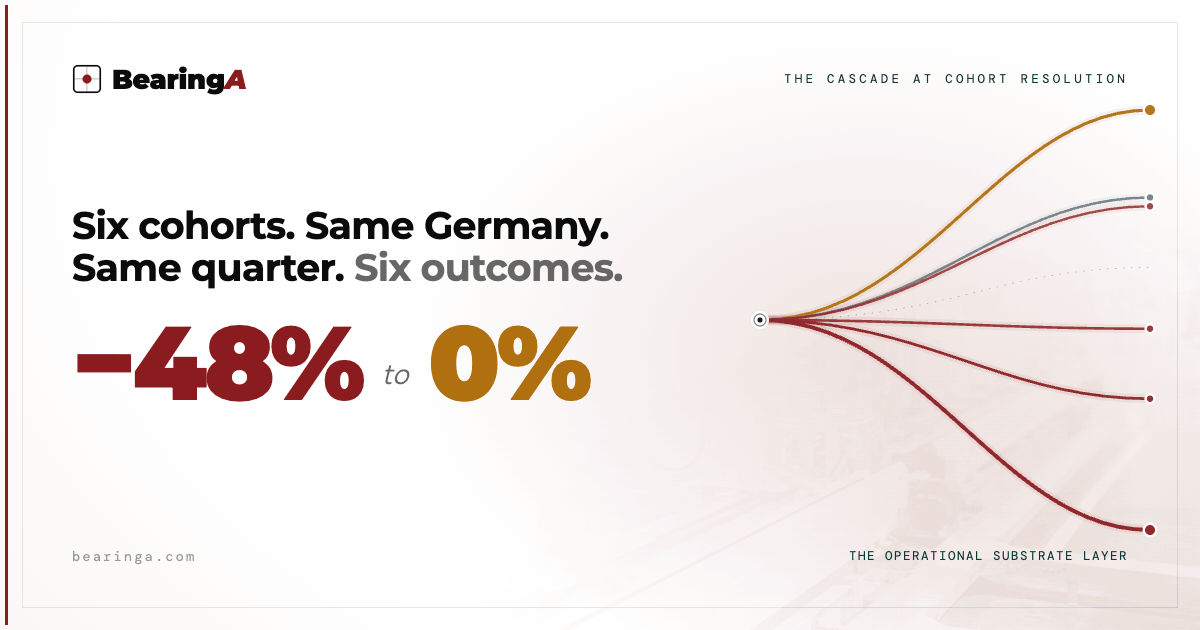
The shape of a Bearing substrate composed against a scaled operator.
IA Company as the shape of a composition against a global operator, every altitude the engagement travels through, composed once and rendered per audience. The demonstration a senior partner reviews on a first-scope conversation.
Read the showcase05
How we know what we know
The working shown
A Bearing substrate stands on evidence that survives partner review.
Some of what a Bearing substrate stands on is grounded in the last time similar conditions ran. When Brent held above $95 through Q1 2023, and TTF broke €80/MWh in H2 2022, subscription operators in the middle-income band reported downgrade cadence acceleration 8 to 14 weeks after the CPI peak. Retention print followed 4 to 8 weeks after the downgrade. Compression ran 6 to 11 percent on net revenue retention for the middle-income cohorts specifically. The upper-income cohorts held. This is what was measured on operators like the client your engagement targets, when the mechanism last ran. Not a model output. A cited study on subscription retention across the 2022-23 cycle. Every historical claim in a Bearing substrate carries a citation like this. Your senior partners can check the citation. The client’s C-suite can check the citation.
Some of what a Bearing substrate stands on is grounded in what we have composed before. Prior Bearing substrates against subscription-commerce operators through conditions like these produced over-investment figures in the $3.8M to $7.2M range on portfolios of the scale we see on engagement domains like the one you are nominating (N=4). Prior substrates against consumer-goods operators produced margin-compression figures in comparable ranges on their books. When your engagement’s substrate composes, you see the range and you see where the specific client sits inside it. Median, upper end, or outside the pattern. Your client is not the first case we have composed. They are a case inside a growing record.
Nothing in a Bearing substrate pretends 2026 is 2022 with different numbers on it. The starting condition is different in 2026, and the ways it is different matter. Household savings buffers have thinned against the 2022 baseline. Revolving credit balances carry higher. The ECB rate path constrains what monetary policy can absorb on the household side. The ceiling for compression moved higher against the 2022-23 baseline; what any specific book realises depends on the client’s savings-buffer exposure on their cohort, their revolver-balance carry, and their concentration on the middle-income band. Every historical comparison in a Bearing substrate names this specific difference. This is what makes the comparison honest working rather than pattern matching. It is why a senior partner does not push back on the historical anchor.
What a Bearing substrate does not do
A Bearing substrate composes how the current environment reaches the client’s book, at the altitude your engagement operates at, in the vocabulary your framework runs in. It does not read the client. It does not compose the framework. It does not author the recommendation. The client’s competitive positioning, their brand equity, their first-party retention economics, their operational execution, their board dynamics, none of that composes in the substrate. It stays with the client. And the framework composition and partner judgment stay with your practice. The substrate stops where your engagement begins.
06
If you want more than one read
Beyond the pilot · Substrate across the practice
The pilot is one engagement. What lands is substrate for every engagement domain.
A deployed Bearing composes substrate against every engagement domain your practice takes to market. Financial-services engagements get supervisor-altitude substrate. Consumer-operator engagements get customer-cascade substrate. Political-economic engagements get transmission-altitude substrate. The same underlying composition engine running against every engagement domain, in the deliverable format each engagement’s client already reads.
The substrate composes at the cadence your engagement pipeline actually runs at. New engagement scopes: substrate composed against the domain before the first partner check-in. Engagements in flight: substrate composed against the compound-configuration shift when the environment moves under the engagement’s original scope. Partner-review altitude: substrate composed for the senior-partner or client-side review at the cadence the practice’s review calendar sets.
Same discipline at ten engagements as at one. Same drillable-to-source citation. Same historical anchoring with the delta discipline. Same boundary claim about what the substrate does not read. Your framework runs on top of every substrate. Your partner judgment authors every composition. Your firm’s methodology is what scales; the substrate underneath composes at the ratio between analyst hours and client value that internal AI was supposed to reach.
What deployment looks like practically
Kickoff.
60 days from contract close to the first deployed substrate against a live engagement domain.
Cadence.
Substrates compose at the frequency your engagement pipeline runs at. Per-engagement, per-partner-review, or triggered by specific compound-configuration shifts.
Delivery.
Same deliverable format your engagements already ship in. Board pack, ExCo memo, JST submission, ORSA input, DCF appendix, covenant compliance annex.
Access.
Multi-user within your practice, per-engagement scoping, no per-seat charge.
Pricing.
Two-tier published rate, per engagement domain. The rate applies transparently against the composition volume shape you contract for. Full specification composes in the deployment conversation. No pricing surprises between there and contract.
07
Three paths from here
What’s yours to do next
Nominate an engagement. Read a Bearing composition first. Open a deployment conversation. We will not chase you either way.
Twenty minutes to scope. Twenty-four to forty-eight hours to substrate. If it holds, it goes into the engagement.
First conversation within four working hours of contact.
See also: About BearingA · Record · Method · Bearing Financial · Business · Advisory