It is late August and your Q4 forecast is on your screen.
Renewals on one side, pipeline on the other. AI platform investment booked against defence. What you are looking at is offence.
Your client, the enterprise CMO on your renewal list, runs an in-house AI on attribution, creative, and audience. So does the category. Q3 attribution reads correlated across the comparator set. Your client knows. It is why the CFO conversation carries pressure that was not there two years ago.
What we are watching this week, too.
Brent oil: $92-93/bbl, sixth session up. UAE-Iran severance 20 Aug.
European gas (TTF): €65/MWh, up 3% on 20 Aug.
Household inflation expectations resetting across your client base.
01
Why this matters
Your client’s in-house AI reads aggregates. It does not compose what changes the CMO conversation.
What the in-house AI stack does not produce is a compound-configuration read on the client’s own book, walked through the customer cascade. Which cohorts absorb the current cycle. Which compress. Through what specific transmission the compression reaches marketing return. Not the aggregate demand curve the attribution model consumes.
We tested this against Claude in August. Identical substrate. $253M in spend. 10,000 campaigns. Aggregates matched. The LLM missed every actionable specific: 0.20 marginal ROAS on the average dollar, 0.08 on the compressed cohort, the flagged aggregate reading 79 percent of portfolio while the actionable slice was 20 percent on a nameable segment, the LTV differential between the downgraded middle tier and the buffered upper tier, the single at-risk figure diluted into a sensitivity range. Headline understatement 38 percent. Not a prompting gap. A substrate gap.
You put the compound-adjusted read in front of the client. The category is not producing it. Your agency is. That is what changes the renewal, and it is the reference that opens the next three pitches.
02
See your blind spot
The offer · One compound-configuration read · On your client’s book · Under NDA
One Bearing read on your client’s book, at CMO altitude, in QBR-ready form.
Nominate an at-risk account this quarter. Share the client’s context and the data you are comfortable sharing on their behalf. We compose one read on the client’s book, walked through the customer cascade, sized at CMO altitude, in the vocabulary the QBR runs in. You put the composed read in front of your client. What the category is not producing, your agency is. NDA first. No sales team receives your data or your client’s. No follow-up unless you ask.
What we ask you for (three fields)
1
Which client account are you sharpening?
The client on your renewal list, or the account you are pitching against. The specific decision the QBR turns on. Renewal defence, tier restructure, pitch competition, budget reallocation, category expansion.
2
What part of their business does it concentrate on?
Category, geography, cohort, channel, product cluster, market, business unit. However the client segments.
3
What data are you comfortable sharing on the client’s behalf, and what raised the question?
Attach or describe an attribution export, cohort read, campaign file, or retention snapshot. And tell us what raised the question. A QBR agenda, a CFO note through the CMO, a pitch RFP, an internal account review.
The read. A Bearing composition on the client’s book, tracing how a current event in the world reaches specific lines in their P&L through paths the in-house AI stack does not draw. Every claim cites a source. Every historical comparison names the year, the conditions, and what is different now. Every row carries a confidence tag: real (math on the client’s own data), read (our read of the current configuration), modeled (benchmark data used where first-party data has a gap).
The QBR framing. The read arrives in the vocabulary the QBR runs in, sized at CMO altitude, structured against the specific decision the QBR turns on. Your team walks the client through it. The reference is yours to carry.
What you do with it, starting this quarter. Put it in front of the client at the next QBR. Use it in the pitch against the incumbent agency. Anchor the tier-restructure recommendation. Sharpen the budget-reallocation case. Every one of these is work you can start this quarter because you have something composed on the client’s book to work from, while the category is still producing aggregates.
A first read in your hands within the QBR window.
From account nomination to composed read in your download, in the days the QBR calendar has, not the weeks an incumbent research shop would take.
Zero human touch on the client’s data.
The composition engine that runs BearingA’s deployed reads runs your compound-configuration read. Same engine, same discipline. No sales team, no consulting team, nobody at BearingA sees the data unless the composition fails our safety check, in which case one engineer reviews it and we tell you before delivery.
NDA before you upload anything.
Our NDA is standard and mutual, and covers your client relationship. If you prefer to use yours or the client’s, send it over.
No follow-up unless you ask.
If the read lands and you want to talk, our contact is on the page. If it does not, we will not chase you.
Designed for practice heads, principals, and agency presidents at marketing holdings and specialist advisories.
If Bearing Financial, Business, or Consultancies is a better fit, see the other doors03
See the difference
The same portfolio. Your client’s AI on one side. BearingA’s read on the other.
We composed this on Ashford Living, a subscription-commerce operator, against the Iran-US compound in the second week of August 2026. Same enriched portfolio, two reads. What her stack sees on one side (the same MMM output your clients run today). What BearingA composes on the other (what your agency would put in front of them).
Without BearingA · what your client’s in-house AI sees
Run the enriched portfolio through a standard marketing-mix model, the analysis Ashford’s team runs today in Measured or Northbeam. It produces:
Channel-to-conversion attribution. Paid Search, Paid Social, Email, Affiliate, Direct, Referral, each attributed its share of conversions across the 10,000 campaigns. The attribution is clean and the model is well-specified for what it measures.
Marginal ROI curves per channel. Each channel’s response curve fitted, the blended return reading healthy at an aggregate ROI near 2.0, the growth spend directed toward the channels the curves rank highest. The curves are concave, the model knows returns diminish, and it optimises against that.
Subscription-tier retention rates as observed. Basic, Standard, and Premium retention measured on trailing data, the tiers treated as stable populations, the tier-upgrade path projected forward on the observed rates.
Campaign-level optimisation recommendations. Reallocate toward the higher-attributed channels, trim the underperformers, scale the winners. Standard plan-optimisation output.
Cohort behaviour treated as stable across the projection window. This is the load-bearing assumption, and it is invisible because it is never stated. The model reads channel-to-conversion within cohort behaviour it holds constant. It does not carry a variable for the cohort’s economic state changing underneath the conversion.
Iran-US does not enter. Not because the analysts judged it irrelevant, but because the measurement substrate has no place to put it. The MMM reads channels and conversions; a geopolitical configuration is not a channel and produces no conversion, so it is structurally outside the model. The stack is not wrong. It is complete for what it measures, and silent on what it does not.
With BearingA · what you would put in front of them
Read the identical enriched portfolio at cohort-position state altitude, against the five upstream configurations, with the Iran-US resolution-path invariance rendered explicitly. It produces what Side A structurally cannot:
Per-cohort sensitivity against the compound. Each cohort-position carries a sensitivity coefficient against the Iran-US price signals (Brent, DXY, fuel pass-through through landed cost), grounded in the resolved-cycle anchors and the sourced demand mechanism (SOURCE 055, household inflation expectations as the predominant consumption-response driver). The portfolio splits, 50 of 58 cohorts materially sensitive, 8 buffered, along a line the MMM reads as one homogeneous population.
Tier-transmission asymmetry. The subscription-tier mechanic the MMM treats as three stable retention rates, Bearing reads as three different transmission topologies. Standard subscribers carry a downgrade-to-Basic middle state that leads churn; Basic subscribers churn directly with no leading state; Premium subscribers hold. The compression surfaces as a downgrade cadence before it surfaces as the retention-rate change the MMM eventually measures (SOURCE 275).
What the MMM does not see, dated. The Standard middle-income cohorts, the ones the plan’s tier-upgrade growth assumption runs through, are structurally compressed roughly 60 days ahead of the conversion signal that would surface in her stack. The gap is not a modelling difference; it is an altitude difference. Bearing reads cohort state; the MMM reads downstream conversion; the 60 days is the distance between them.
The Q3-Q4 marks at cohort altitude, framed as over-investment prevented. Hold or redirect the growth spend leaning into the compressed Standard middle-income cohort; preserve or lean into the Premium control side. The commercial figure is roughly $5.4M, the compound-caused increment on the growth dollar’s marginal return, on a sourced concave response curve (SOURCE 276) depressed by the compound for exactly the cohorts the spend targets.
The over-investment-prevented framing is what the CMO takes to her CFO. The CMO does not have to argue BearingA forecasts better than her in-house stack. She has to accept one thing the concave response curve makes near-arithmetic: the marginal growth dollar returns a fraction of the blended average the MMM books, and the compound depresses that marginal return further for a nameable slice of cohorts. The $5.4M is small, specific, and sourced. It is not a claim her marketing is broken; it is a claim that a defined slice of growth spend is committed against a return the compound has already removed, on cohorts her MMM cannot see and BearingA can name. And it is your agency that brought her the composition that made the claim defensible.
Ashford Living · Iran-US compound · 19 August 2026
04
Read one first
Actual Bearing reads · What you would bring to clients
Before you nominate an account, read what a Bearing composition looks like at CMO altitude.
The reads below are real Bearing compositions on events in the world right now, at the altitudes CMOs and their teams work at. Not case studies. Not sales collateral. Reads in the form your client would receive if you deployed a compound-configuration read on their book. Open one or two. Check whether the language, the specificity, and the working shown are what you would put in front of your client tomorrow.

The CMO read on the retention line.
Ashford Living, subscription-commerce operator, Q3-Q4 2026 planning. How Brent reaches freight, freight reaches landed cost, landed cost reaches household inflation expectations, and household inflation reaches the middle-income Standard tier. What your agency would put in front of the CMO at the next QBR.
Read the read
The read the CFO reviews before signing off on the marketing budget.
How the current cost cascade reaches gross margin, with the structural claim that spot signals retrace but absorbed cost effects do not. The compound your client’s CFO is asking the CMO about.
Read the read
The read the European client team brings to the international pitch.
How the current political-economic environment transmits into corporate operating conditions at named-market altitude, with the specific difference between now and the last comparable cycle called out.
Read the read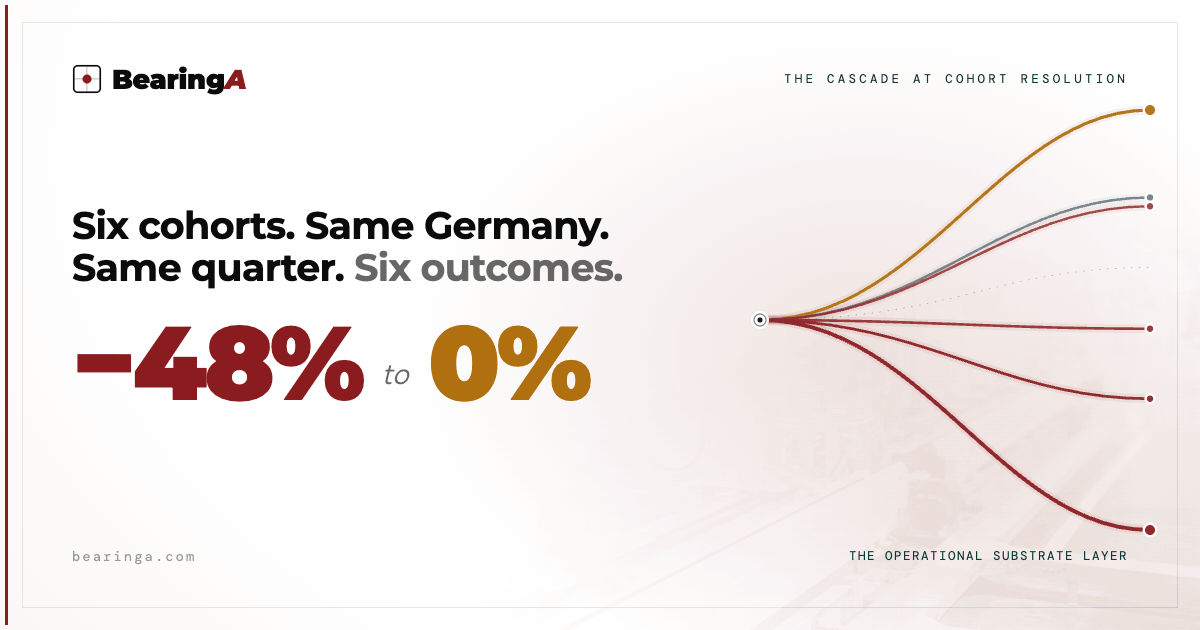
The shape of a compound-configuration read against a scaled operator.
IA Company as the shape of a Bearing composition against a global operator, every altitude a decision travels through, composed once and rendered per audience. The demonstration you would show a category lead on a first-scope conversation.
Read the showcase05
How we know what we know
The working shown
A Bearing read stands on evidence your client’s CFO can check.
Some of what a Bearing read stands on is grounded in the last time similar conditions ran. When Brent held above $95 through Q1 2023, and TTF broke €80/MWh in H2 2022, subscription operators in the middle-income band reported downgrade cadence acceleration 8 to 14 weeks after the CPI peak. Retention print followed 4 to 8 weeks after the downgrade. Compression ran 6 to 11 percent on net revenue retention for the middle-income cohorts specifically. The upper-income cohorts held. This is what was measured on operators like your client when the mechanism last ran. Not a model output. A cited study on subscription retention across the 2022-23 cycle. Every historical claim in the read your agency puts in front of the client carries a citation like this.
Some of what a Bearing read stands on is grounded in what we have composed before. Prior Bearing reads against subscription-commerce operators through conditions like these produced over-investment figures in the $3.8M to $7.2M range on portfolios of the scale we are seeing on your client’s book (N=4). Prior reads against consumer-goods operators produced margin-compression figures in comparable ranges on their books. When your client’s read composes, they see the range and they see where their book sits inside it. Median, upper end, or outside the pattern. The client is not the first case we have composed. They are a case inside a growing record.
Nothing in a Bearing read pretends 2026 is 2022 with different numbers on it. The starting condition is different in 2026, and the ways it is different matter. Household savings buffers have thinned against the 2022 baseline. Revolving credit balances carry higher. The ECB rate path constrains what monetary policy can absorb on the household side. The ceiling for compression moved higher against the 2022-23 baseline; what any specific book realises depends on the client’s savings-buffer exposure on their cohort, their revolver-balance carry, and their concentration on the middle-income band. Every historical comparison in the read names this specific difference. This is what makes the comparison honest working rather than pattern matching. It is why the CFO who reviews the read alongside the CMO does not push back on the historical anchor.
What a Bearing read does not do
A Bearing read reads how the current environment reaches the client’s book, at CMO altitude, in QBR vocabulary. It does not read the client’s operation. Their competitive pricing power, their brand strength in specific markets, their downgrade cadence by month, their first-party retention economics. Those stay with the client. And they stay with you, the agency, as the parts of the account you know best. The read stops where the client’s operation, and your service on it, begins.
06
If you want more than one read
Beyond the pilot · A recurring line
The pilot is one QBR. What lands is a recurring line.
A compound-configuration read against the client’s book each quarter. Underneath it a service architecture. Customer cascade for retention. Competitor transmission for pitch defence. Pricing-tier absorption for tier restructure. Market microstructure for international. Supply-side compound as the category shifts. Each priced against the client’s scope of work.
The composition engine runs against the client’s live book at the cadence the account calendar actually runs at. Continuous, quarterly, or triggered by a specific event in the client’s environment. Your account team receives every read in the vocabulary the QBR runs in, ready to put in front of the client. Same read composes at CFO altitude for the client’s finance team when the tier-restructure or budget-reallocation case needs their sign-off. Different altitude, no retranslation, same underlying composition.
What deployment looks like practically
Kickoff.
60 days from contract close to the first defensible Bearing read on the client’s first-party data.
Cadence.
Reads compose at the frequency the QBR calendar and the pitch calendar run at. Continuous, quarterly, or triggered.
Delivery.
Web view, PDF, email alerts, Teams or Slack, or an authenticated API endpoint into your account-team workflow.
Access.
Multi-user within your agency, per-account scoping, no per-seat charge.
Pricing.
Two-tier published rate, per account. The rate applies transparently against the composition volume shape you contract for. Full specification composes in the deployment conversation. No pricing surprises between there and contract.
07
Three paths from here
What’s yours to do next
Nominate an at-risk account. Read a Bearing composition first. Open a deployment conversation. We will not chase you either way.
Twenty minutes to scope. If it lands, you keep the account, win the pitch, carry the reference.
First conversation within four working hours of contact.
See also: About BearingA · Record · Method · Bearing Financial · Business · Consultancies