Not how much arrives.
What it passes through.
BEARINGA · COMPOUND READ
SCROLL TO READ
COMPOUND READ · UKRAINE RECONSTRUCTION

Ukraine's reconstruction: what the money passes through.

Seven sectors tested against one claim. Three of them cut against it. Where reconstruction money reached new producers, it went around an incumbent, and where it passed through one, the structure came out unchanged.

BEARINGAAUGUST 202613 SECTIONS10 CHARTS8 DATED TESTS
§1 — §3 A reader who stops after §3 has the whole argument. The tests come before the evidence, deliberately.
01

What we think

Ukraine's own central bank reported in June that consumer sentiment sits above where it stood before the invasion. Ask the people running businesses through this reconstruction and the picture reads differently, not despair, but something closer to vertigo. Billions committed. Defence manufacturing expanding by the month. Energy, housing, ports, hospitals, an AI sector minting unicorns off battlefield software. Nearly everyone believes their own read, and most are right about their own piece of it. What nobody can do is hold it together into one account of where this goes.

We think the reason is that everyone is measuring the wrong thing. The question is not how much money arrives. Ukraine has already had a boom financed under comparable uncertainty, between 2002 and 2007, and it did not compound. The question is what the money passes through on its way to a producer.

Across seven sectors, one pattern holds without exception.

Where reconstruction money reached new producers, it went around an incumbent. Defence routed past the state enterprises entirely, Brave1, Diia.City, procurement pointed at eight hundred private firms. Technology never went through an incumbent because the industry predated the war. Housing pays households directly and skips the contracting layer. The health purchaser funds services rather than the hospitals holding the estate.

Where money had to pass through an incumbent, the structure came out unchanged. Energy restore rebuilds the network as it was, by definition, and it is the largest line in the sector. Nuclear runs through a single operator that has already shown what real accountability looks like, a governance rebuild triggered by the country's own anti-corruption bureau catching what needed catching. Capital reconstruction in healthcare rebuilds the Semashko estate faithfully.

Four for four on building beside. Nothing, anywhere, on reforming through.
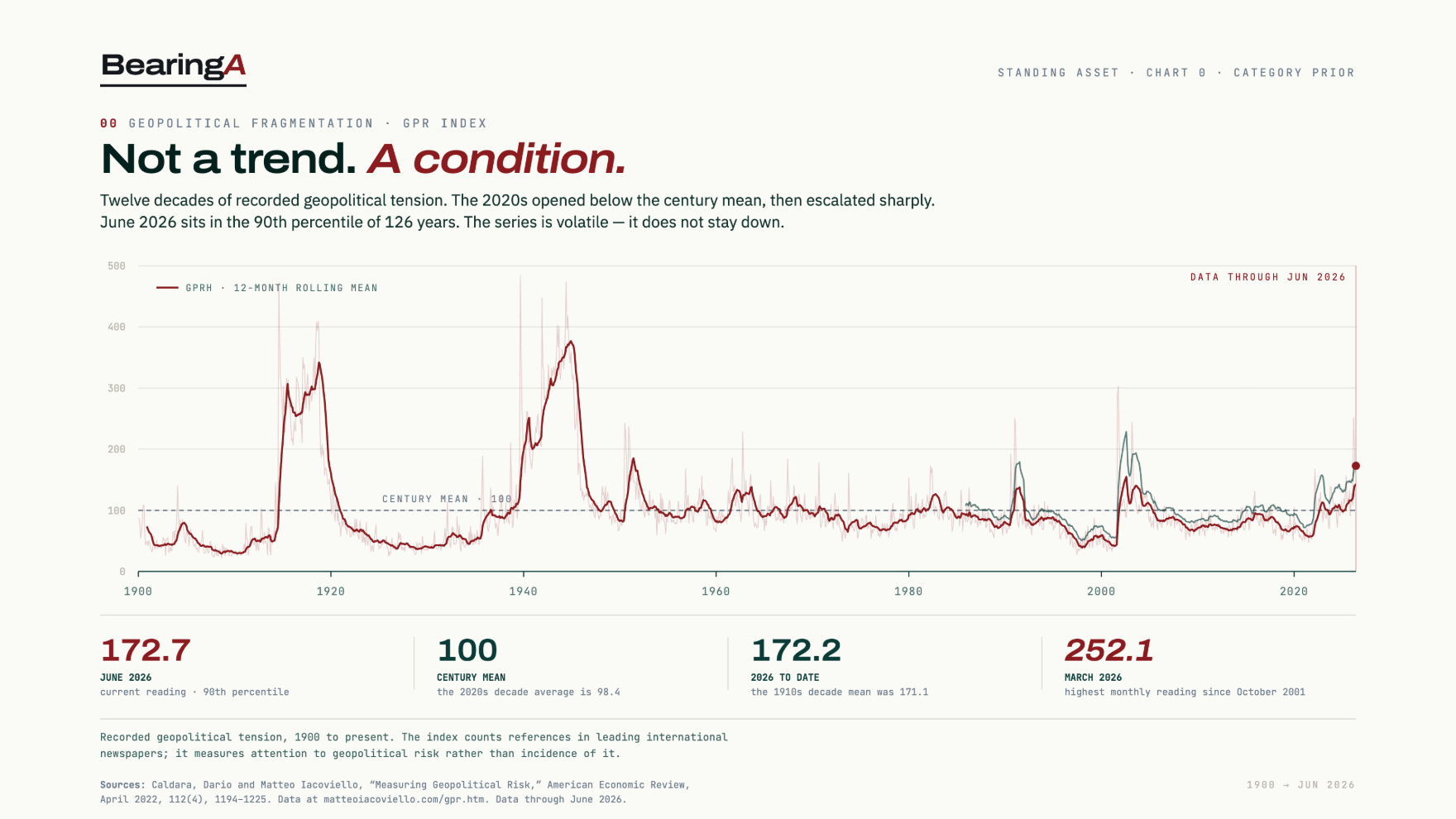
Chart 0 — Global fragmentation index, 1900 to June 2026
CHART 0THE CATEGORY PRIOR · STANDING ASSET

That is narrower than it sounds. We are not saying Ukrainian institutions cannot reform. We are saying that in this reconstruction, so far, nothing has demonstrated it, and that every success shares one architecture.

The two sectors working best are the two most exposed to the thing that made them work. Defence and technology dispersed because preservation forces were occupied losing a war. That is a window, not a settlement, and it is already closing: a competition authority blocking a defence transaction, capacity running at four times funded orders, serial manufacturers holding contracts large enough to absorb the firms around them. The sectors that changed least, the restored grid, the rebuilt hospital estate, are the ones nothing threatens, because there is nothing to reverse.

The parts that are working are the fragile parts.

Which is a finding about architecture rather than about Ukraine. Nothing in it depends on Ukrainian institutions being good or bad. It depends on where the money goes on its way to a producer, and that turns out to be a decision, made deliberately in some cases and by default in most.

02

Who is actually choosing

Everything above describes a design choice: money that reaches producers by going around an incumbent changes structure; money routed through one does not.

Ukraine is not the one making that choice in most cases.

The Ukraine Facility disburses against a plan written with the Commission. The IMF sets conditions. The World Bank and the CEB fund housing compensation. Nine points of Ukrainian GDP arrive as transfers voted annually in parliaments answering to other electorates. The clearest case of beside-not-through in this entire piece, the dispersed defence industry, was substantially financed by the Danish model, a foreign procurement design that channels donor money straight into contracts with Ukrainian producers. Its authors were solving a delivery problem. The institutional consequence was a by-product.

External funders' own incentives run toward through. Disbursing at scale via a ministry, a state enterprise, or three large contractors is operationally simpler and safer for the disbursing institution's risk committee than disbursing via eight hundred firms. That is not carelessness; it is what happens when an institution optimises for its own accountability rather than for the structure of the recipient economy. The path of least resistance for external capital reproduces incumbency, and almost nobody frames the choice this way, so nothing currently corrects for it.

So the question we would put to a European policymaker or a development bank is not whether Ukraine will reform. It is whether their own disbursement architecture is building a competitive economy or a concentrated one, and whether anyone inside their institution is accountable for that, as opposed to for the money moving on schedule.

By the time a project list reaches a funder, it has already been filtered. Ukraine has adopted eighteen instruments since August 2025 governing how a public investment is documented, assessed and reported — strategy procedures, investment units at every level of government, a territorial typology, a monitoring platform, a procurement law passed in May. Qualifying against them takes a feasibility study, a cost model, an environmental screen, procurement documents. Producing that file takes staff. The communities with the fewest staff are the ones the war hit hardest.

None of the eighteen governs who is allowed to bid. Together they govern who is able to apply, which arrives at the same place more quietly. The Centre for Economic Strategy said as much in June: a formalised standard may favour communities with strong administration over those with the greatest need. What nobody currently checks is whether the list arriving on a funder's desk was shaped by damage or by administrative capacity.

EU accession is the strongest instrument available and it is aimed somewhere else. Accession conditionality solves the problem a government under existential pressure cannot solve for itself: it makes commitments credible by making them externally enforced. Ukraine's neighbours did exactly this. But conditionality is currently written mostly around legal harmonisation and anti-corruption process. Very little of it addresses market structure, who is allowed to compete, whether procurement disperses, whether a licence regime admits entrants. The instrument with the most leverage over the variable that matters is pointed at something adjacent to it.

03

What would show us wrong

We would rather be corrected by something dated than be vague enough to survive.

SCOREBOARD
Eight dated tests
0 / 8
RESOLVED · REVIEWED 2 AUG 2026

Each test resolves publicly, and this block is updated when one does. A test that resolves against us is marked CLAIM FAILED and stays on the page. The scoreboard is the commitment; the prose is only the argument.

DOMESTIC FROM KYIV FIVE TESTS
T1

If new energy generation gets licensed to a broadening set of operators, the reform-through path works and our central claim fails.

OPEN
T2

If defence firm counts hold as individual contract sizes rise, we overweighted the closing window.

OPEN
T3

If housing certificates convert into units rather than into prices, demand-side design beats blocked supply and our caution was misplaced.

OPEN
T4

If Energoatom's supervisory board keeps its independence through the Khmelnitski procurement, detection-and-response is durable rather than episodic.

OPEN
T5

If Kyiv appoints a managing authority, an audit authority and a payment function before the money arrives at that scale, the routing choice is Ukraine’s to make and our claim that it is being made elsewhere fails.

OPEN
EXTERNAL FROM BRUSSELS THREE TESTS
T6

If the Ukraine Facility's next tranche conditions name market structure rather than only legal process.

OPEN
T7

If a major reconstruction programme publishes counterparty concentration and it is falling.

OPEN
T8

If accession negotiations open a competition chapter with teeth before the money is largely spent.

OPEN

All eight are public, dated, and checkable, five from Kyiv, three from Brussels.

What follows is the evidence, sector by sector. Each section tests the claim rather than restating it. Housing qualifies it, transport complicates it, and healthcare breaks it outright.

04

The precedent

CHARTS 1, 2 AND 3

Ukraine has run this model before, and the result is the reason we frame the question as we do.

Between 2002 and 2007, capital arrived and firms grew. A company founded in that window reached roughly nine times its starting size by its tenth year, American growth rates, in an economy that had spent the previous decade in post-Soviet wreckage. Weak firms exited. More than half the small firms in any cohort had grown out of that category within five years. By any measure applied at the time, it was working.

It happened through a contested election, a revolution, two changes of government and a gas cutoff. Uncertainty was not the variable then either.

Then it stopped. Firms founded after 2014 barely doubled over the same ten years. The small-firm graduation rate fell from more than half to one in five.
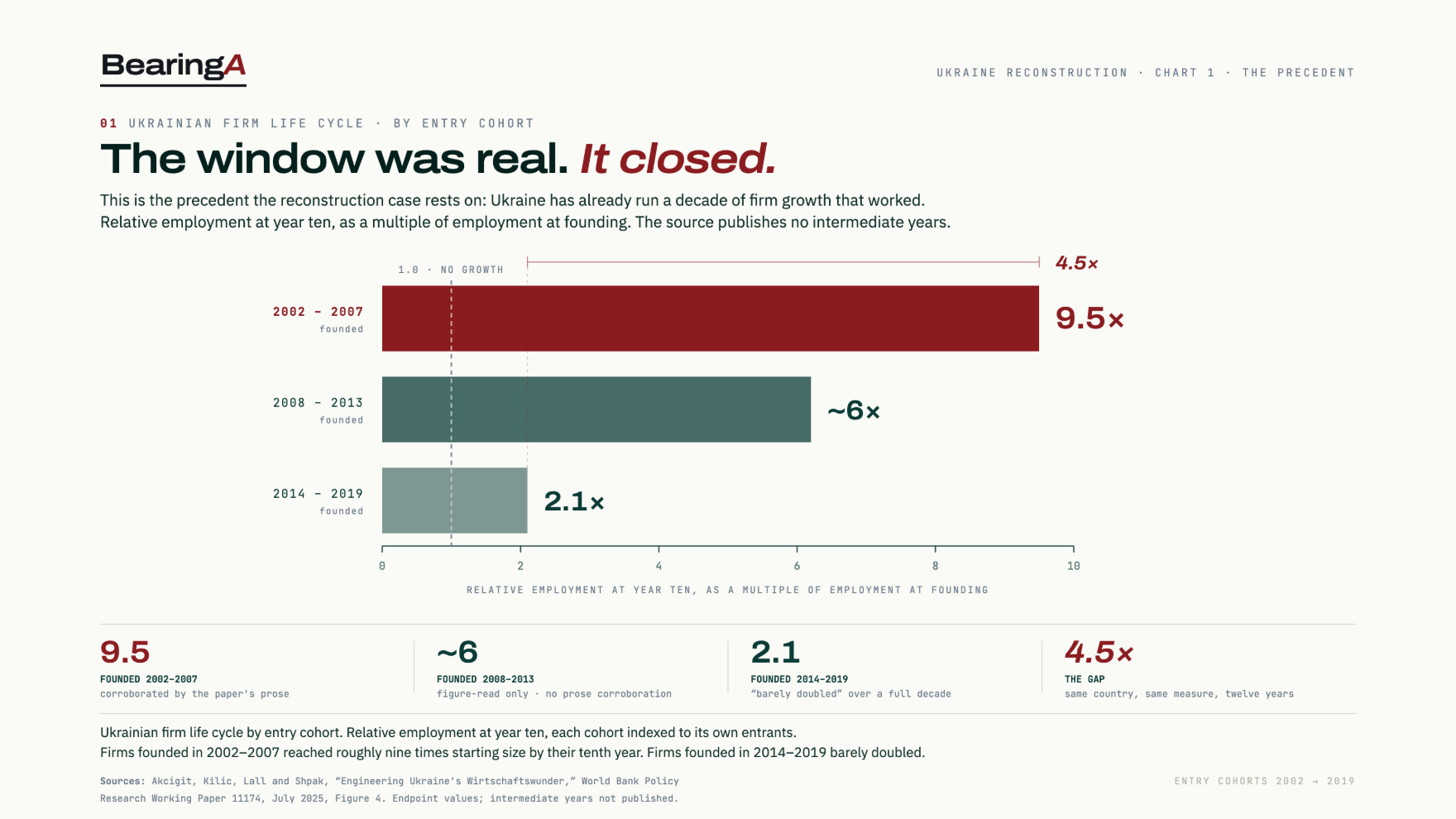
Chart 1 — Ukrainian firm life cycle by entry cohort
CHART 1FIRM LIFE CYCLE BY ENTRY COHORT

Market concentration climbed from 48 to 53 percent of manufacturing sales, above the United States, which is among the most concentrated economies in the world. State-owned enterprises took share while their productivity fell.
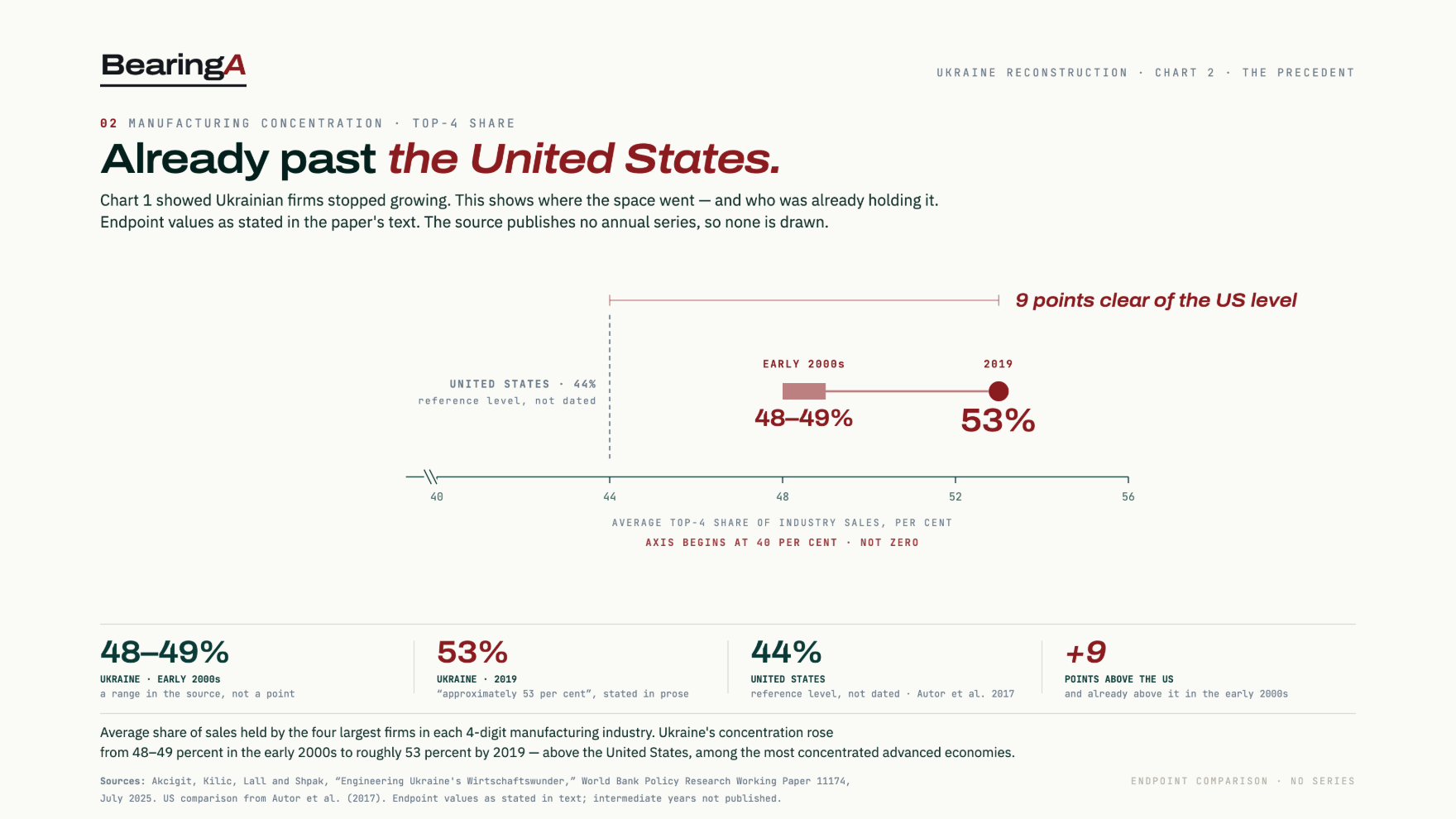
Chart 2 — Ukrainian manufacturing concentration against the European and US comparison
CHART 2MANUFACTURING CONCENTRATION · TOP-4 SHARE

Nobody would call that boom fraudulent. The money was real, the growth was real, and none of it became durable. Ukraine has cleared the volume bar before, proof the underlying capacity is real. What it has not done yet is convert that volume into something that compounds, and that is a solvable design problem, not a verdict on the country.

Which is why the mechanism matters more than the amount, and why West Germany is the comparison worth making rather than the one usually made.

The version most people carry has two elements: Marshall Plan capital and a currency reform. Both were real. The third is the one that bears on Ukraine, the occupying powers broke up IG Farben, and industry concentration fell while patenting activity rose. Capital arrived in an economy where the incumbent that would otherwise have absorbed it had just been dismantled. Remove that step and the other two produce a smaller, slower result: the same money, landing on the same structure.

That is one of two mechanisms by which crisis produces durable industry. Ukraine has run the other one.

The second is procurement. Vernon Ruttan's study of six general-purpose technologies, mass production, aircraft, nuclear power, computing, the internet, space, found each would have arrived substantially later, and several not at all, without sustained military purchasing. The mechanism is demand: guaranteed, large-scale, long-duration orders that let firms invest against a book they can forecast. Not subsidy. Not tax treatment. Somebody committing to buy.

Ukraine has applied the second mechanism deliberately and at scale, and has not attempted the first. Domestic weapons-procurement share moved from 46 to 82 percent in a year. Over 95 percent of drone procurement went to Ukrainian manufacturers. Brave1 registered 4,800 developments from 2,300 teams. The state did not break its incumbents; it made them irrelevant to the sector's growth and pointed the money elsewhere. That single fact explains most of why defence and technology look different in the sections that follow from energy and healthcare.

There is a reason the second mechanism worked when it did, and it is the warning underneath our position. The study Ukraine's own trajectory comes from puts it in Schumpeter's terms: crises weaken the forces of preservation that maintain the status quo. Diia.City, drone deregulation and Brave1 were not reforms fought through entrenched resistance. They were possible because the resistance was occupied.

Windows like that close, and they close fastest where the money is largest.

One further difference between then and now, and it is the least comfortable because nothing Ukraine does affects it. The IMF's assessment of global external positions this July contrasts the current widening of global imbalances with the last one. In the early 2000s, imbalances widened while real interest rates fell, the world held more capital than it had uses for. Now they widen while real rates rise, because saving has fallen further than investment.
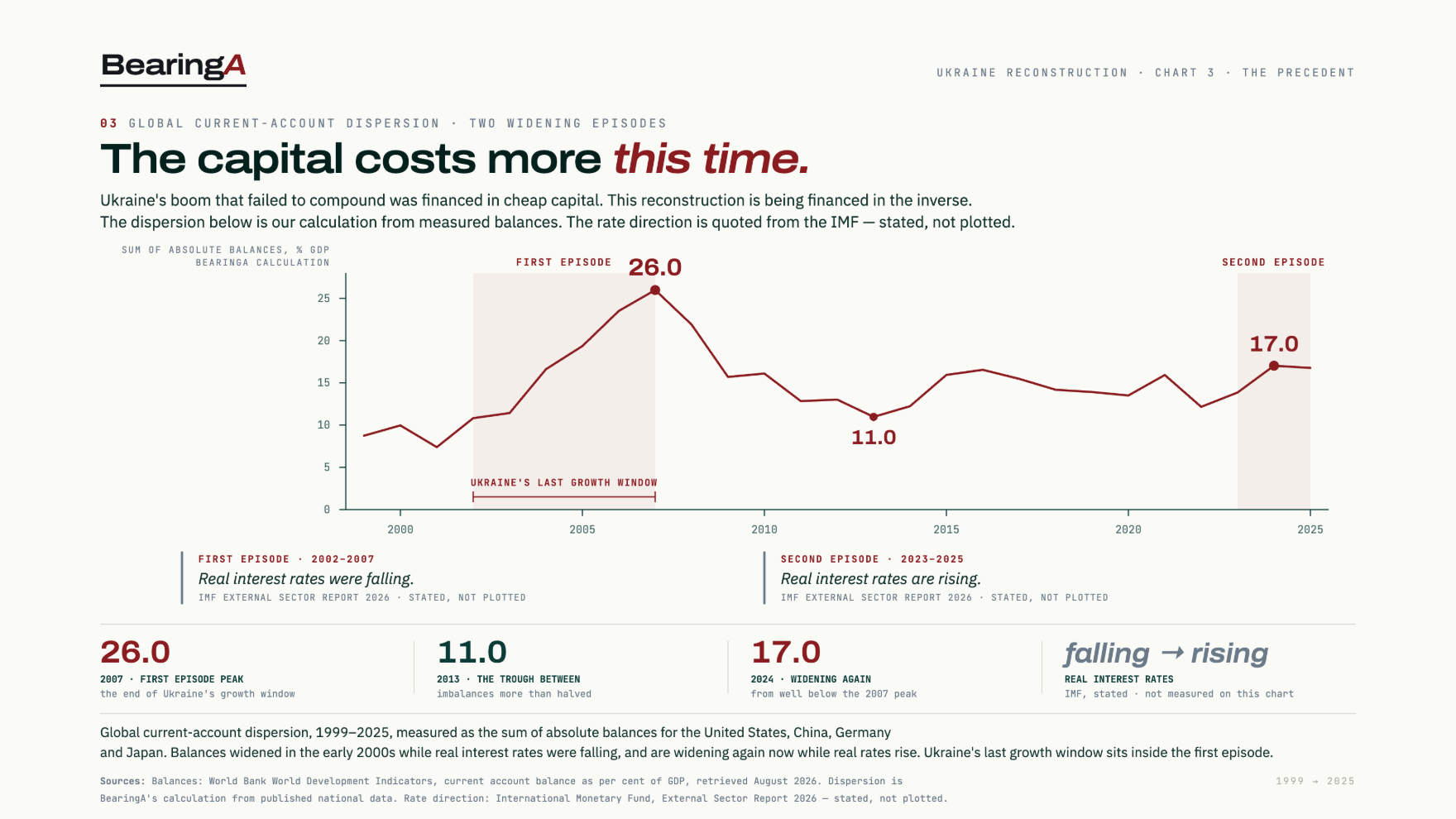
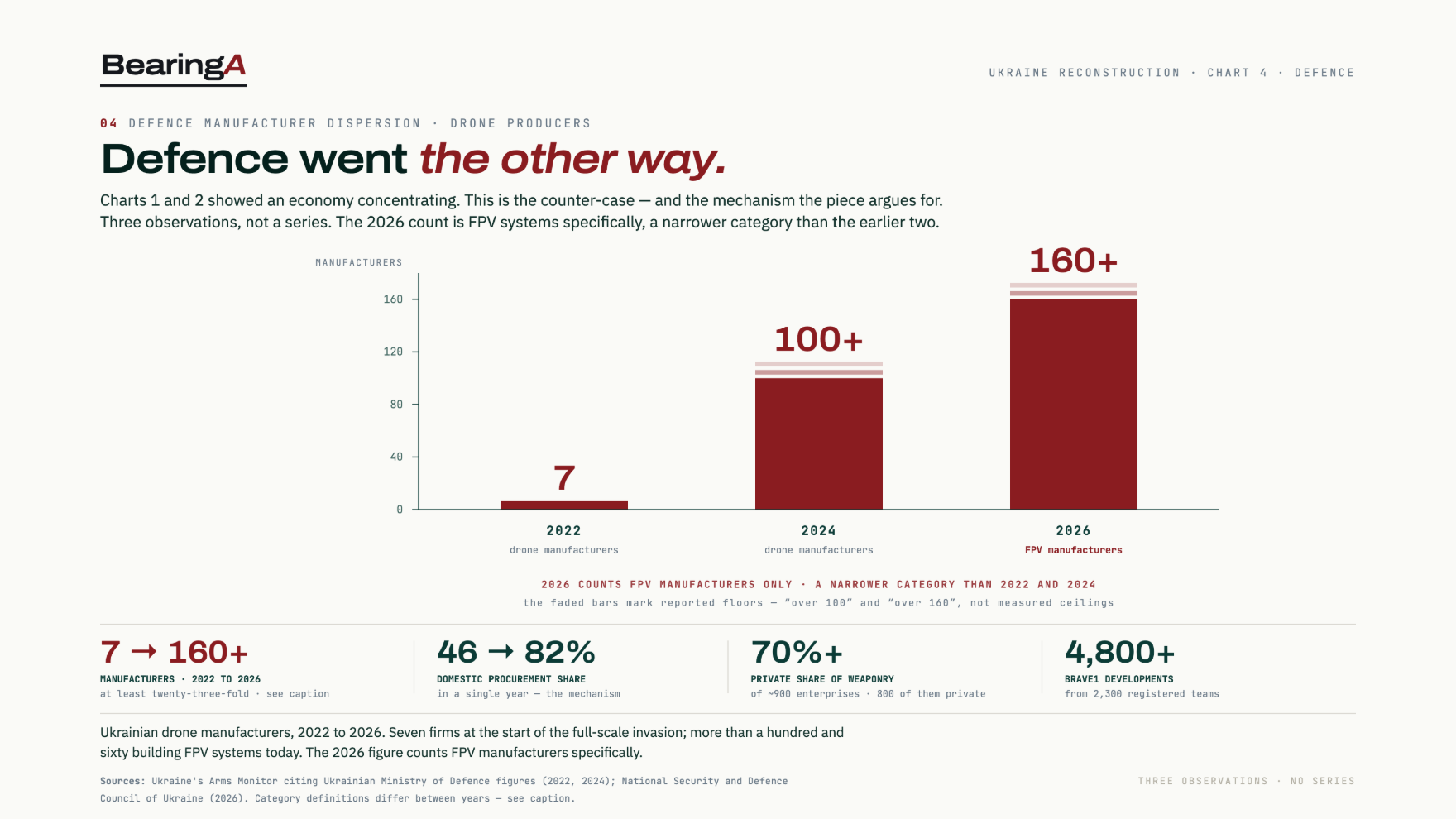
Chart 3 — Global current-account dispersion across two widening episodes
CHART 3THE FINANCING INVERSION · DISPERSION AGAINST RATE DIRECTION
WHAT NOBODY HAS EXPLAINED §4 · THE PRECEDENT  ¶

Ukraine ran one of the two mechanisms that make reconstruction compound, deliberately and at scale, and has not attempted the other. Nobody has said why.

The comfortable answer is that you cannot break up incumbents during a war. It sounds obvious and it is contradicted by the case everyone cites: West Germany's de-cartelisation happened under occupation, in a ruined economy, before recovery rather than after it. Difficulty was never the constraint.

Our reading is that Ukraine chose the mechanism that creates a constituency and avoided the one that creates an enemy. Building an industry beside an incumbent makes eight hundred firms who owe you something. Breaking the incumbent makes one adversary with money, lawyers and access, at a moment when national unity is a war aim rather than a slogan. Under existential pressure, a government does the thing that adds allies and defers the thing that subtracts them.

That is a rational sequencing decision. It may be correct. But it has a consequence nobody has stated: Ukraine has not yet had the peacetime conditions to test whether the deferred half of this, reforming rather than routing around, was ever going to happen. That is not something available to assess mid-war. It is the test the next phase of this piece will actually be able to run: whether the sectors where routing around is not possible, the grid, the reactors, the hospital estate, move once the pressure that made bypass rational eases. Sequencing only works if the deferred half eventually happens, and nothing in the current architecture obliges it to.

WHAT WOULD PROVE US WRONGIf the sequencing is genuine, expect a serious competition or privatisation agenda to open once the fighting stops. If our reading holds, expect the bypass mechanism to keep expanding into whatever sectors permit it, and expect the incumbent-locked sectors to be described as too critical to disrupt for as long as anyone is willing to say so.

The boom that failed to compound was financed in cheap capital. This reconstruction is being financed in its inverse, at more than $53 billion a year, in a market the Fund describes as one where demand for funds from deficit countries outweighs supply from surplus ones. Whatever Ukraine's institutions do, the capital costs more this time.

05

Defence

CHARTS 4 AND 10

Defence is the clearest case for our claim, and Ukraine built it by declining to fix anything.

The sector runs to roughly 900 enterprises: about 100 state-owned, 800 private. Private firms build more than 70 percent of the weaponry reaching the front and as much as 90 percent of FPV drones. Most did not exist in 2021. Many began as volunteer teams or software startups and now hold contracts worth hundreds of millions.

None of that came from reforming a state enterprise. Drone deregulation, the Diia.City tax structure and Brave1 built an industry alongside the incumbents, and procurement then followed it there, domestic share from 46 to 82 percent in a year, over 95 percent of drone funds to Ukrainian manufacturers, roughly UAH 430 billion placed domestically in 2025. Production capacity is reported up thirty-five fold in three years.

The dispersion is measurable. Ukraine had seven drone manufacturers in 2022. By 2024 it had over a hundred. Today more than a hundred and sixty build FPV systems alone. Set that against what the same firm-level data shows happening everywhere else in Ukrainian manufacturing, concentration climbing, productive firms unable to expand, and defence is running opposite to its own economy.

Which is the whole point. Nothing about Ukrainian institutions changed. The money simply stopped going through them.

Chart 4 — Ukrainian defence manufacturer counts and industry structure
CHART 4DEFENCE DISPERSION · 7 MANUFACTURERS TO 160+

The harder question is whether that survives, and the answer is visible in a gap nobody is reporting.

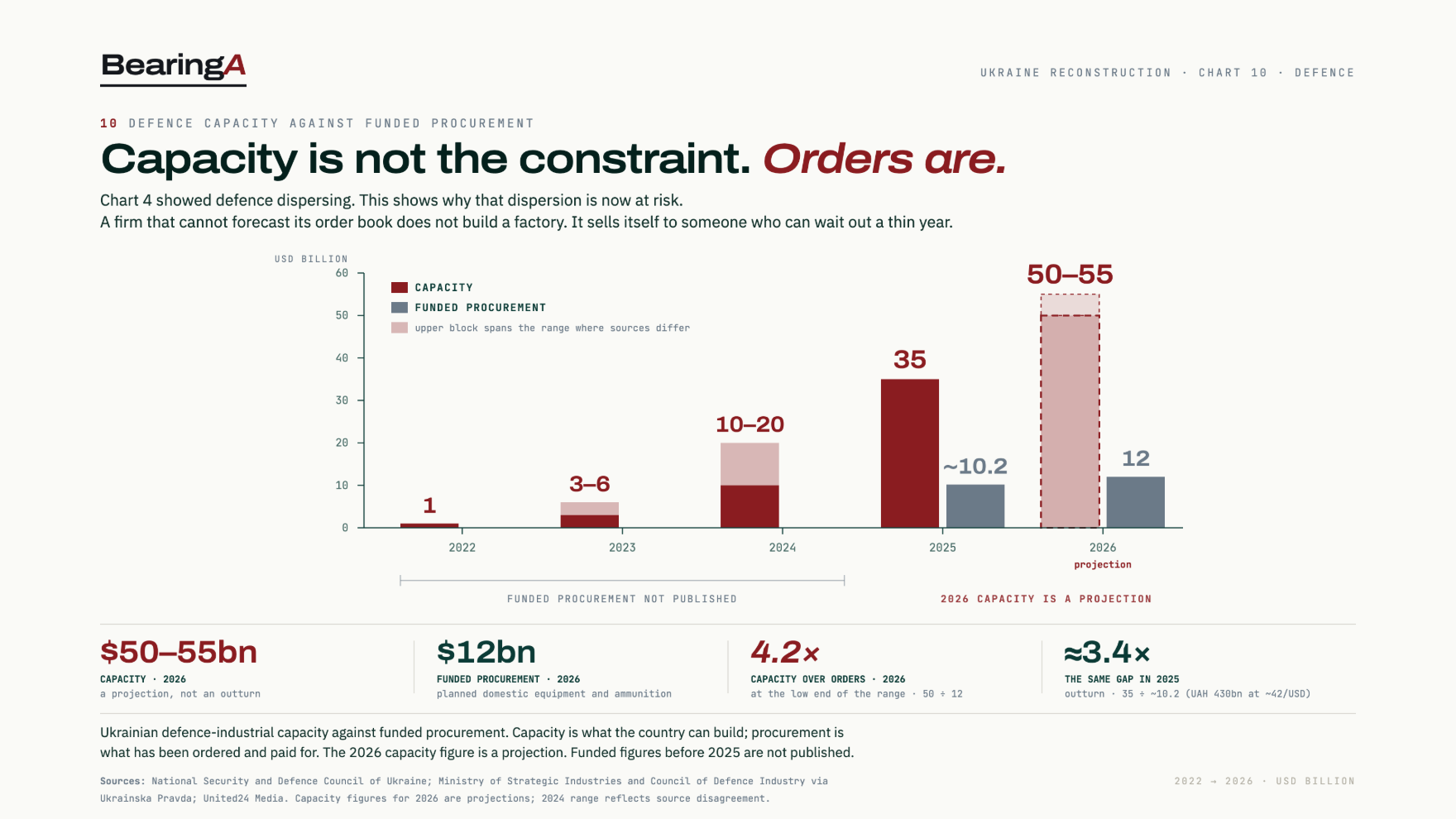
Ukraine's defence-industrial capacity has gone from roughly a billion dollars at the start of the full-scale invasion to a projected fifty to fifty-five billion this year. That figure comes from Ukraine's own security council and should be read as an interested party's projection rather than an audited number, but the shape of the curve is corroborated independently, and the segment detail is specific enough to check. Deep strike alone is a twenty-five billion dollar capacity segment. FPV capacity runs above eight million units a year. Interceptor production reached roughly a thousand units a day by early this year.

Against that, planned procurement of domestically produced military equipment runs around twelve billion dollars.

Chart 10 — Ukrainian defence capacity against funded procurement
CHART 10CAPACITY $50–55BN AGAINST $12BN FUNDED

Ukraine has built roughly four times more capacity than it has funded orders to fill, and the industry knows it, factories running below output for want of contracts rather than for want of capability. A firm that cannot forecast its order book past the current tranche does not build a factory. It builds what it can sell this quarter. And when the orders do not come, it sells itself to someone larger who can wait.

That is how a dispersed industry concentrates without anyone deciding to concentrate it. Not capture, not corruption, idle capacity and the arithmetic of surviving a thin year. Three signals suggest it has started: Ukraine's competition authority declined a significant defence transaction this year; serial manufacturers hold contracts large enough that acquiring smaller producers is the obvious next move; and producers name unpredictable contracting, not capital, as their binding constraint.

The labour problem compounds it. Defence manufacturing needs precisely the engineers and machinists mobilisation is taking, and unlike postwar Germany, where demobilisation returned the workforce, nothing reverses that flow. Ukrainska Pravda, surveying the industry in January, put it without qualification: people are the industry's main bottleneck.

WHAT NOBODY HAS EXPLAINED §5 · DEFENCE  ¶

A country fighting for its existence has built four times more defence capacity than it funds, and leaves the rest idle.

That is not a shortage of money in any simple sense, Ukraine spends what it can raise, and raises what it can. It is a choice about what to buy, made repeatedly, in a way nobody has set out.

The obvious answer is that Ukraine cannot afford more, and it is incomplete. Procurement is limited not only by the budget but by what the budget is permitted to be spent on. Most of Ukraine's external financing arrives with conditions, and donor money overwhelmingly funds equipment bought from donor industries or routed through donor-approved channels. A euro that could buy three Ukrainian drones frequently must buy one European shell instead.

Our reading is that the capacity gap is substantially an artefact of whose money it is. The Danish model, donors funding contracts directly with Ukrainian producers, exists precisely because that constraint was recognised, and it remains the exception rather than the mechanism. Ukraine has built an industry that its own budget cannot absorb and its funders are not structured to buy from.

If that is right, the fix is not more money. It is a larger share of existing money passing through Ukrainian producers, the same euro, spent through a different channel, and it is a decision taken in Copenhagen, Berlin and Brussels rather than in Kyiv. That it remains the exception rather than the default is the most consequential unforced choice in the financing of this war.

WHAT WOULD PROVE US WRONGIf the gap is genuinely fiscal, expect it to narrow as domestic revenue recovers and to be indifferent to how external financing is structured. If our reading holds, expect it to narrow only where Danish-model arrangements expand, and expect Ukrainian producers to keep reporting order-book uncertainty even in years when total defence spending rises.

Ukrainian officials talk about the sector in terms of what it produces. The producers themselves talk about it in terms of what they cannot forecast. Those are not the same industry, and only one of them builds factories.

06

Energy

CHART 5

Energy is the hardest case for our claim, because it is the sector where going around the incumbent is not available.

Defence worked because the state built a private industry beside its enterprises and pointed procurement at it. That option exists for drone manufacturing. It does not exist for a transmission network. A substation is not a workshop. You cannot stand up a grid with grant funding and a team of engineers, and you cannot route around an incumbent who owns the wires the money must travel through.

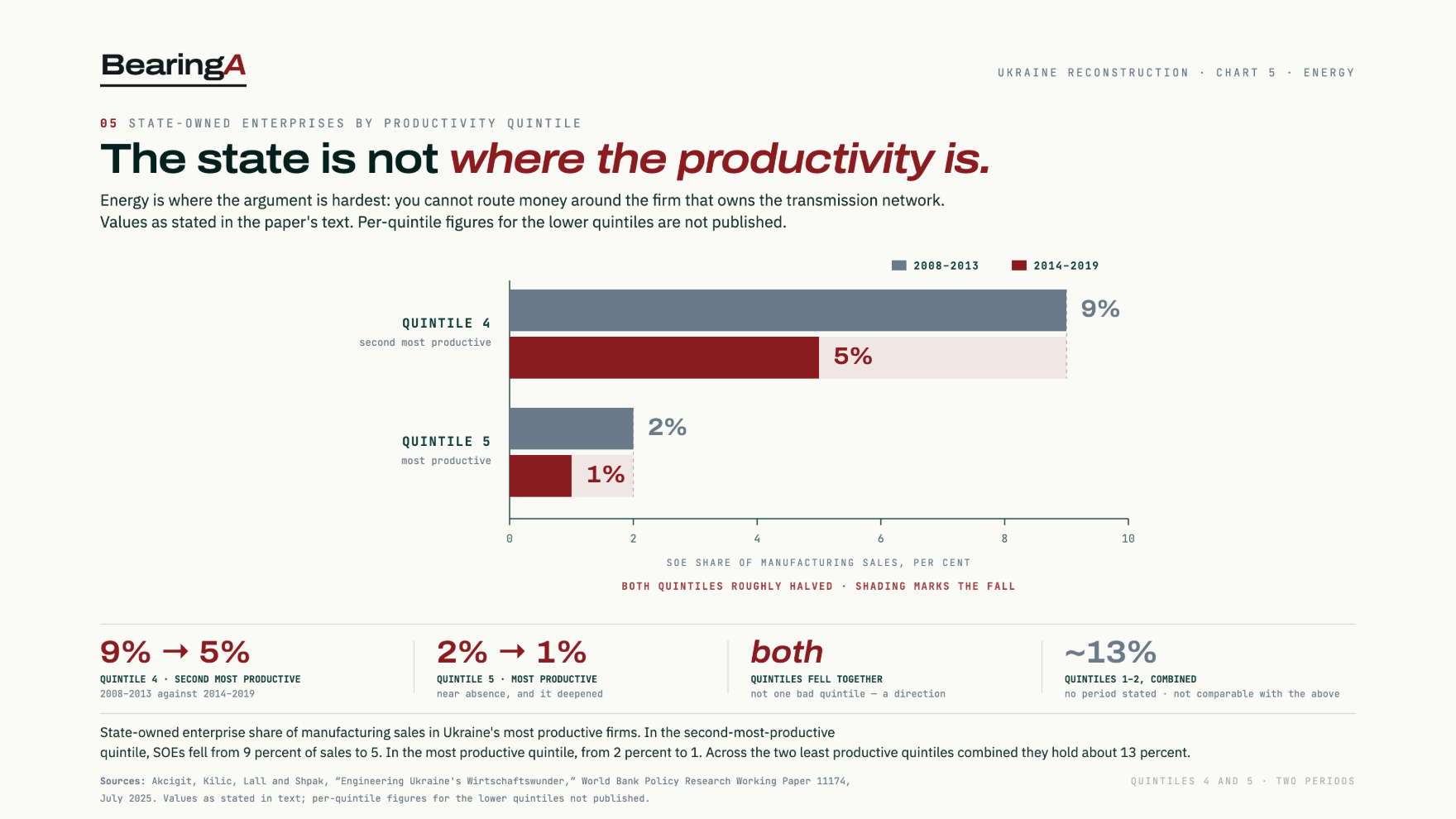
In Ukraine, that incumbent belongs to the category that measures worst. Across manufacturing, state-owned enterprises hold roughly 13 percent of sales in the two least productive quintiles combined, against 1 percent in the most productive, down from 2 percent a decade earlier. In the second-most-productive quintile they fell from 9 percent to 5. Their market share has held or grown while their relative productivity fell.

Chart 5 — State-owned enterprise share of manufacturing sales by productivity quintile
CHART 5SOE SHARE BY PRODUCTIVITY QUINTILE

The case for spending is not in question, Ukraine's central bank attributes a 0.6 percent contraction in first-quarter GDP this year specifically to electricity disruption and the imports it forced. What is in question is whether the money changes anything structural. And the answer differs across five categories that arrive as one reported number.

ONE REPORTED NUMBER · FIVE CATEGORIES READ AS ONE, THE AVERAGE DESCRIBES NONE OF THEM
Restore

Repairing what was struck, to prior specification. Incumbent-locked by definition, same network, same licences, same teams. Fastest money to deploy and the largest share of what gets spent. It reproduces the pre-war structure faithfully, including its ownership and productivity profile, because that is what restoration means.

Protect

Hardening what exists: shielding, dispersal, redundancy, air defence around critical nodes. No productivity metric improves because a transformer survived. But a substation rebuilt once costs considerably less than one rebuilt three times, and on current strike patterns that is the live comparison. This category will barely appear in reconstruction reporting.

Construct

New conventional generation and transmission, thirty-year assets, licensed now under whatever ownership structure is chosen now. Whatever is built here sets the sector's shape for a generation, and it receives the least scrutiny per dollar committed.

Renewable

Solar, storage, distributed generation below transmission level. Capital thresholds low enough that independent producers can enter without owning the grid, the closest thing in energy to what worked in defence. It also happens that many small generation points are materially harder to disable with missiles than few large ones. The competition logic and the survivability logic point the same way, which is rare.

Expand

Capacity beyond pre-war levels, oriented at European markets that want non-Russian supply. The only one of the five where the question is what Ukraine becomes rather than what it recovers.

Read as five, the distribution is legible and it supports our claim: the largest share goes to the structurally incumbent-locked category, the two genuine openings are the smallest, and the decision that fixes the sector for thirty years sits in the middle where attention is thinnest.

The regional arithmetic is usually stated backwards. Before 2014, Crimea, Donetsk and Luhansk held some of the most dynamic firms in the Ukrainian economy, business life cycles roughly 40 percent steeper than the rest of the country. That was productive capacity removed by force, not weak territory that became a burden. Grid access to those regions is an economic line item.

Nuclear

Nuclear does not fit the five, because it is not a phase. It is a single-operator asset class where all five questions arrive at once, it is the largest source of electricity Ukraine has, and it is where our claim gets its hardest test in both directions at once.

Fifteen reactors across four plants, around 13,100 MW, all operated by Energoatom: a state company, Ukraine's largest electricity producer, annual revenue above four billion euros. Zaporizhzhia alone was over 20 percent of national generation before the war. Its six reactors have sat in cold shutdown under Russian control since March 2022, Energoatom the operator de jure, Rosatom de facto, and in 2026 Russia's own regulator began issuing operating licences for units it does not lawfully hold. The plant lost off-site power entirely twice in April, running on emergency diesel to keep cooling pumps turning.

That is the physical position. The institutional one is why nuclear sits at the centre of this piece.

The institutional story here is worth telling in full, because it is the clearest evidence in this piece that reform machinery in Ukraine is not theoretical. In November 2025, Ukraine's anti-corruption bureau closed a fifteen-month investigation into Energoatom, a scheme NABU itself described as an enterprise with annual revenue over four billion euros “carried out not by officials, but by outsiders who had no formal authority.”

What happened next is the part that matters for this piece's claim.

The supervisory board was dismissed and rebuilt with four independent members by early 2026, an independent whistleblower system was procured, four board committees were established, the government audited every state-owned company, and cases went to the anti-corruption court.

A capture mechanism was found in Ukraine's largest state energy asset, and the detection-and-response machinery caught it, in public, with consequences. That is not the absence of risk in reconstruction financing. It is the presence of a system built to find it. Reading either alone produces a story, captured state, or reforming state, and whoever writes from one of those will be wrong.

Nuclear also holds the sector's only genuine expansion asset. Khmelnitski units 3 and 4 have stood unfinished since 1990, one around 80 percent complete and the other around a quarter, and parliament backed a plan in 2025 to buy equipment from Bulgaria's abandoned Belene project to finish them. The national strategy targets 24 GW by 2050. Every euro of that will be contracted through the entity now operating under the governance NABU's investigation forced into place, which is either the strongest evidence in this piece that oversight holds, or the next test of whether it does.

WHAT NOBODY HAS EXPLAINED §6 · ENERGY  ¶

The five categories are not funded equally, and nobody has defended the split.

Restore takes the largest share. Protect, the category that determines whether restored assets survive the winter, is barely reported as reconstruction at all.

The usual explanation is urgency: you rebuild what was destroyed because people need power now. It is true and it is not sufficient, because a third rebuild of the same substation is also urgent, and arrives faster than the first one did.

Our reading is that the allocation follows what is legible to funders rather than what is defensible on engineering grounds. Restoration produces a countable output, megawatts returned, substations rebuilt, that a disbursing institution can report against. Hardening produces an absence of loss, which is real and unreportable. Distributed generation produces neither at the scale a single tranche can point to. So the money concentrates where the reporting is easiest, and that happens to be the category structurally locked to the incumbent.

Nobody decided that the incumbent should receive the largest share. It is what happens when spending is organised around what can be shown to have been spent, which also means it is fixable at the level of the reporting line rather than the policy. The obstacle is that no disbursement framework currently has a column for a substation that did not need rebuilding twice.

WHAT WOULD PROVE US WRONGIf the split reflects genuine engineering priority, expect protection spending to rise sharply after each strike season as damage patterns become clear. If our reading holds, expect it to stay flat regardless of damage, and expect distributed generation to grow fastest where it is financed outside the main reconstruction channels, by private capital and municipal balance sheets rather than by donor programmes.

Khmelnitski units 3 and 4 have been unfinished since 1990. They were half-built by a Soviet ministry, abandoned by an independent state, and are now to be completed with equipment bought from a Bulgarian project that was itself abandoned. Whatever governance Energoatom has by the time that contract is signed is the governance Ukraine will have bought thirty-six years of reactor with.

07

Housing

CHART 8

Housing is our claim tested at its cleanest, somebody designed the money to go around the contracting layer entirely, and the design worked exactly as intended. What it ran into next is the more interesting problem: paying people well does not build a house by itself, and nobody has yet connected the two labour markets bidding for the same builders.

The compensation programme pays households, not builders. Ukraine's Register of Damaged and Destroyed Property holds roughly 248,000 recorded objects, about 222,000 residential. Against that, eVidnovlennia has compensated more than 100,000 families since 2023, averaging UAH 1.5 million for destroyed housing, UAH 2.2 million for rebuilding on an owner's own land. A separate UAH 15 billion tranche went to displaced people who lost their only home. The World Bank and the Council of Europe Development Bank fund alongside. In Donetsk region alone, compensation has passed UAH 47 billion.

Every other sector here moves money the same way: the state contracts a producer, and the question is which producers get contracts. Housing inverts it. A certificate issued to a family is not a procurement decision, it is a hundred thousand small procurement decisions made by the people who lost the housing. Architecturally, that is the least capturable design in this reconstruction. There is no counterparty large enough to be worth capturing.

Paying households well was not enough on its own, the constraint that came next is worth studying rather than reading as failure. Dispersed demand does not produce dispersed supply. A hundred thousand families holding certificates still buy from whatever construction market exists, and that market is physically constrained.

Reading it through rent against price

The useful instrument is the spread between what people pay to own and what they pay to occupy, city by city.

Kyiv: primary-market prices up 4.69 percent year on year, one-room median resale up 8 percent. Kyiv rents over the same period, one-bedroom down 8.33 percent, two-bedroom down 7.41, three-bedroom flat.

Rent is what someone pays to live somewhere. Price is what someone pays to hold it. When they separate, the asset is being bought for something other than occupancy, store of value, hryvnia hedge, somewhere to put a certificate. Kyiv housing is appreciating while demand to actually live in it softens.

Western Ukraine runs the other signature. Primary-market prices since March 2021: Ivano-Frankivsk up 113.95 percent, Lviv up 70, Uzhhorod up 50.68. Rents in those markets are rising rather than falling. Both series moving together means people are there, occupying, bidding. Displacement demand, showing up where displacement went.

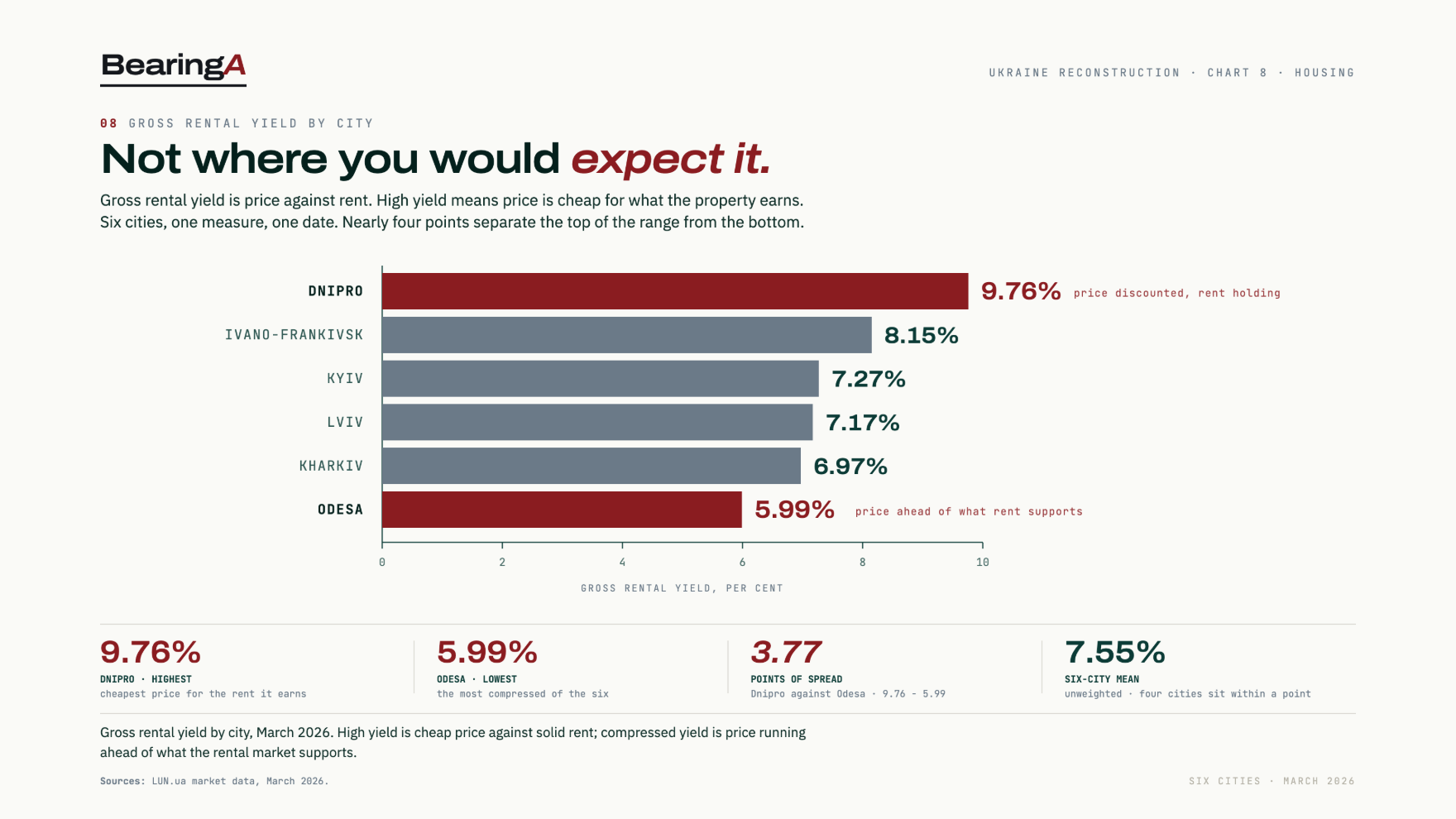
Chart 8 — Gross rental yield by Ukrainian city
CHART 8GROSS RENTAL YIELD · SIX CITIES

Yields sort the same way: Dnipro 9.76 percent, Ivano-Frankivsk 8.15, Kyiv 7.27, Lviv 7.17, Kharkiv 6.97, Odesa 5.99. Dnipro's is cheap price against rent that is holding. Odesa's compression says price is running ahead of what the rental market supports. The tempting reading is that yield tracks distance from the fighting, and it does not: Kharkiv sits thirty kilometres from the border and ranks fifth of six. The two most exposed cities in this set sit at opposite ends of it, which means something other than proximity is setting these prices.

Why the signal does not convert

New residential project counts in Kyiv are down 30 to 40 percent. Prices rising, building contracting, at the same time.

The market names its own constraints: personnel shortage driven by mobilisation, and input costs rising sharply. Lviv comfort-class new-builds are up 18 percent year on year to UAH 57,500 per square metre, cost pushing price rather than margin expanding. Hot-rolled steel at 41,700 hryvnia a tonne sits inside every one of those figures.

The price signal is firing correctly and the supply response is physically blocked, not by permits or capital, but by labour committed elsewhere and inputs repricing faster than builders can absorb. Owners are getting wealthier and builders are building less. Neither is a market failing; it is a market receiving a clear instruction and being unable to act on it.

Which qualifies our claim rather than confirming it. Routing money around the incumbent is necessary and it is not sufficient. Housing got the architecture right and hit a physical wall instead of an institutional one.

THREE SERIES, WATCHED TOGETHER REGIONAL PRICE · REGIONAL RENT · NEW STARTS
ALL THREE RISE

Supply is responding. The money is reaching builders and the builders are building.

PRICE AND RENT RISE · STARTS FALL

The constraint is physical, and the return sits with holders rather than with producers.

PRICE RISES · RENT FALLS

The housing is functioning as a currency hedge and should be priced as one.

The financing layer

The state-backed eOselia programme accounts for roughly 83 percent of Ukrainian mortgages. With subsidised business lending and government securities, that is part of why a third of Ukrainian bank assets depend on public finances. This is not a mortgage market with state participation; it is a state mortgage programme with a small private remainder, and that concentration is a fiscal exposure before it is a housing one.

Discretion enters locally. Damage assessment runs through commissions that inspect and classify, and the classification determines the payment tier. Permits, land allocation and municipal relationships are where construction capture happens in every country that has tried this. Nothing in the public record suggests systematic failure. It remains the pressure point, at the level where scrutiny is thinnest.

The programme's own behaviour is the encouraging signal. In January 2026 the government repriced compensation schedules to match market rates and committed to annual review, and fixed a co-ownership rule that had been silently blocking payments whenever one owner was unreachable. Unglamorous corrections, made because the mechanism was failing specific people.

WHAT NOBODY HAS EXPLAINED §7 · HOUSING  ¶

Somebody designed this programme well, and then it ran into a wall nobody appears to have anticipated. The wall was not institutional.

The standard reading is that war makes building hard. True, and it explains too much, it would predict the same constraint everywhere, and defence manufacturing expanded thirty-five fold under the same conditions.

Our reading is that Ukraine has two labour markets competing for the same people, and the state is bidding in both. Defence manufacturing, funded by procurement, pays what it needs to pay. Construction, funded by household certificates at fixed compensation rates, cannot bid against it. The certificate values were repriced in January 2026 to match market rates, which is an admission that they had fallen behind, and repricing the certificate does not create a builder.

So the state built a demand-side mechanism of unusual quality and then, through an unrelated and entirely defensible procurement decision, hired the supply side away from it. Neither decision was wrong. Nobody was in a position to see them as one decision, which is the part that is addressable, since defence procurement and housing reconstruction are one labour market whether or not anyone is responsible for treating them as one.

WHAT WOULD PROVE US WRONGIf the constraint is generic wartime disruption, expect construction starts to recover in step with security conditions and input costs. If our reading holds, expect them to stay suppressed while defence hiring holds, and expect the first real recovery in building to appear when defence manufacturing plateaus, not when the war ends.

A hundred thousand families have been paid. Kyiv is building thirty to forty percent fewer homes than it was.

08

Transport and ports

CHART 9

Transport is where our claim collides with something it does not account for: the competition question and the survival question turn out to be the same question, and July proved it.

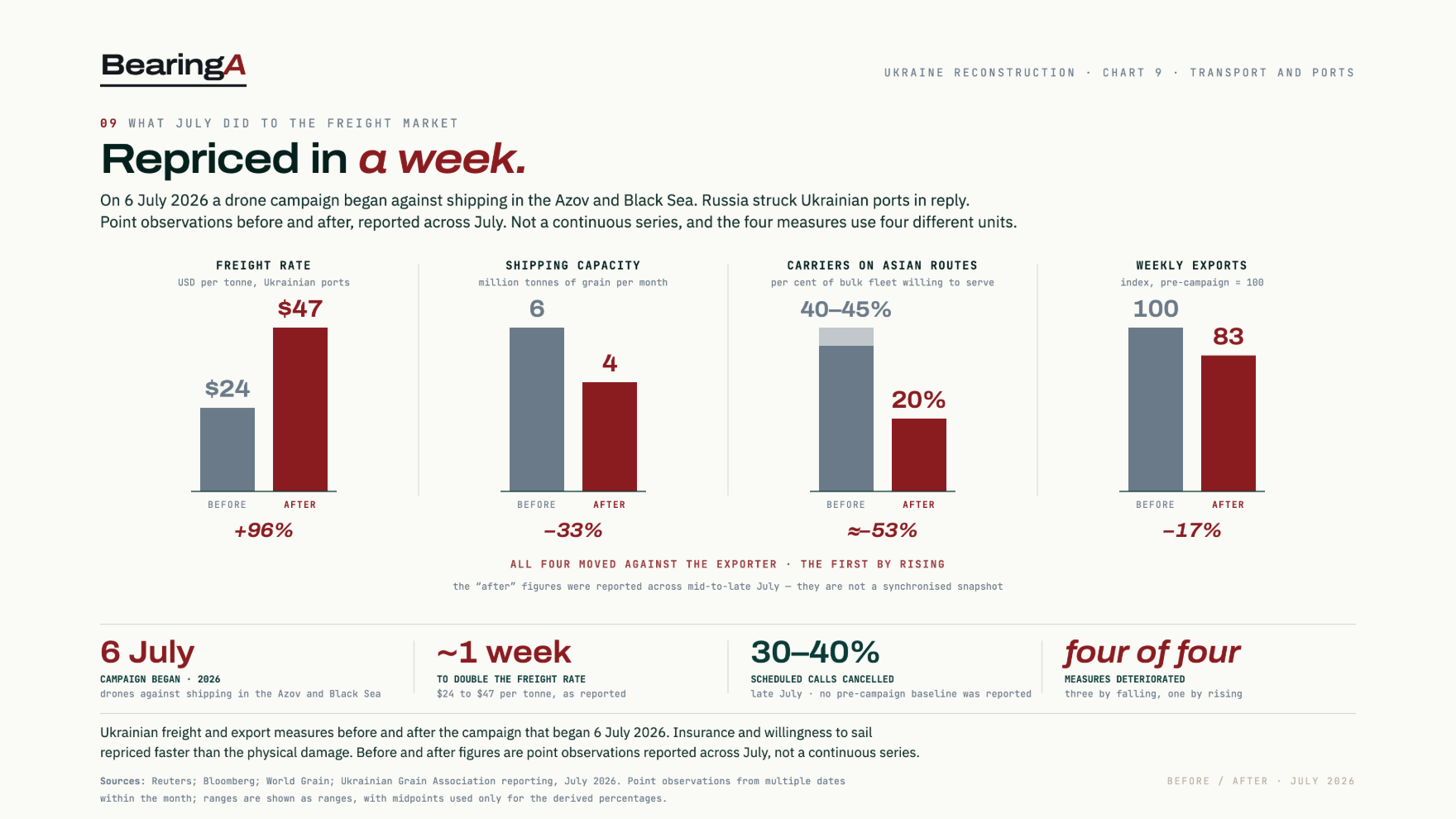
Ukraine's export economy runs through a handful of Black Sea ports. For decades that concentration was an efficiency. Since 6 July it has been a target. Monthly grain-shipping capacity fell from roughly six million tonnes to four. Exports dropped 17 percent in the first full week of July. Around a third of seaborne grain export capacity was lost, according to the farmers' union. Kernel suspended Chornomorsk operations on 13 July after losing 45,000 tonnes of wheat and 9,000 tonnes of sunflower oil. The Golden Leo, struck on 19 July with ten killed, sank a week later.

Chart 9 — Black Sea freight rates and export capacity through July 2026
CHART 9FREIGHT $24 → $47 PER TONNE IN A WEEK

The commercial machinery repriced within a week. Freight rates roughly doubled, from about $24 to $47 per tonne. Between 30 and 40 percent of shipowners scheduled to call in late July and early August cancelled. Bulk carriers willing to serve Asian routes fell to around 20 percent from 40–45. Reporting from the trade through this period names insurance and willingness to sail, rather than physical damage, as what actually stopped the cargo, a port that stands but cannot attract a hull is closed in every sense that matters to a seller. The measures show the repricing; they do not on their own establish which constraint bound first.

Russia's position is symmetrical, which most coverage misses. Roughly a quarter of Russian wheat exports move through the Sea of Azov. Don-Azov Channel shipping was halted, Kerch Strait ferry capacity cut by around three-quarters, and Novorossiysk's Sheskharis terminal stopped loading on 21 July. Both sides have now learned the same thing about the other's export architecture.

Which sharpens the reconstruction question in a way our claim does not fully capture. Rebuilding port capacity to its prior configuration restores the concentration that made this possible. More terminals, more operators, rail and Danube capacity independent of a Black Sea hull, that is simultaneously the competition answer and the survivability answer. Second time in this piece those two logics point the same direction, and both times in a sector where a single strike removes a large share of national capacity. Dispersion is not only about who gets to compete. It is about whether the system survives being hit.

WHAT NOBODY HAS EXPLAINED §8 · TRANSPORT AND PORTS  ¶

Ukraine opened this campaign mid-harvest, against shipping in waters its own export economy depends on, and invited exactly the response it received. Nobody has published a convincing account of why.

The explanations on offer are weak. Escalation for its own sake does not fit, the corridor is what keeps Ukrainian grain moving and the people running it are not confused about that. Retaliation does not fit either, since the campaign preceded the July strikes on Ukrainian ports rather than following them.

Our reading is that the timing is commercial, and that the calendar makes it legible. August and September are when North African and Middle Eastern state buyers price the coming season. Algeria's OAIC was tendering for August loading from mid-June. Egypt's GASC runs the same cycle. Between them they are the largest structural buyers of Black Sea wheat in the world.

Through July, Russian and Ukrainian wheat were quoted within a few dollars of each other. When two origins price identically into the same tender, the buyer stops choosing on price and starts choosing on whether the cargo will actually arrive. Deliverability becomes the differentiator.

Read against that, the campaign looks less like attrition and more like an attempt to make a competitor's supply appear unreliable in the weeks before the season's largest buyers commit. Whatever the operational reasoning behind the timing, the market effect was real: Ukrainian and Russian grain were pricing within a few dollars of each other through July, and deliverability, not price, became what buyers were actually choosing on.

Grain infrastructure has moved from collateral to a contested commercial position, which is worth tracking on its own terms regardless of what caused the shift.

WHAT WOULD PROVE US WRONGIf this was attrition, expect sustained pressure on Azov flows regardless of the tender calendar. If it was leverage-building toward negotiations, expect it to slacken around a diplomatic moment rather than around a procurement one. If our reading holds, expect activity to concentrate ahead of tender deadlines and Ukrainian share in the resulting awards to rise.

For anyone holding Ukrainian agricultural exposure, that distinction is the whole question, and the price does not answer it. A farmer watching wheat move from $239 to $231 to $227 sees the number and not the mechanism, which is exactly the position this piece argues most participants in this reconstruction occupy: reading outcomes and guessing at causes. Unlike most of what this piece describes, that gap is closeable without anyone's policy changing. The tender calendar is published. The award volumes are published.

The mechanism for admitting operators exists, and unlike most things in this piece it has a track record.

Ukraine began conceding seaports in 2020. Kherson went to Risoil-Kherson against a commitment of more than UAH 300 million. Olvia went to Qatar's QTerminals in 2021 on a 35-year term. Both projects then ran into the invasion, and what happened next is the informative part: rather than collapsing, they went into renegotiation. QTerminals signed a memorandum in August 2025 to restore the Olvia project, and a working group has been meeting through 2026 to amend the agreement for force majeure. The concessionaire stayed.

The live projects are more revealing still. The Chornomorsk container terminal, previously handling up to half of Ukraine's container traffic, 540,000 TEUs annually, drew interest from more than forty companies across four continents, with concessionaire selection targeted for the first quarter of 2026 on a 40-year term. The EBRD and IFC ran the feasibility work. And Ukraine deliberately changed the method: unlike Kherson and Olvia, Chornomorsk uses competitive dialogue, because the state is interested not only in concession fees but in investment and port development.

That is a procurement design choice, made explicitly, to buy something other than revenue. It is the transport equivalent of what Brave1 did for drones: an entry mechanism built because someone decided the default mechanism selected for the wrong thing.

A second Chornomorsk concession followed in June 2026, the ferry terminal, 35 years, at least $40 million of investment, roughly 2 million tonnes of annual throughput, presented at the Ukraine Recovery Conference alongside a portfolio of more than thirty public-private partnership projects, fifteen of them prioritised for launch this year.

So the answer to whether Ukraine can admit new port operators is that it already has, twice, and is running two more. The unresolved question is narrower and harder: whether the operators are diverse enough to matter. Four concessions in six years is a functioning mechanism. It is not yet a competitive market, and the throughput each one controls means a handful of awards decides the sector's structure for four decades.

POSITION DISCLOSED ADVISED MAY 2026 · REPORTED IN FULL, INCLUDING THE CALL THAT WAS WRONG

What this looked like from inside a position

In May 2026 a Ukrainian agricultural operator held its full wheat, corn and sunflower crop. The read we gave was seasonal and had nothing to do with anything above, none of which had happened: sell wheat forward into the May–July window ahead of the August harvest overhang, sell sunflower before the mid-June ceiling, hold corn toward the October-to-February tranche window.

The operator sold the entire portfolio in May. Wheat moved at $235–239 FOB. By mid-July it sat at $231.60, and as this is written at the start of August, Ukrainian milling wheat is offered at $227–233 for August–September loading. The position is still ahead, and now on the far side of the harvest pressure the read was calculated against. Sunflower moved at $705–739 CPT plant, inside the specified window.

Corn is the honest part. The read said hold. The operator sold. Reporting only the two that aligned would make this weaker evidence, not stronger.

The interesting part is the one nobody could have planned. The May exit was calculated against a seasonal mechanism. It also cleared the position entirely before a geopolitical mechanism arrived that nobody was reading in May, a drone campaign starting 6 July that took a third of national export capacity offline. Two independent mechanisms, one exit, and getting the first one right was sufficient.

That is a narrow claim and it should stay narrow. Not that anyone forecast the campaign. Reading a seasonal configuration correctly produced a position that survived a shock it was never designed for, which is the thing worth carrying into every other sector here. In a compound configuration, correct reads on the mechanisms you can see buy protection against the ones you cannot.

Terminal count and operator count, then. Not tonnage. A port sector returning to pre-war throughput through the same three facilities has rebuilt the vulnerability alongside the capacity.

09

Healthcare

Healthcare is the section where our claim breaks, and it breaks in the direction nobody would expect.

Everywhere else in this piece, there is a specific actor whose incentives you can trace, a state enterprise, a contractor, a permit-holder. Here there is not one, and that turns out to be worse, not better. Here the incumbent is an architecture. The Soviet-era Semashko model funds hospitals by capacity rather than output, beds, buildings and staff establishments attract money because they exist, not because anyone is treated in them. Ukraine inherited one of the densest hospital-bed networks in Europe and a financing logic that rewarded keeping it dense.

Nobody has to behave badly for that to persist. There is no kickback in a funding formula. There is a structure that pays for capacity, and a set of institutions whose position depends on that capacity continuing to be funded.

Ukraine built the way around it before the war, and built it well. The National Health Service of Ukraine is a single national purchaser: it contracts providers regardless of ownership, pays them directly, and applies the same standard agreements and unified tariffs to public and private facilities alike. A clinic that treats patients is funded whether or not it occupies a Soviet hospital block. Patients choose their doctor irrespective of registered residence. Public health spending rose from 2.5 percent of GDP in 2000 to 4.1 percent in 2021, and the reform continued through the invasion rather than pausing for it.

It worked. Private primary-care providers contracted by the NHSU grew every year for five years: 226 clinics and 594 individual practitioners in 2021, rising through 302, 386 and 444 to 473 clinics and 963 practitioners in 2025. That is the health-sector version of Brave1, an entrant channel, opened deliberately, filling steadily.

Then it reversed.

In specialised care, private participation fell from 264 institutions and 85 individual practitioners in 2025 to 221 institutions and 16 practitioners in 2026. Individual practitioners in that segment dropped by more than eighty percent in a single contracting cycle. Of 770 proposals private providers submitted for the 2026 campaign across 34 packages, the NHSU rejected 146, nineteen percent, concentrated in 17 packages. Primary care flattened at the same time, 473 clinics to 476.

Two readings of that, and both are serious. The NHSU's is that it has updated its approach to forming a capable network of providers. That is a real argument, and it may be correct, a purchaser paying unified tariffs to anyone meeting a standard has an obligation to police the standard, and a regulator that never rejects a proposal is not exercising judgement. The private medical association's is that this is not a natural market process but the result of targeted selective contracting, and that the trend predates this cycle.

We cannot adjudicate between them from outside, and we do not think anyone can on the published data. A purchaser tightening quality thresholds and a purchaser narrowing its network produce the same numbers. What is not in dispute is the direction: the mechanism Ukraine built to let new providers in is admitting fewer of them than it did.

That matters beyond healthcare. Every other instance of the pattern in this piece, Brave1, Diia.City, competitive dialogue at Chornomorsk, household compensation certificates, is young. None has yet been through the phase where the institution running the channel decides how wide it should be. Healthcare has.

This is the failure mode our claim does not account for. Building a route around the incumbent is not a permanent structure. It is an institution, run by people, with its own view about how many providers a capable network needs, and that view can tighten for entirely defensible reasons, with no capture, corruption or incumbent pressure anywhere in the story. The channel does not have to be captured. It only has to be administered.

Which puts the reconstruction fork in sharper terms than the earlier sections allowed. Financing can flow through the purchaser, following patients, indifferent to who owns the building, or as capital reconstruction to regional administrations rebuilding the estate they already hold. Both are legitimate. One changes the structure. And capital reconstruction is far easier to spend at speed, which is what reconstruction programmes reward.

The constraint no financing model touches is not the one usually named

The usual read, that Ukrainian medicine has been hollowed out by emigration, is not what the numbers show. Roughly thirty thousand healthcare professionals enlisted or took voluntary military roles; somewhat more than two and a half thousand emigrated. Enlistment exceeded emigration by an order of magnitude.

What is actually depleting the workforce is older and slower. Fifteen percent of nursing posts stood vacant in 2022, with ten to twenty percent vacancy rates across technicians and midwives. More than half of primary-care doctors are over fifty and twenty-nine percent are over sixty, roughly a quarter of all doctors are at retirement age. Meanwhile the replacement pipeline is closing: medical school admissions fell sharply in 2022 and 2023, to thirteen entrants per hundred thousand people against a European average of sixteen, and output of junior nurses has fallen by around fifty-six percent.

This is ageing plus collapsed replenishment, which reconstruction money cannot fix and which no financing architecture addresses.

The emigration risk is real but it sits ahead rather than behind. Wartime exit restrictions have held the workforce in place, and the pay gap on the other side of the border is not marginal: a Polish specialist physician's statutory minimum runs to roughly UAH 156,000 a month against about UAH 42,000 for the best-paid Ukrainian public-sector doctor. Poland simplified qualification recognition for Ukrainians in 2022, and ninety-two percent of non-EU nurses working there are already Ukrainian. The channel is open, tested, and currently dammed.

Which is why the licensure asymmetry matters. A machinist who leaves can return to a production line. A physician who obtains Polish licensure, moves a family and enters a system that will not release them has made a decision that does not reverse on demobilisation. Postwar Germany's labour shortage resolved when the war ended and workers came back. This one has a mechanism that could deepen at exactly the moment the war stops.

Out-of-pocket payments remain close to half of all health spending, which measures how much of this system still sits outside the purchaser entirely.

WHAT NOBODY HAS EXPLAINED §9 · HEALTHCARE  ¶

The NHSU opened a channel for private providers, filled it for five years, and then narrowed it sharply in a single contracting cycle. Neither explanation on offer has been tested publicly.

Our reading is that both are describing the same pressure from different sides, and that the pressure is fiscal rather than doctrinal.

A purchaser paying unified tariffs to any provider meeting a standard has costs that rise with the number of providers. When the budget is fixed and the war is not, the cheapest available saving is to contract fewer of them, and the defensible version of that saving is to raise the threshold. That is not corruption and it is not capture. It is a national purchaser doing arithmetic, and the arithmetic points at the entrants because they are the marginal contracts.

If that is right, the narrowing is not a policy turn against private medicine. It is what a purchaser mechanism does under sustained fiscal stress, which means the entrant channel this piece treats as Ukraine's most reliable reform architecture has a failure mode nobody has mapped: it does not get captured, it gets economised.

The defence against that is unglamorous and cheap, a floor on entrant participation inside the purchaser's own budget, so that the marginal contract is not automatically the first saving available. A target would not do it. Targets are what get missed when money is short.

WHAT WOULD PROVE US WRONGIf this is a quality drive, expect rejections to concentrate among newer or smaller providers while total contracted volume holds. If our reading holds, expect rejections to track budget pressure rather than provider characteristics, and expect the same narrowing to appear in other packages as financing tightens.

Facilities rebuilt is the number that will be reported. Contracted providers, falling in specialised care, flat in primary, is the number that says whether the Semashko architecture is being replaced or quietly restored.

10

Tech and AI

Technology is the sector where our claim holds so completely it barely needs testing, and where a different risk replaces the one the rest of this piece is about.

The common read is that a war produced a drone industry and the question is what happens afterwards. That starts three years too late and misses the larger half of the sector.

Ukraine's IT market reached $7.85 billion in 2025, 41.6 percent of the country's service exports, around 3.2 percent of GDP, across roughly 2,200 companies and more than 305,000 specialists, paying UAH 50.5 billion in taxes and supporting over 800,000 jobs in adjacent sectors. Exports peaked in 2022, declined two years, turned back up 3.3 percent in 2025. About a fifth of Fortune 500 companies run dedicated development teams in Ukraine, alongside roughly a hundred R&D centres belonging to global technology firms.

That base produces products, not just contract engineering: Grammarly, GitLab, MacPaw, Ajax Systems, Readdle, Preply, Creatio, airSlate, People.ai, Respeecher. Two unicorns emerged in 2025: Fintech IT Group, the holding behind monobank, above $1 billion, and Preply at $1.2 billion and EBITDA-positive.

This sector never had an incumbent to route around. It is asset-light, talent-driven and export-integrated, structurally difficult to hold, because you cannot licence a software company or own the wires it runs on. Our claim is satisfied trivially here, which is why the interesting question is a different one.

Whether the industry stays Ukrainian.

The precedent is domestic and unencouraging. Grammarly and GitLab both trace to Ukrainian founders and Ukrainian engineering. Neither is a Ukrainian company today in any sense a tax authority would recognise.

But the mechanism is narrower than the anxiety around it. Redomicile is not a decision about patriotism or risk appetite. It is a term sheet condition, and it arrives at a specific moment: the first institutional round. A US or Western European fund needs an entity it can hold preferred stock in, with conventions its lawyers recognise. Historically Ukrainian law offered none of that, so the founder incorporated in Delaware or Cyprus, and the Ukrainian company became a development subsidiary of a foreign parent. The engineers stayed. The equity, the tax base and the eventual exit did not.

Which is what Diia.City is. Not a tax break, a jurisdiction built to remove the reason to leave. It carries the venture-law instruments Western investors require, and it says so explicitly by comparing itself to Estonia, Singapore and Delaware. Applications take ten working days without permits or licences.

And it has worked at a scale that ought to be better known. Over 3,000 residents and 130,000 IT specialists. More than 80 percent of the Ukrainian technology sector. The resident list runs from Samsung, SAP, Visa, Nokia, Stellantis and Lyft to Ajax Systems, MacPaw, Preply, and Grammarly, which appears despite its foreign parent, which is itself the more interesting fact. Retention here is not binary.

So this is the third instance of the pattern in this piece, and the most deliberate. Ukraine did not reform its corporate law. It built a parallel legal regime beside it and made that the place technology companies live. Same architecture as Brave1, same architecture as the health purchaser, same architecture as competitive dialogue at Chornomorsk.

The unresolved part is the stage above. Diia.City is demonstrably good at retaining companies through early and growth rounds. Whether it holds them at the point where a Nasdaq listing or a US defence contract makes an American parent structurally necessary is not yet tested, Swarmer opened Warsaw and Austin on raising US capital, and ITAR-adjacent work requires an allied domicile regardless of how good Ukrainian corporate law becomes.

monobank is the counter-example worth holding against that. Fintech IT Group serves Ukraine, employs over 800 people domestically, and built a billion-dollar valuation on a domestic customer base rather than an export one, which suggests domicile may resolve by vertical rather than uniformly, and that the sectors serving Ukrainian customers are the ones that stay Ukrainian.

One comparison holds the proportions, with a caveat worth stating precisely because it is easy to get wrong. Planned procurement of domestically produced military equipment runs around $12 billion, roughly half again the entire commercial IT market at $7.85 billion. But capacity in defence is projected at fifty to fifty-five billion. Funded orders and productive capacity are different measures, and conflating them overstates defence against commercial technology by a factor of four.

The precedent everyone reaches for is Israel's, and it rewards closer reading. Unit 8200 did produce a durable civilian technology sector, Check Point, Wix, Waze, CyberArk, Palo Alto Networks, Wiz all trace back to it. That is the encouraging half. The other half is that as of mid-2025, roughly fourteen hundred veterans of Israeli intelligence were working inside American technology firms, about nine hundred of them from Unit 8200 specifically, in senior engineering and security roles. The capability converted. A substantial part of it converted in California.

WHAT NOBODY HAS EXPLAINED §10 · TECH AND AI  ¶

Diia.City works, and it has not stopped a single company from incorporating abroad at the point where it matters.

The usual framing treats this as an unfinished job: a good regime that needs more instruments, more capital, more time. Our reading is that it is doing what it was built to do and cannot do the other thing.

Diia.City solves a tax and employment problem. It does not solve the problem that actually drives redomicile, which is that a US or EU institutional investor requires an entity in a jurisdiction whose courts they can predict. That is not a preference a better tax regime overcomes. It is a term sheet condition, and no amount of domestic reform changes what a Delaware-domiciled fund's lawyers will accept.

Which means the retention question was probably decided before it was asked. Ukraine can keep the engineers, the payroll, the tax base and the R&D. It cannot keep the holdco, the equity or the exit, because those follow the capital and the capital follows its own legal system.

If that is right, arguing about domicile is arguing about the wrong variable, and policy aimed at incorporation is aimed at the thing Ukraine controls least. Measuring the wrong variable has a cost beyond the measurement: it produces instruments designed to prevent something unpreventable, at the expense of instruments that would deepen the part that stays.

WHAT WOULD PROVE US WRONGIf domicile is genuinely contestable, expect at least one Ukrainian company to take institutional capital at scale while remaining Ukrainian-incorporated. If our reading holds, expect the redomiciles to continue and the Ukrainian engineering base to grow anyway, and expect the sectors that stay Ukrainian to be the ones serving Ukrainian customers, as monobank does.

Grammarly is a Diia.City resident and an American company. Both of those are true, and which one matters depends entirely on what the Kyiv office is still doing in five years.

11

Banking, currency and rates

CHART 12

Every question in the preceding seven sections prices in three instruments, and anyone holding Ukrainian exposure is already watching them: the hryvnia, the NBU policy rate, and whatever their bank counterparty's balance sheet looks like this quarter.

They are read as three separate risks. They are one variable, priced three ways.

Ukraine's fiscal deficit runs around 12 percent of GDP with grants included. Without them, 21 percent. That gap is the entire structure of the problem. Nine points of GDP arrive as transfers voted annually in parliaments that do not answer to Kyiv. The 12 percent figure describes a country running a wide but survivable deficit. The 21 percent figure describes what the country actually costs to run.

External financing requirements exceed $53 billion this year, arriving through the IMF's four-year programme, the EU's €90 billion Ukraine Support Loan, the Ukraine Facility, and the ERA loans against immobilised Russian assets. These instruments are not interchangeable, some are loans, some grants, some conditional on reform milestones. The composition matters more than the headline, because the headline is what gets reported and the composition determines rollover risk.

The NBU has held at 15 percent against inflation of 8.2 percent, forecast toward 9.4 by year-end. A real rate above six points is expensive, and it is not primarily about inflation. It is defending deposit preference. In a war economy with a depreciating currency, the natural behaviour of households and firms is to move savings into dollars, and every hryvnia that converts is a hryvnia the domestic banking system cannot lend. The FX share of deposits has been falling, toward 31 percent. That decline is what 15 percent buys. The rate is not a monetary stance in the usual sense. It is the price of preventing a run that has not started.

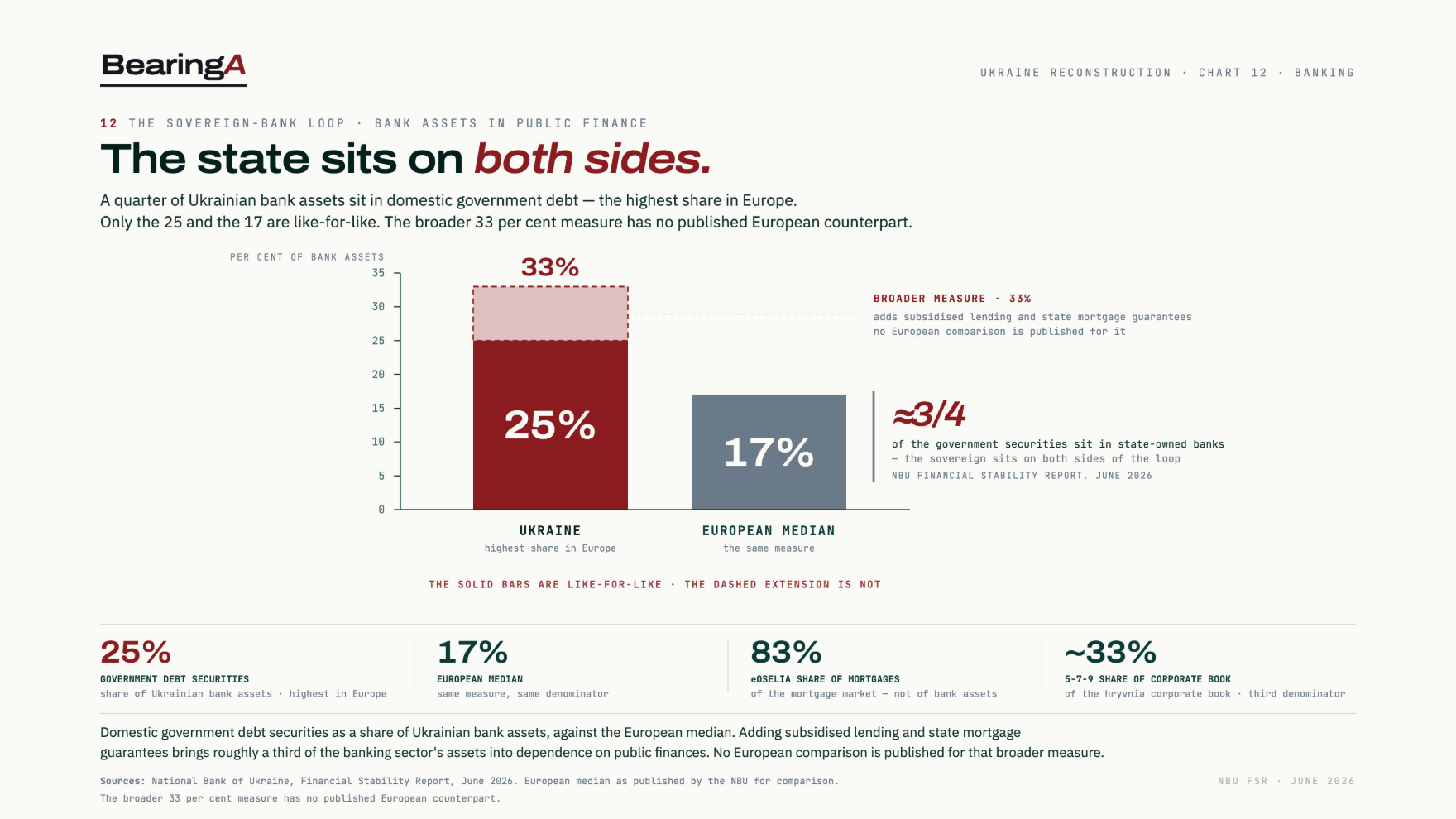
Chart 12 — Ukrainian bank assets dependent on public finances
CHART 12SOVEREIGN-BANK LOOP · 25% AGAINST A EUROPEAN MEDIAN OF 17%

A quarter of Ukrainian bank assets sit in domestic government debt securities, the highest share in Europe against a median of 17 percent. Add subsidised corporate lending, roughly a third of the hryvnia corporate book, and the state mortgage scheme at 83 percent of mortgages, and about a third of banking-sector assets depend on public finances.

The mechanism runs in a circle. Sovereign stress marks down the bond portfolio. The mark-down consumes bank capital. Banks preserve capital by contracting lending. Contracted lending weakens growth. Weaker growth worsens the fiscal position that started the sequence.

Ukraine's version has an unusual feature that bears directly on our claim: almost all lending to state enterprises and around three-quarters of the government securities are concentrated in state-owned banks. The loop is not distributed across the system. It is concentrated in the institutions the state also owns, which means the sovereign sits on both sides of it. The financial system is itself an instance of the pattern, money routed through incumbents, reproducing the structure that already existed.

Worth noting what is not deteriorating: top-20 borrower concentration has fallen from roughly 40 percent to 28 percent over the decade. The private credit book is diversifying while the sovereign book concentrates. Two opposite trends inside the same balance sheets.

What all three prices are asking about is whether the fiscal position is credible enough to fund itself over time. Under a regime where debt service is credibly funded through future primary surpluses, a price-level shock reverts. Under a regime where it is not, the shock is permanent, and today's pricing is approximately correct. Same shock, same opening numbers, opposite outcomes, and the variable that decides it is not economic. It is whether commitments hold when they become expensive.

Which is the question every previous section has been asking in its own vocabulary. Whether procurement stays dispersed once contracts get large. Whether Energoatom's supervisory board keeps its independence when Khmelnitski lands. Whether port concessions produce operators or landlords. Whether health financing runs through the purchaser or rebuilds the estate.

A country cannot credibly promise its own fiscal discipline. It gets solved from the outside, and Ukraine's neighbours did it within living memory: the Central European and Baltic accession states bound themselves to EU conditionality, not because the rules were wise, but because breaking them carried consequences the domestic political system could not overrule. The commitment became credible when it stopped being self-enforced.

Ukraine's version of that machinery exists. The Ukraine Facility disburses against a reform plan with milestones. Accession negotiations carry their own conditionality. NABU's continued function under pressure is what an external anchor looks like when it is binding rather than nominal. The instrument that makes Ukrainian commitments credible is held abroad. Whether it is pointed at market structure or only at legal process is a choice being made now, by people who mostly do not know they are making it.

If the credibility question resolves favourably, currency, bank equity and local yield reprice together, because they are the same bet in three costumes. If it resolves badly, the premium already embedded in all three is approximately fair. Bounded downside against correlated upside is a specific structure. It is why this sector is where a view on Ukraine gets expressed most efficiently, and emphatically not where it gets expressed most safely.

WHAT NOBODY HAS EXPLAINED §11 · BANKING, CURRENCY AND RATES  ¶

Ukraine holds the highest share of sovereign debt on bank balance sheets in Europe, and three-quarters of it sits in banks the state owns. Every supervisor in Europe treats that configuration as a hazard.

The obvious reading is that there was no choice, a state at war borrows where it can, and its own banks are where it can. That is true of the first year. It is less true of the fourth, in which the concentration deepened rather than being managed down, and in which the NBU has been explicit about the risk in its own reports.

Our reading is that this is not a failure of supervision but a deliberate exchange, and that the price is being paid in a currency nobody is counting. Routing sovereign financing through state banks buys stability now, predictable demand at auction, no failed placements, no market signal to defend. What it costs is that the banking system's capacity to lend to anything else is progressively consumed. A third of sector assets tied to public finances is a third not available to the private economy, and the firms that cannot borrow are the same entrant firms this piece has been tracking across six sectors.

If that is right, the sovereign-bank loop is not merely a financial-stability question. It is the same architecture as everywhere else in this reconstruction: money routed through the incumbent because the incumbent is the reliable channel, and the entrants crowded out as a by-product nobody chose. It is also the one place where the crowding-out is directly measurable, private credit to the corporate sector, tracked against the sovereign share, would tell any supervisor exactly what the arrangement is costing. Nobody currently reports the two together.

WHAT WOULD PROVE US WRONGIf this is pure wartime necessity, expect the sovereign share to fall as external financing stabilises and domestic markets deepen. If our reading holds, expect it to persist after the war, and expect private credit to the corporate sector to stay thin even in years when the banks are well capitalised and profitable.

§12 — §13 The finding only appears when the eight sector tests are read together. It closes on demonstrated capability, not forecast.
12

Whose job it is

Seven of the eight readings above end in something addressable, and none of them requires anyone to be persuaded of anything they do not already believe.

A funder that books avoided damage as an output moves money toward hardening. A donor government that expands the Danish model buys more with the same euro. A purchaser with a floor on entrant participation stops economising on the door it built. A supervisor that reports private credit alongside the sovereign share can see what the arrangement costs. An accession chapter that names market structure makes competition a condition of money rather than a hope attached to it. None of that is reform in the sense that requires a political fight. It is reporting lines, budget floors and procurement channels.

The finding only appears when all eight sections are read together.

The entrant channels in this reconstruction are not failing because anyone attacked them. Nobody in this piece is a villain. Donor reporting frameworks, purchaser budgets, defence procurement, term sheets, disbursement schedules, each is a defensible local decision made by someone doing their job correctly. What is missing is anyone whose job is the interaction between them. Keeping the entrant channels open is not assigned. It is not measured. It is not anybody's brief.

The cheapest intervention available in this entire reconstruction is to make it someone's.

One thing on that list is not available to outsiders, and it should be said plainly rather than left implied. Every mechanism in this piece that worked was built beside an incumbent rather than through one. That was a rational choice under existential pressure, bypass creates allies, confrontation creates enemies, and a country at war needs allies. The sectors where bypass was not possible, the grid, the reactors, the hospital estate, are exactly where the next chapter of this story gets written. External conditionality can raise the cost of waiting. Only Ukraine can make the call, and everything in this piece suggests it has the institutional muscle to do it when it decides to.

13

What this is evidence of

The preceding sections read easily as a catalogue of constraint. Labour that does not return. Capacity running at four times funded orders. A grid rebuilt as it was. Money arriving in the most expensive financing environment in twenty-five years, from institutions whose own incentives push it toward the incumbents.

That reading would miss what the evidence actually shows.

In 2022, Ukraine had seven drone manufacturers. It now has more than a hundred and sixty building FPV systems alone, producing at a scale no European country has matched in decades. That did not happen because conditions were favourable. Conditions were the worst on the continent. It happened because a set of specific choices, deregulate, tax-structure, fund the entrants, point procurement at them, were made quickly and then held.

The commercial technology sector did the same thing earlier and without a war to force it: three hundred thousand specialists, two thousand two hundred companies, forty-one percent of national service exports, built while the state was doing something else entirely.

And in the window everyone has stopped talking about, 2002 to 2007, through a contested election, a revolution, two changes of government and a gas cutoff, Ukrainian companies grew ninefold in their first decade. Not foreign companies operating in Ukraine. Ukrainian firms, in Ukrainian conditions, matching American growth rates.

The capability is not the open question. It has been demonstrated three times, and it is measurable.

The open question is whether the architecture that produced it gets used again, in the sectors where it has not been, and whether the people writing the disbursement rules understand that they are choosing.

West Germany is instructive here, and not because it was inevitable. Nothing about it was. The currency reform was contested, the de-cartelisation was imposed rather than chosen, and there was no reason in 1948 to expect what followed. It became a Wirtschaftswunder in retrospect. At the time it was a series of decisions that could have gone otherwise, made by people who did not know they were building a miracle. It is the more accurate parallel, and the more encouraging one. Ukraine is not waiting for conditions to improve. Ukraine is in the part where the decisions get made, and unlike West Germany, it is making some of them itself, and has already shown, in two sectors, exactly what it looks like when it gets them right.

The window is closing.
It is not closed.
§13 · WHAT THIS IS EVIDENCE OF
BearingA
COMPOUND READ · AUGUST 2026
DATA AND PROVENANCE SHIP WITH EACH CHART AS CSV
CHARTS SET IN ARCHIVO, IBM PLEX SANS AND JETBRAINS MONO — FONTS ARE NOT EMBEDDED IN THE SVGS