Ukraine's reconstruction: what the money passes through.
Seven manufacturers of unmanned systems became roughly five hundred because four instruments moved together in March 2023. Three of them expire. The rule they displaced was not repealed, it was suspended for the duration of martial law, sits unamended since March 2021, and is four lines long. This is the level the outcomes were decided at, and nobody is reading it.
§1 to §3What we think, the architecture, the mechanism. The argument is here; the sectors that follow are the evidence.
01
What we think
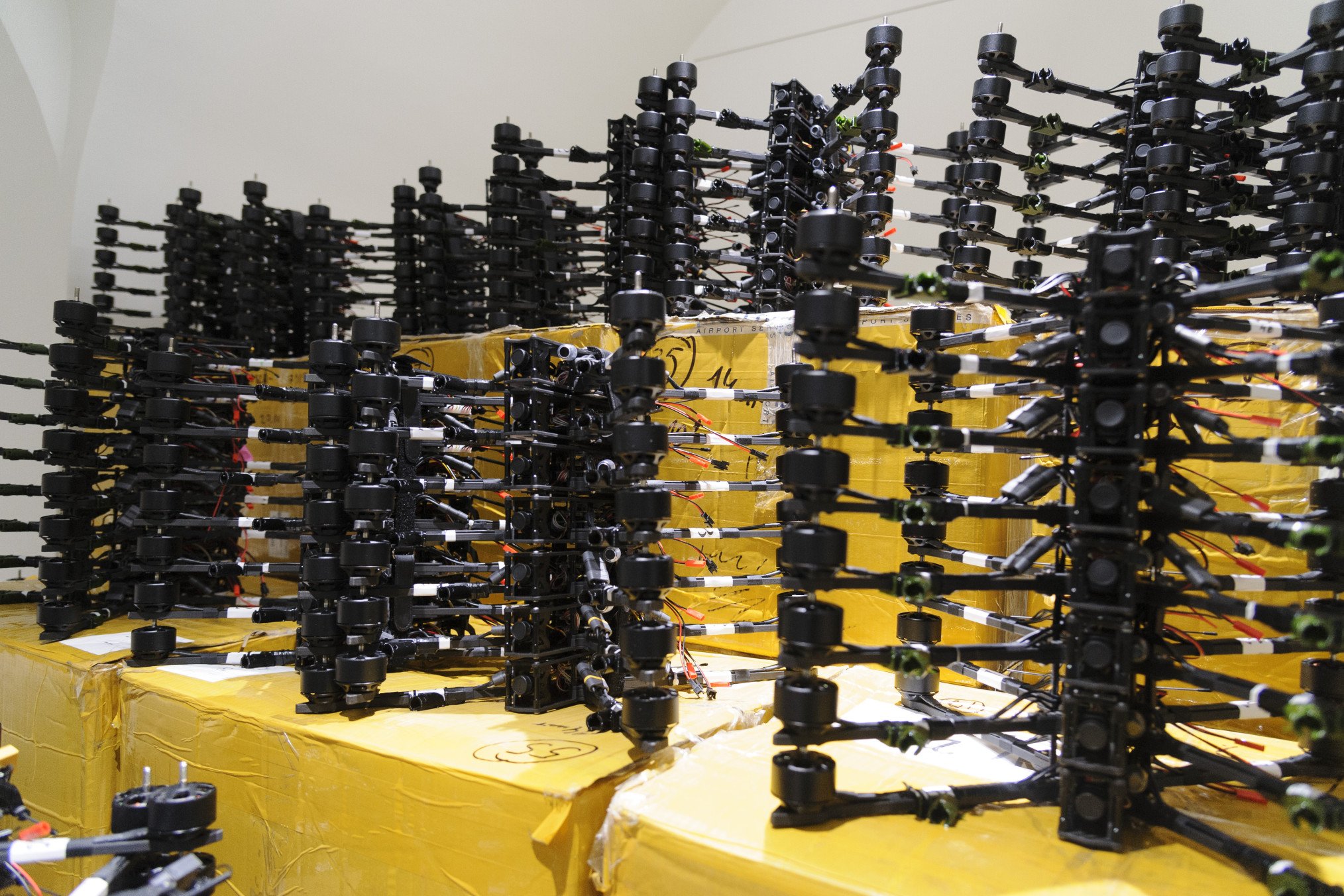
Ukraine did in eighteen months what most states take a decade to do, and it did it under conditions no other state has faced. Seven manufacturers of unmanned systems became roughly five hundred, output passed four million units a year, and the domestic share of weapons procurement went from forty-six percent to eighty-two inside a year. That happened. It is the single clearest industrial success of this war, and it happened while the country was being attacked.
It happened because four instruments moved together in March 2023, and the country that wrote them wrote them fast. That speed is the thing worth naming, because it is the capability the rest of Europe currently does not have and Ukraine now does. A rule paying assembly one percent was suspended for the duration of martial law, an advance payment mechanism was written for producers with no balance sheet, six procedural regimes were switched off, certification was handed to the manufacturer. Four documents, one Cabinet decision, an industry that did not exist before.
The suspended rule was not repealed. It has sat unamended since March 2021 and it is four lines long. On the day martial law ends it returns, unless something replaces it first. What Ukraine built is real and it is worth protecting, and the conversion from emergency measure to settled framework is the work that follows.
That conversion is what this piece is about.
How a pricing annex decided an industry
In March 2021, a year before the invasion, someone in Kyiv wrote a paragraph into a Cabinet procedure on the expected cost of non-competitive defence purchases. It set profit inside a contract price at one percent of anything the firm bought in, and thirty percent of anything it made itself.
Nobody called that an industrial policy, because it does not look like one. A firm that machined and tooled in-house earned thirty percent. A firm that assembled bought-in components earned close to nothing.
A drone is an assembly of bought-in components.
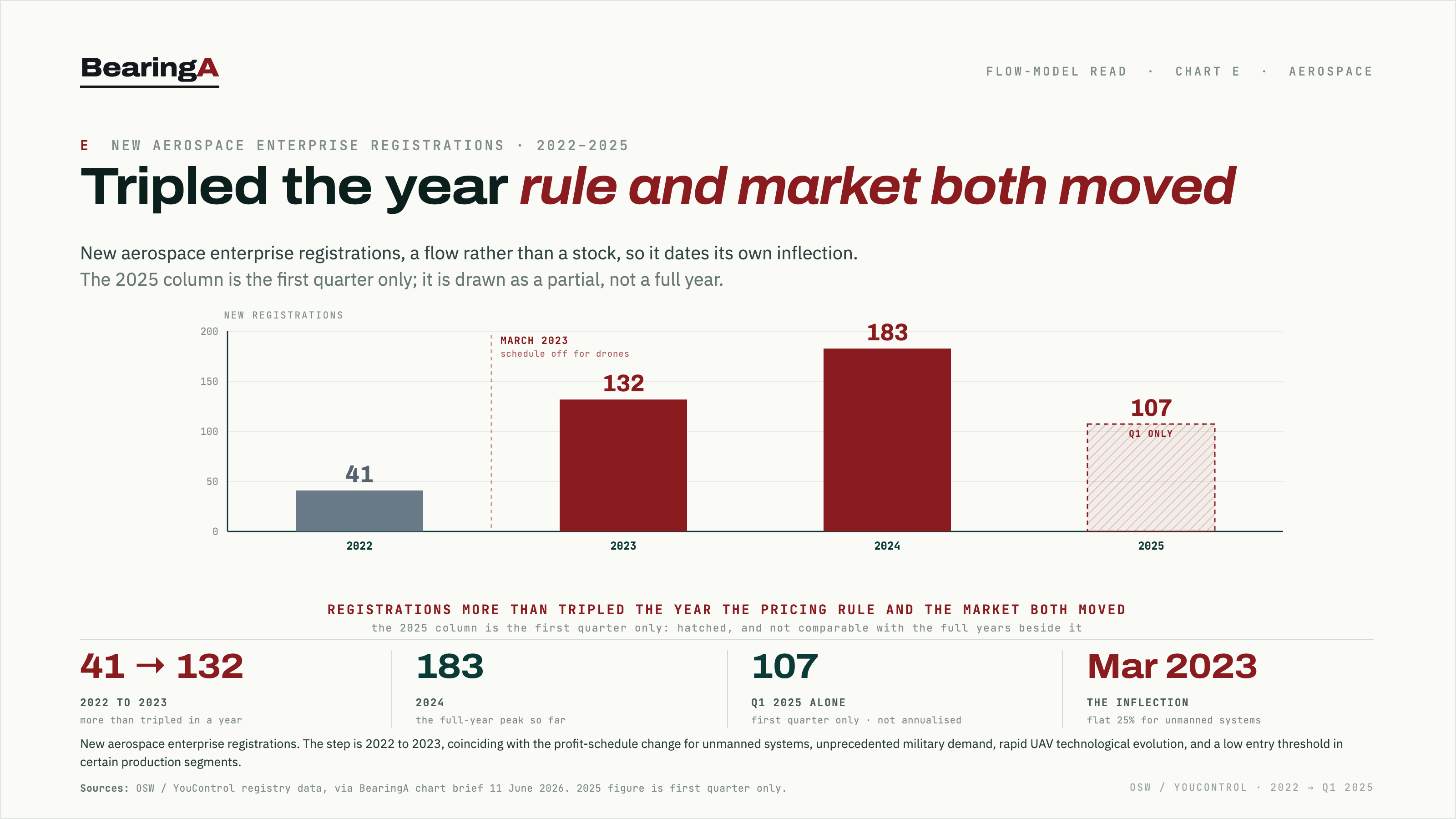
In March 2023 that paragraph was switched off for unmanned systems and replaced with a flat twenty-five percent, alongside seventy percent advance payment, six procedural regimes disapplied, and certification handed to the manufacturer. New aerospace enterprise registrations went from forty-one in 2022 to a hundred and thirty-two in 2023.
What we think
Financial flow decided Ukraine's industrial structure. The instruments that did it are public, mostly temporary, and almost entirely unread. And the supervision built around the money is aimed at a different variable than the one deciding outcomes.
We can name the instruments. A profit schedule that paid assembly one percent. A guarantee register in which the entrant category did not exist for eighteen years. A cost rule making interest recoverable only for firms borrowing under state guarantee. A valuation a producer must commission, pay for, and cannot recover in the price. A customs line that let solar panels in and kept wind turbines out. A tax regime with a nine-person floor.
Four separate bodies, four separate dates, no coordination between them, and every one of them selects for size. Nobody decided that, and the compounding is the finding. Look for intent and you will find people doing their jobs correctly.
Where an instrument stopped selecting against entrants, entrants appeared. Where none moved, nothing did: manufacturing state enterprises gained share across two decades while their relative productivity fell, and a rail cross-subsidy the IMF diagnosed in March 2015 was still running in August 2026 when the state raised the tariff on a captive agricultural user with no alternative route.
Eight sectors. The pattern holds in six and fails in two, and the two failures are why we think the six are real.
Three things this does not claim
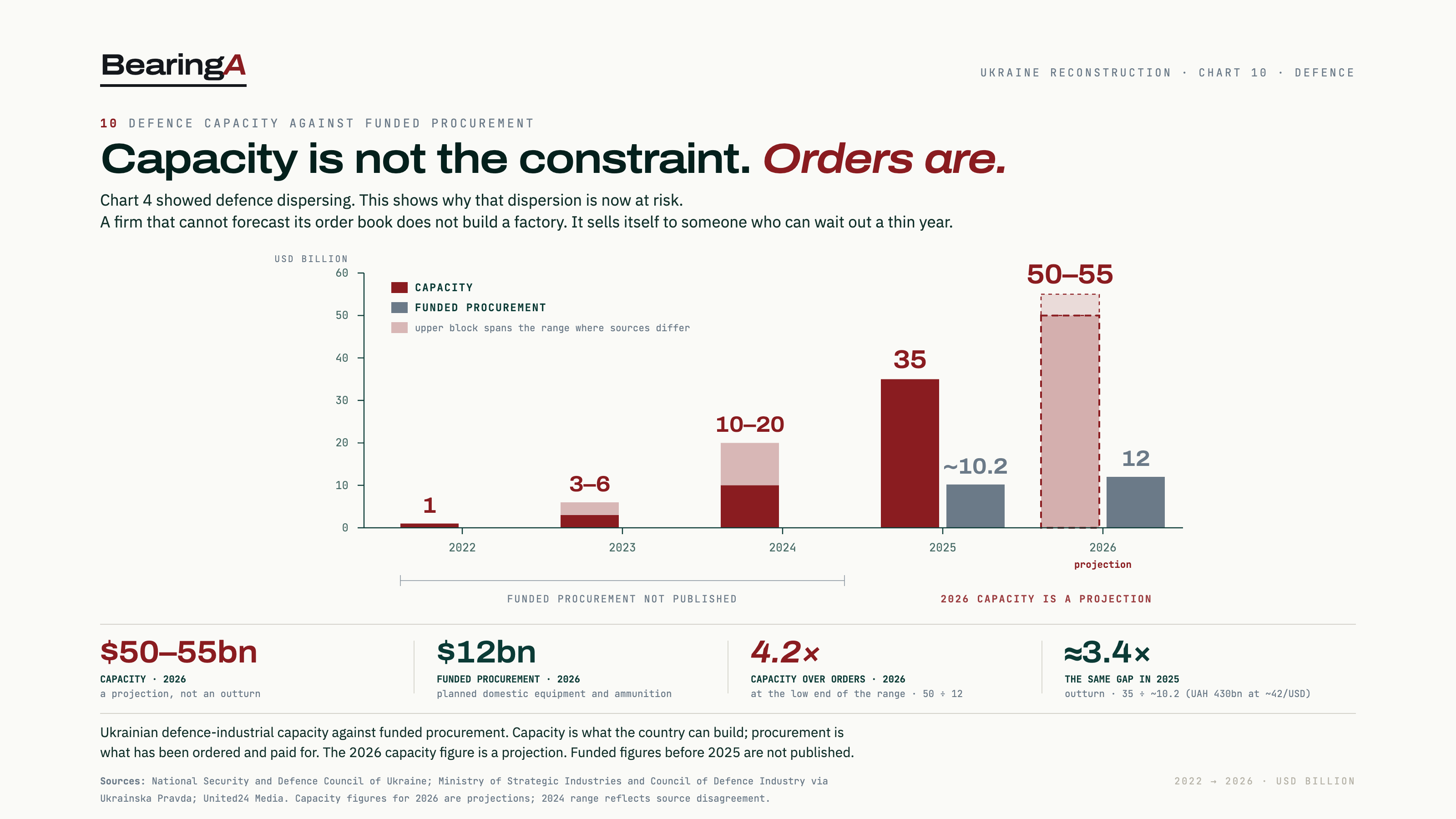
Routing determines who receives the money. It does not determine how much money there is. Ukraine's defence capacity reached fifty-five billion dollars against roughly ten billion of funded procurement, and no paragraph in a procurement schedule reaches a shortfall set by parliaments in other countries.
Routing determines who produces. It does not determine whether the economy grows. A correctly routed industrial base inside an entrenched low-growth economy is still an entrenched low-growth economy.
Routing determines who can pay. It does not determine whether there is anything to buy. Ukraine's housing programme put money into households' hands and residential construction fell sixteen percent, because skilled labour runs at half requirement and no financing instrument builds a bricklayer.
Where we are most likely to be wrong
Three things would break this, and we would rather say them now than have them said to us.
An instrument that reliably allocates against scale. Every one we examined selects for size. If one exists that does the opposite and works, the pattern is an artefact of where we looked.
A structural condition on the defence leg. We rest heavily on sixty-three percent of 2026 European money arriving supervised transaction by transaction while asking nothing about market structure. One condition touching structure on that leg and the argument needs rebuilding.
Dispersion in a sector whose schedule paid against it. If producers multiplied somewhere the pricing, guarantee and eligibility rules all favoured incumbents, instrument design is not deciding what we say it decides.
We have already lost one test this way. We wrote that a customs exemption excluding wind turbines was an instrument nobody was examining, and a solar-industry association had been examining it for eight months and had it extended to 2029 with wind turbines added. That failure is the most useful thing in the piece, and §10 keeps it on the page.
What we would look at, if this is right
We are a research practice and not a government, and what follows is offered rather than recommended. But a piece that describes a mechanism and suggests nothing is doing half a job, so here is where our attention would go.
We would look at the expiry dates before the volumes. Most analysis of Ukraine's reconstruction, including the good analysis, is about how much money arrives and when. The instruments in this piece decide what the money does when it lands, and several of them run out on a condition rather than a date. That set is perhaps twenty lines long and nobody has written it down in one place. We could not find it, and we looked.
We would separate what a condition is for. The supervision attached to European money is built well for one question, whether the money is stolen or wasted, and is not built for another, whether it produces the industry anyone wants to exist. Those need different instruments, and conflating them costs both. §9 puts that to a European reader as a question rather than a verdict, because we hold it as a view and not a finding.
And we would treat the two failures as the interesting part. Healthcare and housing are where routing was correct and the outcome did not follow, for two different reasons that both matter more than the successes do. A state can get the architecture right and still not get the result. Anyone building a reconstruction instrument should want to know why before they want to know what worked.
And the largest thing we take from it, which §9 sets out properly. Reconstruction is planned one level above where its outcomes are decided. Ninety billion euro is allocated by programme, and every outcome in this piece was decided by one critical paragraph. Ukraine is the case where the clock ran fast enough to make that visible, which puts it in a position no other state occupies at a moment when every European government is trying to build defence-industrial capacity from a standing start.
The capability worth naming is not the drone industry itself. It is the demonstrated ability to reorganise an industrial sector deliberately, at the level where decisions actually bind, in months rather than decades. That is what Ukraine has built and nobody else currently has. The industry that resulted is real and it is worth protecting, and whether it survives its own legal basis is a question of conversion rather than of design.
One habit rather than a conclusion. When you next read that a country's industry grew, or failed to, ask which paragraph decided it. There is usually one. It is usually public. And it is usually not the thing being discussed.
02
The architecture
CHART C
Money does not arrive as money. It arrives as an instrument, with a ticket size, an eligibility rule, a set of conditions and a channel that carries it, and each of those is a decision about who can receive it. This section maps the instruments operating in Ukraine in August 2026 and names who sets each one.
Everything in it is a snapshot. The figures move quarterly, several of the largest rest on statements rather than on the documents behind them, and we mark which is which rather than present a moving architecture as a settled one.
Volume is the wrong variable
Recovery-cost estimates cluster at $700 to $800 billion in the government's Prosperity Plan against roughly $590 billion in the World Bank's assessment. They answer different questions, repair against repair-plus-growth, and neither is the number that governs anything. The operative variable is pace, and the Economy Minister's own working figure is $40 to $60 billion a year. Against that, the Budget Declaration puts external financing need for 2026 to 2029 at $145.9 billion, of which $45.3 billion falls in 2027, with Ukraine Facility drawdown at €29.5 billion of €46.8 billion envisaged.
Those three figures rest on ministerial statements and press reporting rather than on the Declaration or Commission documents, and the minister's $40-60 billion is a stated position rather than a measurement. We carry all four at that grade. None of it changes the structure underneath, which is where the routing lives.
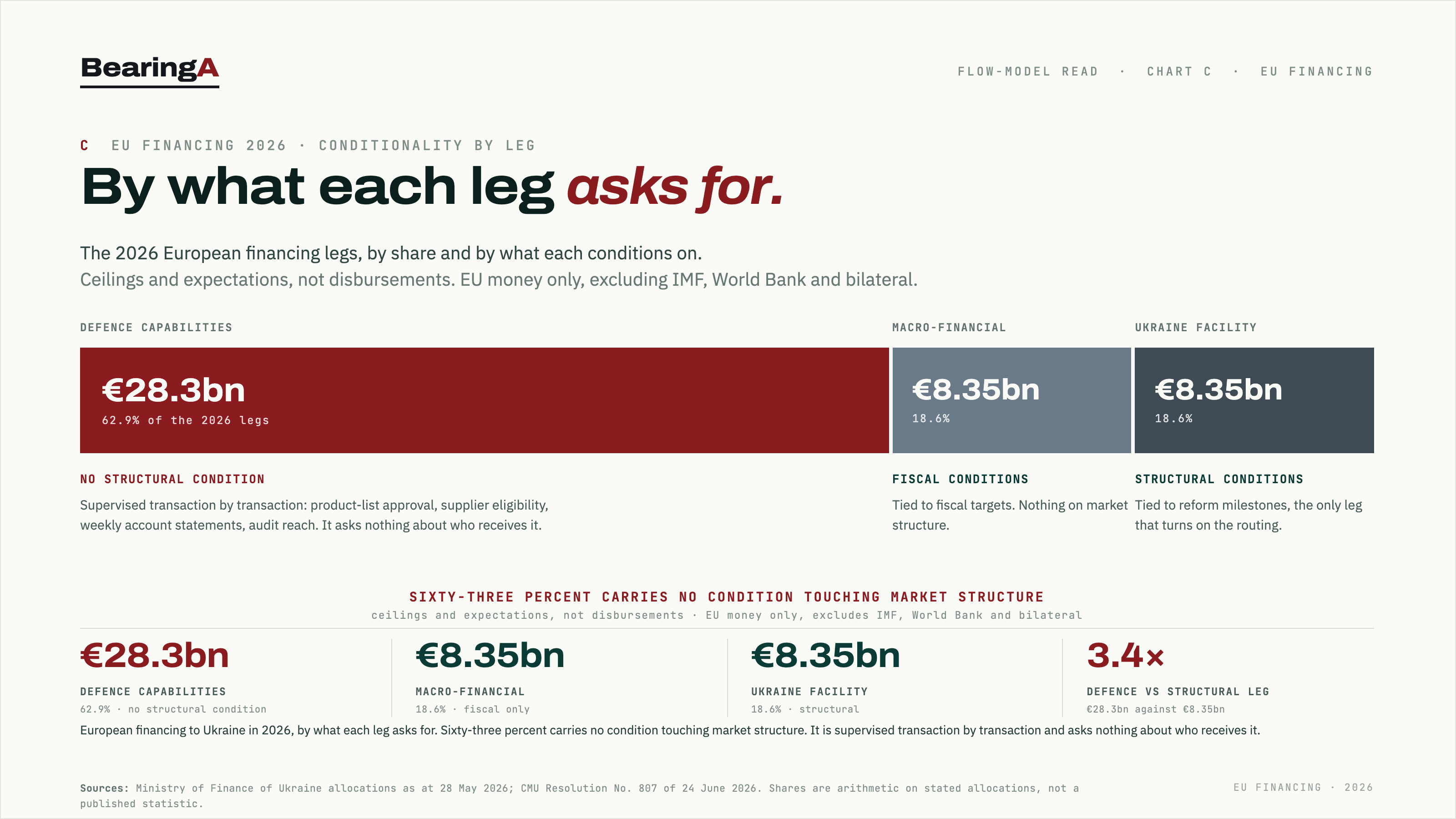
Roughly sixty-three percent of the money asks nothing about structure
The Ukraine Support Loan runs to up to €90 billion across 2026 and 2027, ratified on 28 May 2026, two-thirds of it defence-industrial by design. The 2026 architecture is exact: €28.3 billion for defence capabilities and weapons, plus €16.7 billion in budget support, the latter split equally between the EU macro-financial assistance mechanism and the Ukraine Facility.
The two halves of the budget support are not the same instrument. The macro-financial memorandum runs to revenue mobilisation, expenditure efficiency, public financial management, tax and customs, audit. Nothing in it touches market structure. No state aid, no state-enterprise governance, no competition enforcement, no insolvency, no resolution of non-performing loans. Those live only in the Facility indicators.
LEG
2026
SHARE
CONDITIONALITY
Defence capabilities and weapons
€28.30bn
62.9%
None on reform
Macro-financial assistance
€8.35bn
18.6%
Fiscal only
Ukraine Facility
€8.35bn
18.6%
Structural, the Plan indicators
The money that arrives regardless of whether the routing changes is more than three times the money that depends on it.
CHART CCONDITIONALITY BY LEG · 62.9% ASKS NOTHING OF STRUCTURE
Four constraints belong on that table. The figures are ceilings as at 28 May rather than disbursements. The shares are arithmetic on the ministry's own allocations, not a published statistic. They cover EU money only. And carrying no reform conditions does not make the defence leg unconditional, which matters, because what it does carry is the sharpest evidence here.
Watched closely, and asked nothing
The domestic implementing act, adopted 24 June 2026, routes the entire defence-industrial leg through one budget programme with the Ministry of Defence as manager and a single state enterprise as sole recipient.
What the Commission requires of that flow is precise. Procurement proceeds only against a list of products the Commission has positively assessed. The recipient must obtain declarations that the product, the supplier and the producer meet eligibility criteria. Contracts must oblige suppliers to grant the Ministry and the Commission access to documents and to the premises where they are held. The Treasury notifies account openings within one working day and supplies weekly statements. And access runs to the anti-fraud office, the European Public Prosecutor and the Court of Auditors.
That is close supervision by any standard. None of it asks who receives the money. It asks whether the goods are eligible, whether the supplier is permitted, and whether the euro was spent on what it was declared for.
The largest single flow in this reconstruction carries transaction-level conditionality and no structure-level conditionality at all. The instruments that would ask, state aid discipline, public-service separation, insolvency, loan resolution, sit on the eighteen-point-six percent, and §5 traces what became of them.
Two domestic details belong alongside it. Advance payment runs to 100 percent of contract value. And the sole recipient is itself being merged into a new acquisition agency, so the whole leg routes through an entity under restructuring.
And repayment cannot do the disciplining
Ordinarily a lender needs no conditionality, because the obligation to repay does the work. That mechanism is absent by construction. Principal is repayable exclusively from future Russian reparations, and where those fall short the EU has no claim on any other Ukrainian asset.
Conditionality is therefore not one lever among several. It is the lever. Which places weight on a backlog that is not clearing: nineteen indicators unfulfilled as at July 2026, with roughly €7.35 billion contingent on them. On 30 July the Council mobilised over €8 billion more with twenty-seven new milestones, taking the indicator count from 146 to 173, all due by Q3 2027.
Conditionality is expanding, not easing, and the unfulfilled cluster is the one that governs routing.
The money is designed at one altitude and disposed at another
Everything above operates at the level of programmes. Legs, tranches, indicators, milestones. That is where the money is designed, and where almost all analysis of this reconstruction is conducted, including the good analysis.
Everything that follows was decided one level down, in profit schedules, eligibility registers, cost-recovery rules and customs lines. Those are not in the Plan and they are not indicators. They operate at instrument altitude; tranche negotiations operate at programme altitude, and the same person is rarely in both.
Hold that, because it is what the sectors are about.
The government's own Programme of Activities for 2026 and 2027, submitted on 18 August, is this upper altitude in its clearest domestic form: four directions, twelve goals, quantitative criteria and 2027 deadlines, and none of the instruments that dispose of the money. It is the Kyiv counterpart to the donor architecture above it, planned at the level that allocates and silent at the level that decides.
Who may hold the money, and how little of it reaches an entrant
The investment pillar of the Facility is the Ukraine Investment Framework: €9.6 billion of capacity, €7.8 billion of guarantee cover plus €1.8 billion of blended finance, aiming to mobilise up to €40 billion. As reported at its seventh Steering Board meeting, €8.5 billion has been allocated against €25.7 billion mobilised, which is 88.5 percent of capacity committed at leverage of about three times on allocation.
It is implemented in indirect management by financial institutions the Commission has pillar-assessed: the EIB Group; the EBRD, IFC and Council of Europe Development Bank; and the European development banks BGK, KfW and AFD. Every one is European or multilateral. No Ukrainian institution appears on the list.
The first Call for Expressions of Interest ran from November 2024 and was open to EU and EEA businesses, drawing 113 investment projects. The second, announced at the 2026 EU–Ukraine Business Summit, is open to European and Ukrainian businesses on a rolling basis.
That sequence is not a preference anyone stated. It is the eligibility rule, and eligibility rules are where routing is actually decided.
The entrant floor is set, and it is set low
The Ukraine Facility Regulation carries two quantitative targets: at least 20 percent of framework funding together with Plan investments toward green investment, and a minimum 15 percent of guarantee capacity to micro, small and medium enterprises.
Fifteen percent of €7.8 billion is about €1.17 billion, 12.2 percent of total capacity, and roughly 8.8 percent of the €40 billion mobilisation target if leverage holds.
That is the third quantified instance of the same asymmetry we have found. In October 2023 a single package of $480 million, IFC $130 million, EBRD $100 million, DFC $250 million, went to MHP, Ukraine's largest poultry and processed-meat producer, against roughly €20 million capitalising the Partial Credit Guarantee Fund in Agriculture launched three months later. The two figures are not like for like: one is direct lending to a single borrower, the other capitalises a facility that leverages into a larger loan book, and the orders of magnitude are the point rather than the ratio. §5 gives the third inside a single domestic instrument, where the same subsidy through the same forty-eight banks still splits by lender.
The entrant channel exists, it is mandated, and it is small by design. No individual decision produced that. Three separate instruments, set by three different bodies, arrived at the same proportion.
And the demand it is addressed to is smaller still
Everything above argues from instrument design. Set it against what businesses say they need.
A survey of 504 owners and chief executives, fielded across Ukraine in early 2025 with UNDP and the Ministry of Economy, asked how much additional financing a business needed to execute its three-year strategy. Half answered between thirty thousand and three hundred thousand dollars. Fifteen percent answered under thirty thousand. Eighty-six percent need a million dollars or less.
Set that beside the instruments. A single package of $480 million to one agribusiness. A €1.5 billion acquisition financed with European guarantees and named as the framework's flagship result. A guarantee facility for farms below five hundred hectares capitalised at around €20 million. The instruments and the demand are separated by two to three orders of magnitude.
Two caveats. The survey is self-report and measures what owners say binds them. And stating a need is not being creditworthy for it. What it establishes is scale, and on scale it is not close.
The same survey asked which forms of state support a business had used in the previous twelve months, from a list of eighteen. Fifty-three percent answered none. Subsidised credit reached 18.7 percent, international grants 10.7, reservation of staff from conscription 9.5. Everything else was under 6.5, including the tax regime the reconstruction read named as one of three things that built an industry, at 0.8.
That last figure is worth pausing on rather than scoring a point with. Diia.City is written for technology firms and this survey is cross-sector, so a low number is expected. What it shows is what a routing instrument looks like when it works: narrow, specific, and close to invisible to almost everyone. The instruments here are not failing to reach a general population. They were never addressed to one.
The entrant channel's actual size is not published. The 15 percent MSME figure is a regulatory floor rather than an allocation, and the realised share may be higher. Utilisation of the Partial Credit Guarantee Fund since its January 2024 launch has not been located in any public source. Low take-up would sharpen this finding considerably; high take-up would qualify it. Until one of the two is published, the instrument's design is measurable and its outcome is not.
What the instrument selects when it selects for scale
The Commission names two flagship private-sector results.
In telecoms, with EU guarantees behind it, the French holding NJJ invested €1.5 billion acquiring and merging two leading Ukrainian operators, Lifecell and Datagroup-Volia, into a single integrated operator, financed alongside the IFC and EBRD. The Commission describes it as the largest foreign direct investment in Ukraine in two decades, bringing improved mobile connectivity to more than ten million people and faster internet to four million households.
In agriculture, a partial first-loss risk cover went to Kernel Group for a 106 megawatt solar park with battery storage. Kernel is the group behind the landmark crop-farming transaction of 2026, the $348 million acquisition of Enselco.
Nothing in either case suggests impropriety, both carry substantial and specific public benefits, and both are the Commission's own selection, chosen to demonstrate impact, illustrative of what the instrument celebrates rather than a representative sample of what it funds. The observation is about the instrument, not the recipients. An instrument that optimises for capital mobilised at scale will find the transactions that move the most capital, and those transactions are acquisitions and mergers. Nobody decided to fund consolidation. The instrument's headline results are consolidation because consolidation is what moves €1.5 billion at once.
Mobilisation is a projection, not a measurement. The €25.7 billion figure is investment expected to follow from €8.5 billion allocated; realised investment against allocation is not published. The distinction matters because the entire case for the instrument's leverage rests on it, and because a mobilisation projection is itself an estimate of what private capital will do, which is the behaviour the read is trying to observe rather than assume.
A fifth lever, and it works differently
Ticket size, eligibility, conditions and channel all select who is served. A fifth class does something else: it decides whether anyone can afford to serve at all.
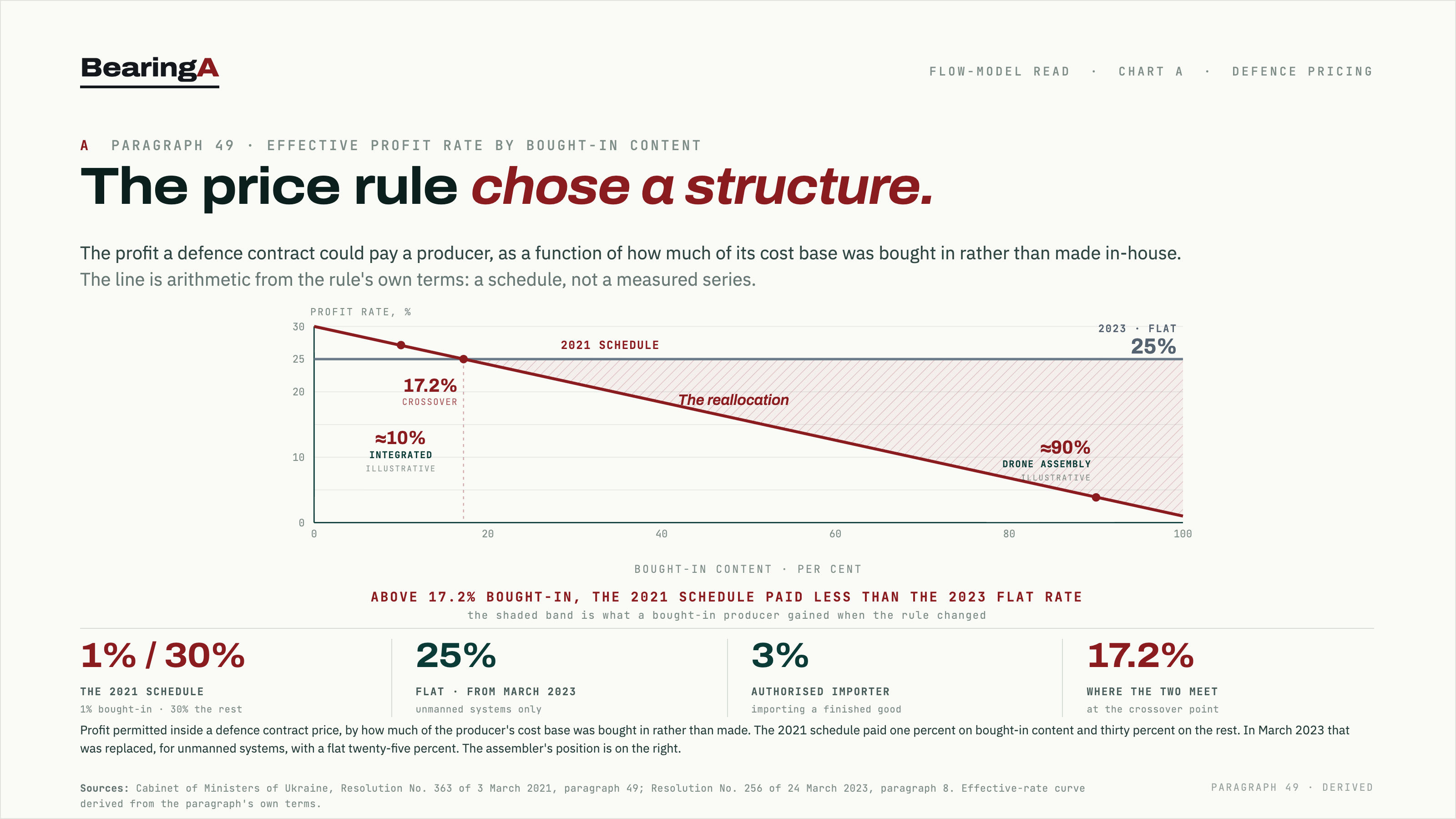
Margin regulation. A profit schedule adopted in March 2021 paid a defence contractor one percent on what it bought in and thirty percent on what it made itself, with a third rate paying three percent to an authorised entity importing finished goods. In March 2023 that was replaced, for unmanned systems, by a flat twenty-five percent. §4 traces what followed.
What belongs here is the class, and two things about how it behaves.
It prices activities rather than firms. The state did not prohibit importing, and it did not favour assembly by naming assemblers. It priced the activities differently and let the arithmetic sort them. That is why nobody had to decide anything for the structure to change.
And a margin instrument can carry an eligibility instrument inside it. The same resolution that lifted the ceiling required a producer to obtain a valuation from a forensic-expert institution before contracting, and the paragraph after it forbade recovering that cost in the price. The margin made entry possible. The valuation decided who could act on it, and charged them for finding out.
The valuation has a reason and it belongs here rather than in a note. Defence procurement prices needed policing and still do: in the first half of 2026 Ukraine's anti-corruption bodies recorded UAH 726 million saved on unmanned-systems procurement, and a separate case involving a million-dollar bribe over drone contracts. A state that requires an independent valuation before it signs is not inventing friction. It is answering something real. It filters anyway, and both are true at once.
Architectures propagate by demonstration
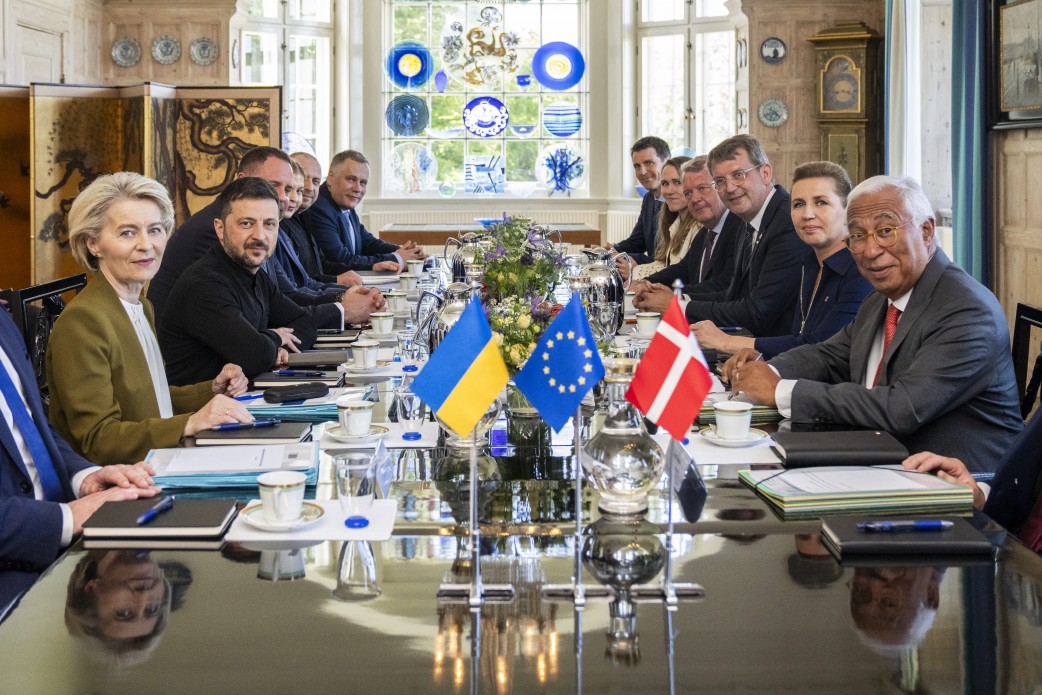
Denmark occupies a role the read should name precisely: it is not only a contributor but the implementing actor through which the EU disburses windfall profits from immobilised Russian assets. That makes it routing infrastructure.
The model on its own terms ran roughly €538 million in 2024 and €1.3 billion in 2025; the wider family of mechanisms ran about $400 million in 2024 and roughly $6 billion in 2025. Against a defence capacity gap of $45 billion, €1.3 billion is about 3 percent and even the family is about 13 percent. The architecture we hold up as the correct one covered a small fraction of the capacity it was designed to activate.
Then it was adopted. On 30 June 2026 the EU disbursed €3.9 billion to Ukraine's State Budget Special Fund, the first instalment of a €6 billion drone package under the €90 billion loan, restricted to Ukrainian drone production, defence-industrial capacity and urgent frontline supplies, with Brussels verifying intended use and delay of subsequent transfers available where it is not observed.
A small country demonstrated a routing architecture, it worked, it stayed marginal in volume for two years, and the largest funder in the system adopted it and multiplied it threefold in a single disbursement. Routing architectures propagate by demonstration rather than by design, and that is the one finding in this section that runs in the read's favour.
A question for the European reader, which we cannot settle
Much of this money is European, and the European instinct is that money should carry conditions. It leaves us with a question we cannot answer and would rather put than pretend to resolve.
The conditioned money is the money that does not move.
The defence leg carries no reform conditions and it disburses. The structural leg carries nineteen unfulfilled indicators, roughly seven billion euro contingent on them, and a state aid step overdue since late 2025 with its enabling bill withdrawn.
And the instrument that reorganised the industry carried no condition at all. A profit schedule changed in Kyiv in March 2023, and eighteen months later Ukraine had a defence-industrial base it did not have before. None of the Commission's supervision touched the variable that decided which firms could exist.
There is a homely version of the objection. A mortgage with a schedule specifying how much may be spent on the roof, the terrace and the kitchen. The lender is not in the house. The owner is, and knows which room is failing.
It understates the case. A mortgage lender holds a lien, so line-item control at least protects a claim. The Ukraine Support Loan is repayable only from future Russian reparations, and where those fall short the Union has no claim on any other Ukrainian asset. The lender here waived the security and kept the schedule.
And the objection has a serious answer, which is why the conditions exist. A household's kitchen does not reshape an economy; procurement routing does. A donor that hands over ninety billion euro with no view on market structure is not being respectful, it is being absent.
Underneath sits a confusion worth separating, because need and trust are different animals and this architecture treats them as one.
Every condition in it is a trust instrument. Weekly statements, premises access, the anti-fraud office and the public prosecutor on one leg. Audit, state aid control, procurement transparency on the other. Each answers can we be sure this money is not stolen.None answers does this money produce the industry anyone wants to exist. You condition on probity when managing trust. You would condition on profit schedules and eligibility registers if you were managing effectiveness, and nobody does.
And need is why the mismatch persists. A borrower who needs the money accepts terms a borrower who does not would negotiate, so the conditions were never tested against the mechanics. That is not a criticism of anyone. It is what happens when the party with the leverage manages one variable and the party with the knowledge manages another.
The same mismatch has a domestic form. The Programme carries quantitative criteria, but sets their deadlines to 2027 with no interim milestones, so at any point before the end of 2027 the executor is within its deadline and the only accountability question available is whether the work is late, which it cannot yet be. The trust-versus-effectiveness split is not only in the donor conditions, it is in the domestic instrument that answers to them.
Ukraine's anti-corruption bodies published their first-half results in August: one hundred and seven notices of suspicion, one hundred and six brought to trial, fifty-five guilty verdicts in force, and a recorded economic impact of UAH 2.06 billion.
Which sharpens the question rather than answering it. Those are instruments built to find what is missing. What finds what was allocated in the open? The lease without auction moved lawfully. The profit schedule was published in 2021. The guarantee register is a public dataset. None of it was concealed, and none of it is what an instrument built to detect concealment is looking for.
So a control system calibrated for theft works exactly as designed and still does not see the thing that determined the outcome. Whether that argues for fewer conditions, different conditions, or the same conditions applied by someone reading different documents, we do not know, and we do not think it is currently being asked.
What this leaves
The instruments are in place. The mechanism inside them is not.
Project-preparation facilities that would take an investment idea to bankable stage are largely absent for the private sector, so selection happens by default rather than by decision. The National Development Institution is eight months old and is redesigning the flagship subsidised-credit instrument now. Eighteen distinct instruments adopted across 2024 to 2026 govern how public investment is documented and assessed, each mapped to the EU provision it approaches, and the recurring finding across them is that formal adoption and functional capacity diverge, particularly at local level. None of the eighteen governs who may bid. Together they govern who is able to apply, which arrives at the same place more quietly. The Government Action Programme states priorities without specifying the mechanism that would deliver them, and we treat announced programmes as stated intent and never as routing, the same discipline we apply to donor announcements, with no exception for domestic ones.
Routing is therefore being determined by instrument design, ticket size, eligibility rules and administrative capacity rather than by anyone's decision. That is not a gap in the evidence. It is the finding, and it is why the decisions are still movable.
The date that governs is Q3 2027, when the remaining Ukraine Plan reforms fall due. What is unsettled is whether the instruments that would discipline routing, state aid control, the public-service separation that makes state-enterprise subsidy visible, insolvency, non-performing loan resolution, arrive inside that window or after it, while 62.9 percent of the money continues to arrive without asking.
03
The mechanism
CHART D
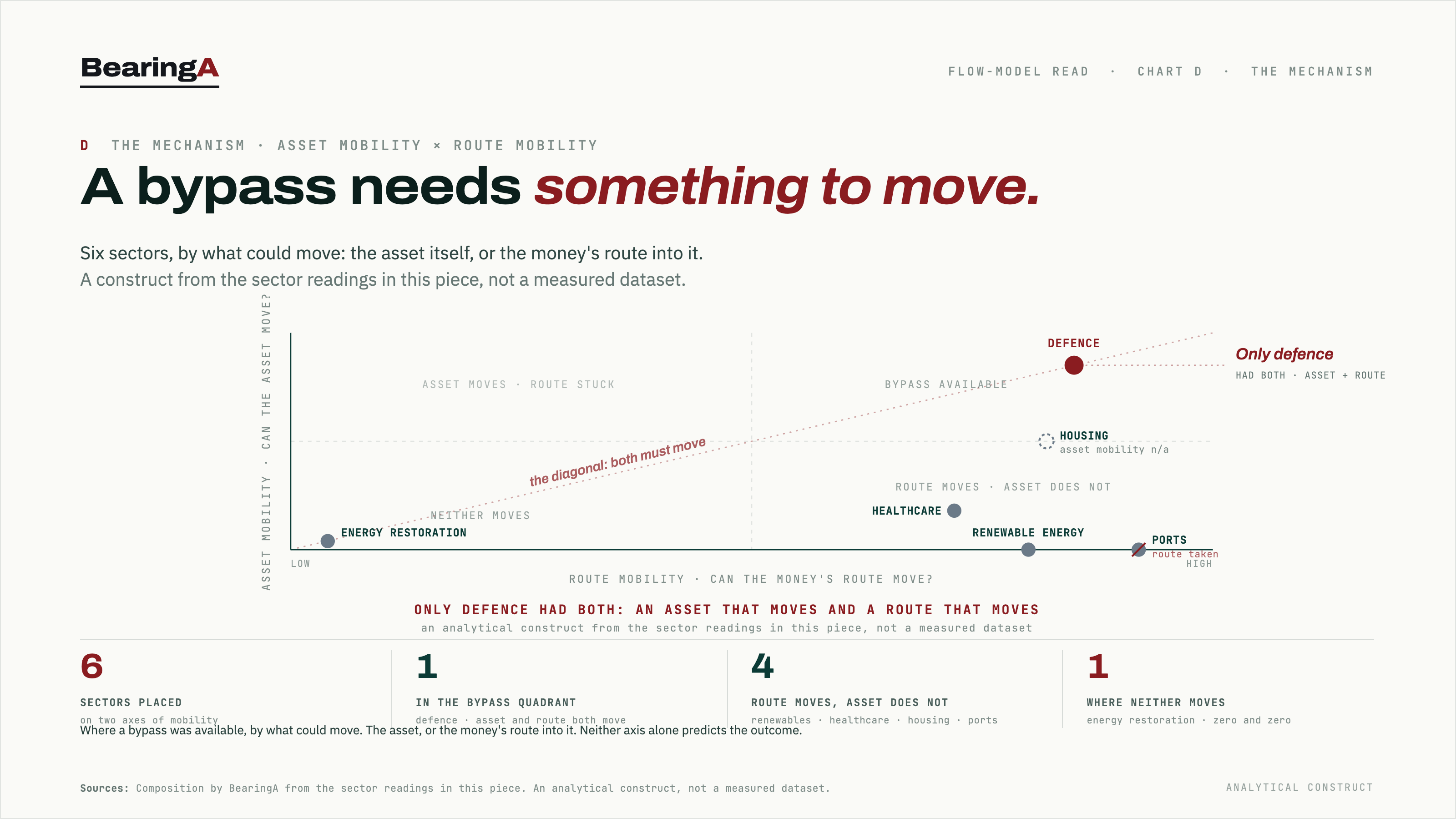
A bypass requires movement, and not necessarily of the factory.
Four properties do the work, and they compose rather than compete. Two of them determine whether a bypass is possible. One determines where it goes. The fourth determines whether anyone can afford it, and that one is the reason the first three sat unexercised for a year.
Something has to move
A bypass requires movement. Not necessarily of the factory.
Asset mobility asks whether the productive unit can relocate. A drone workshop can. A transmission network cannot. Stated on its own the variable is too blunt to be useful, because it sorts most of the reconstruction into a single category and stops.
Topological mobility asks a different question: whether the money's path through the network can change, even where the assets cannot. A grid cannot be picked up and moved. Its shape is not fixed, nodes can be added, licences issued to new holders, generation distributed rather than centralised. The assets are immobile; the topology is not.
The bypass requires that something moves. Either the asset, or the route.
Sorted on those two properties, sectors that read as separate findings turn out to be one mechanism:
In defence both were free, and the dispersion was the largest in the reconstruction. In renewable energy the asset is fixed and the route is not, so entry became possible without anything relocating. In energy restoration neither moved, and the structure reproduced itself by construction. In healthcare services the asset barely moves and the route moves entirely, because a single purchaser pays providers rather than buildings, and the entrant channel opened. In housing the route moves because certificates pay households directly, skipping the contracting layer, and the architecture is correct while the wall is physical. In ports the asset cannot move at all and the route was not only available but taken, privately, seven times, while the state channel stalled.
A single purchaser paying providers rather than premises, a certificate paying a household rather than a contractor, and a solar array feeding a grid below transmission level are the same move in three different sectors. None of them relocates anything. All three change where the money enters the network.
There is a fourth instance, and it is the estate's own. Converting a state enterprise into a joint-stock company moves no asset and builds nothing. It creates a vehicle in which a partner can hold equity. Corporatisation is route mobility applied to ownership rather than to geography or payment, which is why thirty-eight conversions produced a Rheinmetall joint venture and not a single relocated plant.
CHART DMOBILITY MATRIX · ROUTE MOVES, ASSET DOES NOT · ANALYTICAL CONSTRUCT
Two answers that turn out to be one
The parent piece observed twice, once in renewable energy, once in ports, that the competition case and the survivability case pointed the same way, and called the coincidence fortunate on both occasions.
It is not a coincidence and it is not two things agreeing. Many small generation points are harder to disable than few large ones. Dispersed port capacity is harder to close than concentrated capacity. Five hundred producers are harder to destroy than seven. Topological dispersion is simultaneously the competition answer and the survivability answer because it is one property, observed from two directions.
That matters for how the argument lands. A reader who discounts the competition case as an economist's preference still has to account for the survivability case, and it is the same case.
Where a mobile asset goes
Mobility says the asset can move. It does not say where. Four conditions determine that, and only the first is military.
Outside sustained strike range. The obvious one, and usually cited alone.
Where electricity is least interrupted. Manufacturing needs stable power. The central bank attributed a 0.6 percent first-quarter contraction specifically to electricity disruption and the imports it forced. A facility cannot run on an unreliable grid regardless of who owns it or what it is contracted to produce.
Where land and buildable infrastructure exist. Sites, connections, and the capacity to build on them at speed.
Where the incumbent is not. Soviet industrial geography concentrated heavy plant, the state estate and the legacy licence positions in the east and the centre. Western Ukraine has comparatively little of it. Relocating west is not only moving away from the front. It is moving away from the incumbent estate. A facility built in Zakarpattia inherits no Soviet-era ownership, carries no attached estate, and finds no licence-holder in the way.
Three of the four are structural rather than military. They would shape siting if the strikes stopped tomorrow.
That Soviet industrial geography concentrated heavy plant in the east and centre is well established historically. What is not established here is the pre-war distribution of industrial assets by macro-region at the resolution that would turn the fourth condition from a structural observation into a measured one. The read states it as the former.
A second gap in this section is deliberate rather than found. Electricity reliability by region and period is not something we hold, at any resolution. That data describes what a strike campaign achieved. That power availability shapes industrial siting is discussed openly and is publishable; which oblasts had how many hours of supply, and when, is not. The structural argument is made without a single reliability figure by region, and we say so rather than leave the absence to be noticed.
The grid could not move, so the factories did
Energy is the sector where the bypass was least available. The network cannot be routed around at transmission level, restoration rebuilds what was there, and the incumbent measures worst on productivity. The parent piece treated that as energy's problem, but it is not only energy's problem; it is the constraint that shaped every mobile sector's geography.
The sector that was most incumbent-locked pushed the sector that was least incumbent-locked into the one part of the country where the bypass was physically available. Defence's dispersion is partly a downstream consequence of energy's inability to disperse.
That is uncomfortable in a useful way. It means the successes and the failures in this reconstruction are not independent observations to be tallied against each other. They are one mechanism seen from two ends.
And it suggests a movement worth naming. If industry relocated to where power is most reliable, and that power is still not reliable enough, the next step is for manufacturers to build their own, distributed generation, storage, on-site capacity. The bypass would then be propagating from defence into energy through the back door, not by policy but because a relocated manufacturer needs power and building it is faster than waiting for restoration. This is a hypothesis and we carry it as one. It appears in §10 as a dated test, not here as a finding.
Mobility says where a bypass is possible. Price says whether it happens
The three properties above were all true in 2022. The dispersion did not happen in 2022.
Seven manufacturers. Three to five thousand units. Components available off the shelf and purchasable online. Nothing about mobility, topology or siting changed in March 2023, and yet the producer count reached roughly five hundred and output passed four million units a year.
What changed was a paragraph in a pricing schedule.
From March 2021, profit inside a defence contract price was set at one percent of what a producer bought in, components, semi-finished goods, special equipment, subcontracted work, and thirty percent of everything else in production cost. A third rate paid three percent of contract value to an authorised intermediary importing finished goods.
Read that as a schedule of activities rather than as a price control:
Assembling in Ukraine from bought-in components paid an effective rate approaching one percent. Importing into Ukraine through an authorised entity paid three percent of contract value. Manufacturing in Ukraine with in-house capability paid up to thirty.
Assembling in Ukraine paid less than importing into it. And a drone is, definitionally, an assembly of bought-in components.
The rule did not cap profiteering. It priced business models, and it paid least for exactly the model the entrants had, while paying most for the model the state estate has by Soviet design. In March 2023 that schedule was replaced, for unmanned systems, with a flat twenty-five percent of production cost regardless of composition. The assembler was permitted, on paper, one percent, and now twenty-five. The integrated producer, thirty, and now twenty-five. What the schedule permits is not what any contract pays. But the schedule moved, and in one direction only.
That is not a deregulation. It is a reallocation from integrated incumbents to assemblers, executed through a pricing formula, and it is the mechanism we came to describe: an instrument that reads as being about prices turns out to be about which industrial structure can exist.
Mobility, topology and siting are necessary conditions. They make a bypass possible and they say where it would go. They do not make it happen. What makes it happen is whether the instrument pays for it, which is why we say routing is determined by instrument design rather than by anyone's decision, and why the same three properties produced nothing at all for twelve months while the schedule stood.
Before any of it, the money has to become financeable
One layer sits upstream of all four properties and it is the least visible.
Capital does not route to a project. It routes to a bankable project, one with engineering studies done, independent validation obtained, and documentation a credit committee can act on. That preparation is paid for before any financing decision is taken, by whoever is proposing it, under uncertainty about whether financing follows.
As the Economy Minister frames it, Ukraine has never lacked investment ideas and has few that are prepared to bankable stage, and the project-preparation facilities that would close the gap largely do not exist for the private sector. That is his stated position rather than a measurement, and we carry it at that weight. What it describes, if accurate, is selection by balance sheet occurring before any instrument has been designed and before anyone has made a decision that could be reviewed.
A survey of five hundred owners and chief executives in early 2025 puts a number on what is being prepared. Half of them needed between thirty thousand and three hundred thousand dollars to execute their strategy. Preparation costs for a project of that size are not trivial against the project, and they fall on the proposer, before anyone has said yes.
The pipeline selects for balance sheet before the routing question is even asked. That is the earliest of the three stages of one mechanism, bankability first, then eligibility, then ticket size, and it is the stage with no document to point at.
What this leaves
Four properties, one upstream layer, and a finding that ties them.
Something must move, the asset or the route. Where it moves is set by three structural conditions and one military one. Whether it moves at all is set by whether the instrument pays for the activity. And before any of that, the proposal has to be financeable enough to be considered.
None of it requires anyone to decide who receives the money, which is why nobody did.
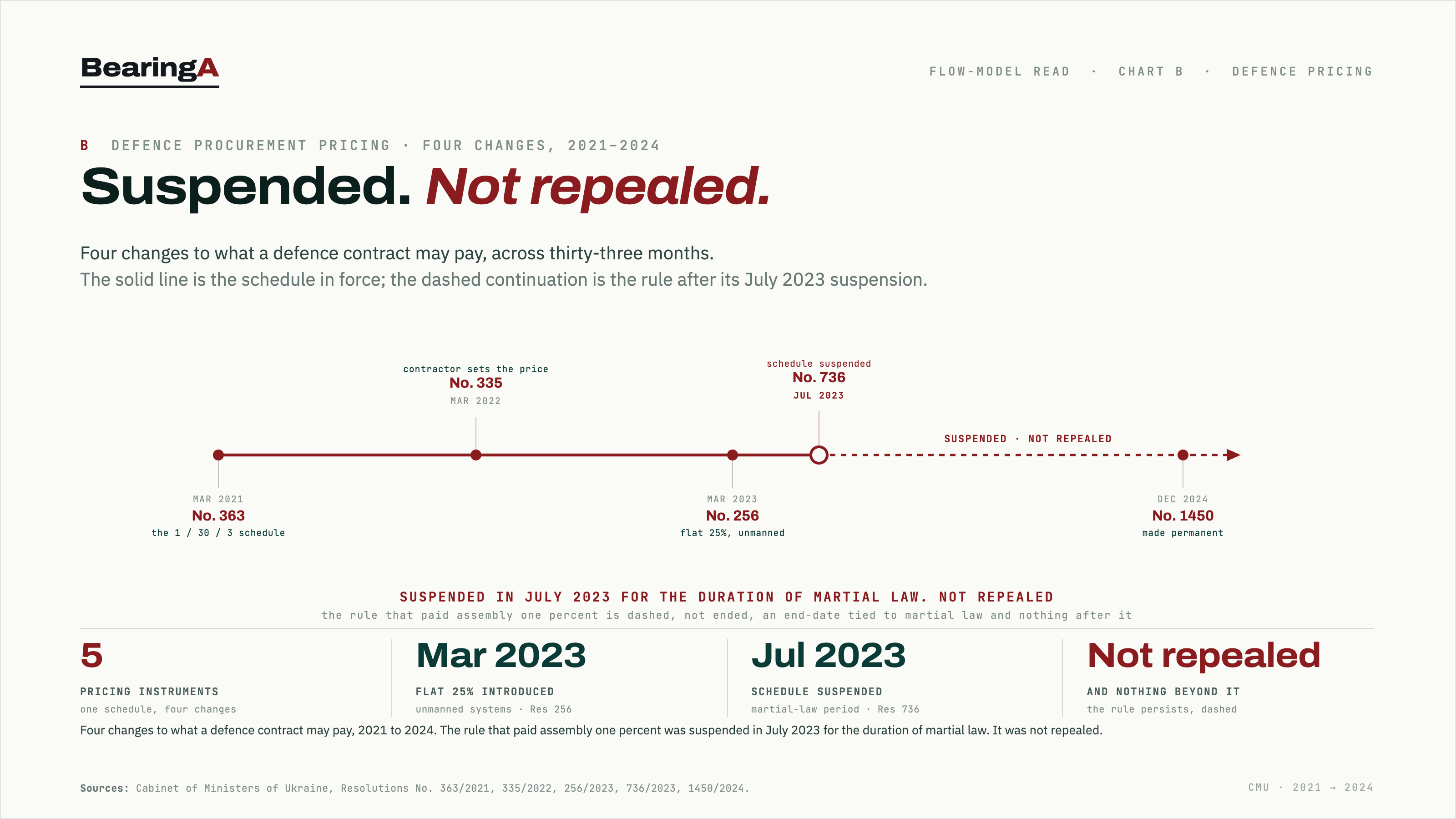
The decision still open is what happens when martial law ends. The schedule that paid one percent on bought-in content was not repealed in July 2023. Its first subparagraph was suspended for the duration of the martial-law regime, by name, in a single clause, while the subparagraph paying three percent on imports was left in force and still is. The suspended rule is unamended since March 2021 and carries no expiry of its own.
On the day martial law ends, it returns, unless something replaces it first. The flat twenty-five percent that made the entrant industry viable sits inside a temporary regime; the rule that made assembly unprofitable sits outside it, waiting.
04
Defence
CHARTS A, E, B AND THE CAPACITY GAP
A company can leave Kyiv with interested officers, a test request and a warm letter, and still have no order six months later.
The usual reading is that the technology was not quite good enough, or that the institution moved slowly, and sometimes both are true. Neither is what separated the Ukrainian drone industry of 2022 from the Ukrainian drone industry of 2024.
The question is not whether the technology was good enough. It is whether anything could be earned by making it.
What did not change
By the middle of 2022 Ukraine had seven manufacturers of unmanned systems, producing between three and five thousand units a year.
Everything usually credited with the later expansion was already there: the components were commercially available and could be ordered online, the demand was overwhelming, Army of Drones had launched in July, and the engineers were in the country, many of them already in uniform.
The workshops were possible. The workshops did not appear.
What did change
On 24 March 2023 the Cabinet approved an experimental project for procuring domestically produced unmanned systems, and four things moved at once. They are worth reading together, because what follows depends on the combination rather than on any one of them.
The profit ceiling was flattened. Contractor profit within the price was capped at twenty-five percent of production cost, a single rate applied to the whole cost base regardless of what it was made of.
Working capital arrived. Contracts could carry advance payment of up to seventy percent of value for up to twelve months, paid into Treasury accounts in the producer's own name and ring-fenced to the contract.
Six standing instruments were switched off for this class of purchase, among them the quality-control regime, the rules governing state-customer representative offices, and the procedure for forming expected cost under non-competitive procurement.
Certification moved to the manufacturer. Technical conditions are now written and approved by the producer and entered in the national register, requiring no sign-off from the Ministry of Defence or anyone else. The Ministry must codify within ten days and may not ask for documents beyond those listed.
Within two years there were roughly five hundred drone manufacturers where there had been seven, output passed four million units a year, and the domestic share of the Defence Procurement Agency's weapons contracting went from 46 percent to 82 percent inside twelve months.
The count is a stock, and stocks are slow; the flow is sharper and it is dated. New aerospace enterprise registrations ran at 41 in 2022. In 2023 they ran at 132, in 2024 at 183, with 107 in the first quarter of 2025 alone.
Registrations tripled in the year the pricing schedule was switched off, and they were not tripling before it.
CHART EAEROSPACE REGISTRATIONS · 41 → 132 THE YEAR THE RULE CHANGED
The objection, at its strongest
A reviewer's first move is to say none of this is routing. Drones proliferated because drones are cheap. The capital threshold for assembling a first-person-view aircraft from purchased components is a few hundred dollars and a bench, and when a technology becomes that accessible under that much demand, producers appear and the procurement rules follow the dispersion rather than causing it.
The objection fails on sequence, and the sequence is not close.
The technology was equally available in 2022, the components equally purchasable, the demand if anything more acute. Seven producers, three to five thousand units. Nothing technical changed in March 2023.
What the rule actually said
The rule that changed is easy to miss, because it does not look like an industrial policy. It looks like a line in a pricing annex.
From March 2021, a year before the invasion, profit inside a defence contract price was set at one percent of what a producer bought in, meaning components, semi-finished goods, special equipment and work subcontracted to other firms. Everything else in production cost carried thirty percent. A third rate paid three percent of contract value to an authorised intermediary importing finished goods.
Read it as a schedule of activities rather than as a cap on profiteering. Assembling in Ukraine from bought-in components earned an effective rate approaching one percent. Importing into Ukraine through an authorised entity earned three percent of contract value. Manufacturing in Ukraine with in-house capability earned up to thirty.
A first-person-view drone is, definitionally, an assembly of bought-in components, so its cost base sits almost entirely in the category the schedule paid one percent on. The same schedule paid thirty percent to a producer that machined, tooled and assembled in-house, which is what the inherited Soviet plants do by construction.
The rule did not cap margins. It priced business models, and it paid least for exactly the model the entrants had. Assembling in Ukraine paid less than importing into it.
Picture a workshop in Zakarpattia in the winter of 2022. Six people, a bench, a bill of materials that is ninety percent bought in. The army wants everything they can build. On that schedule, the price they are permitted to charge returns them about one percent of what the thing cost to make, and they have to finance the run before they see any of it. There is no version of that business that raises capital, hires, or builds a second line.
CHART ATHE PRICE RULE CHOSE A STRUCTURE · PARAGRAPH 49
March 2023 replaced the schedule, for unmanned systems, with the flat twenty-five percent. The assembler was permitted one percent, and now twenty-five. The integrated producer, thirty, and now twenty-five. That was not a general loosening. It was a transfer, and it ran from the incumbent to the entrant.
What this section cannot establish
Demand rose sharply over the same period for reasons that have nothing to do with pricing, an artillery shortage running through 2022 to 2024 and an enemy with numerical superiority. Demand and routing moved together and cannot be cleanly separated. The honest formulation is that demand created the pull and the schedule created the ability to answer it. No private industry scales on a margin approaching one percent however badly the army wants the product, so the pricing change was binding, but it was not sole.
Three further limits belong in the open rather than in a footnote.
Whether the schedule actually bound between 2021 and 2023 is not fully established. The Deputy Minister of Economy has said the profit norm could be applied by state customers in that period, and the modal verb is doing work. It suggests contested practice rather than settled application. If customers routinely disregarded the norm, the mechanism is weaker than we have stated it.
The schedule did not act alone. The advance payment, the six disapplications and manufacturer-led certification each removed a distinct barrier a workshop could not have crossed on margin alone. And beyond the instrument stack the war itself was doing its own work: military demand ran unprecedented against a shortage the state could not procure through, design cycles for unmanned systems compressed to weeks, the frontline pulled producers toward configurations faster than any procurement office could specify them, and in certain production segments the entry threshold was low enough that a bench with a soldering iron and a bill of materials constituted a factory. The schedule opened the door. It did not push anyone through it.
The ceiling is also not what any producer took home. Warranty and defect-remediation are covered from the profit component after the contract signs, so a formal margin of twenty-five percent absorbs its own claims before it reaches the balance sheet. Currency-hedging premia on imported components add another three percent or more, and a workshop-scale producer buying most of its bill of materials abroad wears most of that. The schedule's ceiling and the producer's take-home are different numbers, and this section does not have the second one.
What was not the capital story
Brave1 launched a month after the pricing change and is usually named as the state's instrument for the drone expansion. Its grants total roughly eight to ten million dollars across some four hundred awards.
Against an industry producing millions of units a year, that is not a capital programme.
The third thing usually named is Diia.City, and that one is real. It is a tax and legal regime for technology firms, and the design and production of unmanned aerial vehicles is on its list of qualifying activities by name, as is the production of technological products for defence use. A drone manufacturer that qualifies pays five percent personal income tax, can hire on a contract form available to nobody else, and gets convertible loans and liquidation preferences written into Ukrainian law so that a foreign venture investor recognises the paperwork. The state guarantees those terms for twenty-five years, and the register opened sixteen days before the invasion.
That is the same kind of instrument as the profit schedule, pointed the other way and built to last.
It is also not available to the workshop. Residency requires at least nine employees or gig specialists and an average monthly remuneration of at least twelve hundred euros, which is somewhere around fifty-five thousand hryvnia and well above what an assembly operation pays. A firm can enter as a startup with fewer people for two years, but the salary floor applies from the first month, and failing to reach nine by the end of the second year claws the tax back.
So the six people at the bench get the pricing derogation, and the company that has already grown to nine engineers on European salaries gets the twenty-five year regime. Nobody designed it that way. A threshold set for sensible reasons, to keep the regime for real technology firms rather than shells, sorts producers by an attribute that tracks size, which is what every other instrument in this piece also does. Brave1 does coordination, demand signalling and a marketplace, and it does them well. The money that built the industry came through contracts priced under a changed schedule, not through grants.
The distinction matters beyond bookkeeping. A grant programme is a subsidy layered on top of an existing routing structure, and the evidence on subsidies is discouraging where incumbents are entrenched. What happened here was the routing structure itself changing, which is why that objection does not reach this case. Ukraine did not subsidise entrants. It stopped paying them one percent.
What this leaves
Test one supports the claim, and more precisely than the parent piece could.
Routing determined structure. The instrument was a paragraph in a procurement schedule that nobody described as industrial policy, adopted before the war for reasons unrelated to it, and when it was switched off for one product class that class produced the only genuine industrial dispersion in this reconstruction.
The switch has not been thrown back, because it was never a switch. The paragraph paying one percent on bought-in content was not repealed in 2023. Its operative sentence was suspended for the duration of martial law, by name, in a single clause, while the sentence paying three percent on imports was left standing and stands today. The suspended rule is unamended since March 2021 and carries no expiry of its own.
CHART BTHE PRICING SEQUENCE · SUSPENDED, NOT REPEALED
One more thing about this case is worth stating, because it is why we can describe it at all.
Normally you cannot see this. A pricing schedule changes, and its effect arrives over a decade, mixed with a currency move, a trade agreement, a technology shift and three governments. By the time an industry has a different shape, the paragraph that started it is unrecoverable, and the story gets told as competitiveness or culture or entrepreneurship.
Here it took eighteen months and four documents. The schedule is dated, the replacement is dated, the registrations are counted by year, and the interval between them is short enough that nothing else plausible fits in it. That is not because Ukraine is unusual. It is because the clock ran fast enough to leave a trace.
The contrast is inside this piece. Ukrainian manufacturing state enterprises gained market share for two decades while their productivity fell relative to the firms losing it, and two decades is long enough for the explanation to become anything you like: management, culture, legacy, the war. The same mechanism was running there. Only one of the two ran fast enough to be seen.
One limit belongs here rather than in a note, because this section is where a reader is most likely to overrate what routing does.
Ukraine can now build about fifty-five billion dollars of defence equipment a year and can pay for roughly ten. That gap was fourteen billion in early 2024 and is forty-five now, thirty-five of it in long and medium-range strike, and it widened over exactly the years the routing was working. Routing determines who receives the money. It does not determine how much money there is. No paragraph in a procurement schedule reaches a shortfall set by parliaments in other countries.
CHART · CAPACITY GAP~$55BN BUILT AGAINST ~$10BN FUNDED · ROUTING CANNOT REACH THIS
So the decision still open is not about procurement volumes and will not be taken at a summit. It is whether one subparagraph is repealed or replaced before martial law ends, and if it is not, the schedule returns to an industry that exists because it was switched off.
The subparagraph is four lines long. The window for converting it into whatever replaces it is the same window in which everyone capable of doing so is fully occupied with the war it was written for.
05
The domestic circuit
CHART F
The largest sums in this reconstruction arrive with their routing already fixed. The conditions, the eligibility rules, the ticket sizes and the channels were set in Brussels, Copenhagen and Washington, and they travel attached to the money.
But the instrument that reorganised the drone industry was written in Kyiv, and so was the schedule it replaced. This section is the rest of what Kyiv decided, and it is where the argument stops being about donors at all.
These are the least comfortable findings we have, and they are the reason this is not an argument about donors. A piece sharper on Brussels than on Kyiv would be advocacy, and the first reader who checked would say so.
Ukraine observes the rooms where its routing is set
Two observer seats, and together they are structural rather than incidental.
At the Economic and Financial Dialogue in May 2026, Albania, Bosnia and Herzegovina, Kosovo, Moldova, Montenegro, North Macedonia, Serbia and Türkiye each received jointly agreed, numbered policy guidance on the basis of their economic reform programmes. Ukraine participated as an observer and received none, the stated reason being that the Facility is monitored separately, avoiding duplication and reducing administrative burden in extraordinary circumstances.
On the Ukraine Investment Framework Steering Board, which approves the programmes through which its own reconstruction investment is allocated, the members are the Commission and every EU Member State. The Government of Ukraine participates as an observer, alongside the European Parliament, the Verkhovna Rada and Norway.
The two instruments differ in kind. Dialogue guidance is peer-reviewed, framed around ownership, and not linked to payment. Facility indicators are tied to disbursement. Ukraine's economic-policy relationship with the EU runs entirely through the payment-conditional channel, where its peers' runs through the deliberative one.
What that guidance covers is worth naming, because it establishes that the Plan's demands are ordinary. State-enterprise loans and guarantees, contingent liabilities, oversight of publicly owned enterprises, state aid transparency, and measures that distort market pricing and credit allocation appear in the guidance for nearly every partner in the room. The unfulfilled Ukrainian cluster is not an unusual demand set. It is the standard one, in a country that does not sit at the table where it is agreed.
Three settings, dated within the year
Three further elements were set in Kyiv within the last year. The Defence Procurement Agency and the State Logistics Operator are being merged into a single Unified Acquisition Agency, reversing NATO guidance from 2025 and following corruption investigations, two procurement channels becoming one, reported rather than documented in a published decision. The Ukraine–EU bilateral agreement of 29 October 2025 runs indefinitely, abolishing tariffs and expanding quotas on most agricultural goods, a more permanent frame than the autonomous measures it replaced. And the National Bank eased the foreign-exchange regime across three rounds through 2026, with the January and April resolutions relaxing settlement-deadline requirements on export transactions.
The finding that has to be explained
Ukrainian manufacturing state enterprises gained market share for two decades while their productivity fell relative to the firms losing it. That comes from firm-level data running 2002 to 2024, and the same work measures entrenchment at a level where a product line is captured roughly every ten months.
A market does not do that on its own. Share moving toward the less productive is the signature of something other than competition allocating it.
The obvious reading is entrenchment operating independently of routing, and it has force, because the firm-level evidence carries no channel data. It establishes that share moved and that productivity did not justify the move. It never traces where the money went.
December 2024 traces one case. Ukrzaliznytsia asked its creditors to renegotiate two Eurobond series, $594.9 million at 8.25 percent and $300 million at 7.875 percent, deferring interest through 2025 and 2026 and undertaking not to repay debts above twenty million dollars to other creditors. In the same month it received a record €480 million from the EBRD, under state guarantees, for electric locomotives and generators.
An enterprise the commercial market was actively repricing received new development-bank lending in the same weeks, on a sovereign guarantee. That is not entrenchment. It is capital redirected by an instrument.
THE SECOND LIMIT · OF THREE
Routing determines who produces. It does not determine whether the economy grows.
A correctly routed industrial base inside a low-growth entrenched economy is still a low-growth entrenched economy.
Two functions, one set of balance sheets
The Affordable Loans 5-7-9 programme is Ukraine's own. Launched February 2020, it runs through 48 authorised banks and has issued 157,600 loans worth UAH 566.6 billion. Same subsidy, same rules, same forty-eight banks for every borrower.
It also does not reach most people, and it sits in an economy where the state is a bigger lender than the banks. Asked which financial services they had used in the previous twelve months, businesses named payments first at 50 percent, then state programmes at 23.8 percent, ahead of commercial bank lending at 18.3. In most economies that ordering runs the other way. 18.7 percent had used 5-7-9, the most widely used state instrument in the country, which still leaves four businesses in five outside it.
Among those it reaches, the outcome splits by lender. State-sector banks made 66.1 percent of the loans by count and 45.6 percent by value. The state banks carry the borrowers. The private banks carry the money. That is an average ticket of UAH 3.13 million against UAH 7.29 million, a ratio of 2.33 holding across four snapshots this year.
It is also not, by itself, evidence of anything. Lending scale differs by bank type in systems with no routing question at all. Deposit base, branch network and business model produce ticket differentials on their own, and Ukraine's state banks have branch reach the private banks lack. A farmer in a small town has one bank in walking distance rather than four. The gap may follow from that alone.
No breakdown of 5-7-9 disbursement by borrower size is published. The weekly releases give loan count and value by lender type and by military-risk zone, and nothing on the scale of the enterprises receiving the money. So the ticket differential is a proxy for scale-selection rather than a measurement of it, and we present it as one. The series that would settle it is one additional column in a release the Cabinet already publishes weekly.
What survives the comparison is sharper than what it removed. In Germany the small-ticket local lenders are not the institutions holding the sovereign's debt. Two functions, two sets of balance sheets, in a system with a three-pillar structure written into law.
In Ukraine they are the same institutions. State banks carry the entrant-credit load and hold roughly three-quarters of domestic government debt securities, in a sector where those run at about 25 percent of bank assets against a European median of 17. Counting subsidised loans and the eOselia mortgage architecture, 33 percent of Ukrainian bank assets depend on public finances.
And the banks carrying both functions run the thinnest capital in the system. At the end of March the sector held regulatory capital adequacy of 15.8 percent against a ten percent minimum, but state-owned banks sat at about fourteen percent and foreign-owned banks at about twenty-two and a half. The institutions doing two jobs have the smallest cushion for either.
Germany separates the two functions; Ukraine concentrates them, and that is a routing decision. The same balance sheets fund the state and fund the entrants, so sovereign stress and entrant credit are one exposure rather than two. The National Bank names the consequence itself: state banks increasingly vulnerable to fiscal risks, with concentration to be reflected in higher capital requirements from 2027.
There is a fiscal turn of the same loop. The state taxes bank profit at fifty percent, and the banks paying it are the ones holding its debt: sector net profit fell from UAH 65.5bn to 45.0bn over five months while pre-tax profit rose, the difference being tax alone. The National Bank states the consequence itself, that the fiscal burden reduces banks' capacity to accumulate capital and that at current profitability the sector cannot expand assets by more than fifteen to twenty percent a year. That is a stated ceiling on the channel the entrants borrow through.
And 5-7-9 is subsidised by construction, so the institutions carrying the small-ticket load have their margins compressed by design. The same pressure that weakens resilience elsewhere, applied to banks with no separation of function to fall back on.
Routing that costs nothing until it fails
A state guarantee directs capital to a named enterprise and does not appear in the budget. The Budget Code is explicit: before the guarantee case arises, transactions related to state-guaranteed debt do not affect the state budget. It is the cheapest routing instrument a state has, because the fiscal cost lands only if the borrower fails.
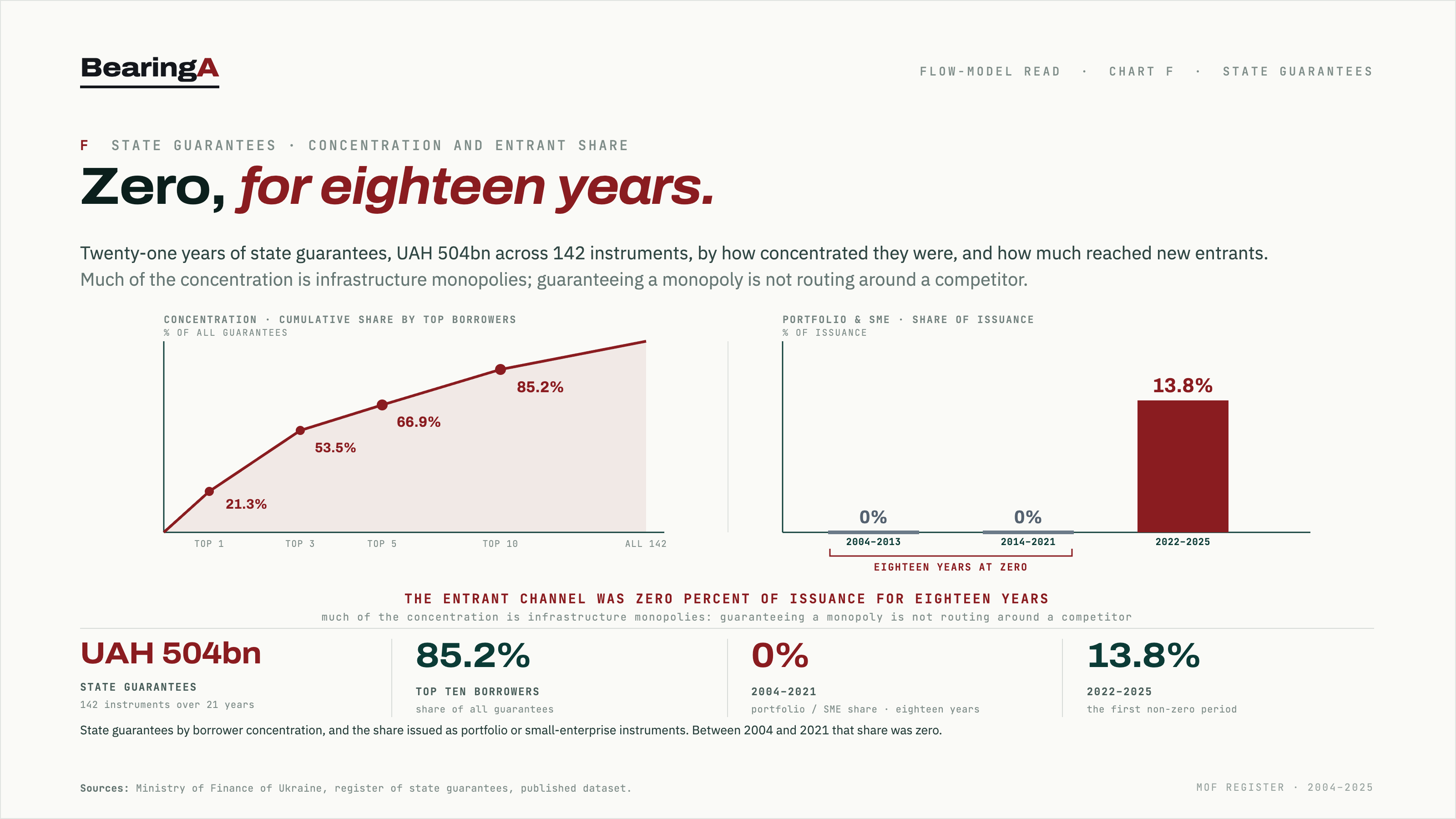
The register runs to twenty-one years, 142 guarantees, UAH 504.0 billion, and the distribution is not close. One borrower holds 21.3 percent of all guaranteed value. The top three hold 53.5 percent, the top ten hold 85.2. Named entities took UAH 483.0 billion across 136 guarantees, 95.8 percent of everything issued. Portfolio and small-enterprise guarantees took UAH 21.1 billion across six.
For eighteen years the entrant channel did not exist as a category. Zero percent of issuance went to portfolio or SME instruments between 2004 and 2013, and zero again between 2014 and 2021. A manufacturer with forty employees and a viable order book could not have applied, because there was nothing to apply to. The share reached 13.8 percent only in 2022 to 2025.
CHART FGUARANTEE CONCENTRATION · ZERO FOR EIGHTEEN YEARS
Two constraints belong on that finding and we carry them here rather than in a note. Concentration is partly structural: the largest borrowers are infrastructure monopolies, the gas incumbent, the railway, the grid operators, and guaranteeing a monopoly is not routing around a competitor. And the register records issuance, not outcome; what the guaranteed capital built is not in it.
What the constraints do not soften is the shape. Manufacturing is nearly absent from twenty-one years of the instrument. No manufacturing enterprise appears in the top ten; the closest is a defence industrial enterprise at 2.4 percent across two guarantees.
What held the estate up instead
If guarantees did not sustain manufacturing state-enterprise share, something else did, and it was diagnosed before the war rather than during it.
An IMF mission worked in Kyiv in early 2015 and reported in March. It found budget subsidies to state enterprises at about 2.5 percent of GDP and indirect subsidies, outside the budget entirely, as high as 6 percent. It found the cross-subsidy quantified inside the tariffs: rail cargo charged above cost to carry passenger services at 40 to 70 percent, costing around UAH 8 billion; industrial electricity users charged above marginal cost to subsidise households; gas priced about 80 percent below cost recovery.
And it found the sector doing, in the report's own words, the social work of employer of last resort. Over a million people, more than 2 percent of GDP in wages, with the railway alone carrying an excess workforce near 100,000, a third of its staff. Those hundred thousand jobs are the reason nobody wants to touch it, and saying so is not a criticism of anyone who has declined to.
That is routing inside the firm and inside the price. It appears in no debt register, which is why an instrument-based test could not find it. A guarantee is visible, dated and attributable to a Cabinet decision. A tariff that charges one shipper above cost so another pays less is the same act of direction with nothing to point at, and the shipper paying it has no way of knowing how much.
The 2015 figures are historical and the levels do not transfer. The structure does, and the same concentration shape recurs across eleven years and two unrelated instruments: in 2014 the top 50 state enterprises took more than 80 percent of sector revenue, and across 2004 to 2025 the top 10 guarantee borrowers take 85.2 percent of guaranteed value.
The date matters more than either number. The diagnosis is from March 2015, seven years before the war. Wartime exigency can explain the pace at which Ukraine has addressed this. It cannot explain the origin.
Nor has it closed. On 1 August 2026 the state indexed rail freight tariffs by thirty percent, and the agricultural council's response names the mechanism: cross-subsidisation remains in place, it functions as a tax, and farmers are not paying for services or their cost but for making it cheaper for someone else, while the grain tariff was, on the railway's own account, already profitable.
Whether manufacturing state-enterprise market share tracks state credit allocation in aggregate has not been established. The mechanism is documented in cases; the sector-wide series is not published. The instrument that would make it visible exists on paper, step 6.8 of the Ukraine Plan requires an independent audit of cross-subsidisation across key state enterprises, and it is blocked, because step 6.7, the legislation separating public-service from non-public-service activity that the audit depends on, has not entered into force.
The discipline is switched off
State aid control is the instrument by which a state constrains its own discretion to direct support toward chosen undertakings. It is the mechanism that would discipline everything described above.
In Ukraine it is suspended. The Ukraine Plan's own word for the required remedy is unsuspension, step 6.9, in the chapter on Management of Public Assets, requiring the full unsuspension of state aid control by the Antimonopoly Committee, due Q4 2025, responsible ministry Economy, Environment and Agriculture. Two carve-outs are written into the step itself, both for the duration of martial law: recapitalisation of systemically important banks holding state-secrecy clearance for defence-industry financing, and aid schemes for small and medium enterprises.
As at July 2026 the step is unfulfilled and the bill that would have delivered it, No. 14345, was withdrawn.
It does not stand alone. The unfulfilled backlog attached to EU money clusters on precisely the instruments that govern routing, the public-service separation that would make state-enterprise subsidy visible, majority-independent supervisory boards, simplified insolvency for micro and small enterprises, non-performing loan resolution, electricity and gas market liberalisation, regulator independence. Nineteen indicators unfulfilled by the July 2026 assessment, with roughly €7.35 billion contingent on them. The instruments that have not been delivered are the ones that would open entrant channels or discipline incumbent routing.
That characterisation is a monitoring consortium's, and the consortium advocates for reform delivery; the €7.35 billion is its aggregation of amounts associated with unfulfilled indicators, not a Commission determination that the money is forfeit. The step text, the deadline, the responsible ministry and the word unsuspension are from the Plan itself.
And it is stated as policy
The clearest instance is not inferred from an outcome. It was said by the minister responsible.
Oleksandr Kravchenko was appointed Minister of Economy and Environment on 16 July 2026, having previously been Managing Partner of McKinsey Ukraine. In an interview recorded that April and published on 29 July, describing how investment should be attracted:
"We need to literally drag some anchor large investors in by the hand."
The reasoning he gives is that anchor entry creates the conditions under which other businesses expand, and he argues openly for a degree of industrial policy rather than pure market allocation, on the grounds that concessional capital is limited. He names the priority sectors: energy, critical and strategic materials including uranium and rare earths, niche machine-building, and the wartime defence industry, selected for export orientation, international offtake, and willingness to sign long-term contracts. Agriculture, the country's largest export earner, is not among them.
This is testimony rather than measurement, recorded before his appointment, and we cite it as the minister's stated position and nothing more. As a statement of position it is the second half of our claim, said aloud by the person who would have to act on it. Where Ukraine chooses the routing, the stated strategy is to route to scale, not as a drift, not as an artefact of instrument design, but as policy with a reason attached.
One coincidence is worth recording without a claim built on it. The ministry responsible for delivering step 6.9, the unsuspension of state aid control, is the ministry Kravchenko heads.
What this leaves
Four instruments, all domestic. A credit programme whose entrant load sits on the same balance sheets that hold three-quarters of the government's securities. A guarantee register that ran eighteen years without a single portfolio guarantee. A subsidy architecture operating inside tariffs where no register can see it, diagnosed in 2015 and unaudited in 2026. And the control mechanism that would discipline all three, suspended, with the bill to restore it withdrawn.
None of that was designed in Brussels. Some of it predates the current war by seven years and the guarantee pattern predates it by eighteen. The donor architecture shapes where most of the money goes and it does not explain any of this, so a piece that stopped at the conditionality would have missed the part Kyiv holds.
And every instrument here has someone on the wrong end of it. A manufacturer who cannot borrow because no portfolio guarantee exists. A shipper paying above cost so a passenger pays less. A small provider outside a package written for institutions. None of them has been refused, and none of them has been told anything at all.
One thing here has a date on it, and it is the only one that does. Step 6.9 came due in Q4 2025 and the bill is withdrawn, while all remaining Ukraine Plan reforms must complete by Q3 2027. Whether state aid control returns before then determines whether any of the routing described in this section becomes subject to a rule, or continues to be determined by instrument design, ticket size and administrative capacity, which is to say, by nobody's decision in particular.
06
Agriculture
CHART G
DISCLOSURE · MANDATORY
BearingA has done paid commercial work in Ukrainian agricultural corridor routing. Every figure in this section is derived from published sources a reader can check, exchange prints, the Commission's own crop bulletin, and the Ukrainian electronic grain exchange. No client document, no client figure and no client name enters this piece. The disclosure is here because the finding is stronger when the reader can weigh it, not because it needs excusing.
The test this section was supposed to run, and why it does not survive
The obvious agricultural case here is concentration. Ukrainian arable land is held by roughly 15,600 companies across 53.9 percent of it, with agroholdings at around 29 percent by 2020 against eight percent in 2007. A financing architecture that routes to scale, and a sector that consolidated. The argument writes itself.
It does not hold, and the reason is worth stating rather than working around.
Concentration in row-crop agriculture is a global secular trend that occurs wherever returns to scale exist, and it occurs in economies with no comparable financing architecture, no war, and no state-bank loop. One percent of the world's largest farms cover more than seventy percent of available farmland, sharply up on the previous decade. In the United States, farms of 2,000 acres and above went from fifteen percent of cropland in 1987 to forty-one percent in 2017, rising in every single census, with midsize holdings falling from fifty-seven percent to thirty-three, and consolidation recorded in sixty of sixty-two commodities over thirty-five years. The share of area in farms above 100 hectares rose in France, Germany and the United Kingdom across 2005 to 2013.
And on the measure that matters most, Ukraine is not the outlier. In Bulgaria, Czechia and Hungary the top ten percent of farms operate eighty percent of utilised agricultural area, more concentrated than Ukraine, in three countries with none of Ukraine's routing architecture.
A test whose result is the same under both hypotheses is not a test. That Ukrainian agriculture concentrates tells us nothing about whether routing caused it, so we do not run it.
What does discriminate: the same grain, the same week, two prices
Corn of identical specification carries two prices, and the gap has held through a collapsing market.
ROUTE
LATE JULY 2026
FIRST WEEK OF AUGUST
CPT Odesa, the port
$200/t
$195/t
FCA Chop, the western border
$228/t
$220/t
Premium to the land route
$28 · ~14%
$25 · ~12.8%
Nothing distinguishes the two lots except which way they travel. Same crop, same specification, same week, same index. Both legs fell; the premium held.
And the port price is not a price anyone is paying. The index author states that contracting toward seaports has practically ceased, so those levels are nominal and do not reflect a liquid market. A quotation nobody trades at is not an alternative a farmer has, which makes the realised gap wider than the printed one.
The differential is not a corn story. In the same week rapeseed printed $500 at the port against $545 at the border, and GMO soybeans $420 against $435. Three crops, three spreads, one direction.
And the better route is capacity-constrained. Land-corridor throughput runs at roughly one to 1.2 million tonnes a month against the five to six million the export programme needs to move, a constraint that has not changed while the port has closed around it.
CHART GCORRIDOR DIFFERENTIAL · THE SPREAD DOES NOT COVER IT · AS OF 14 AUG 2026
Why this discriminates where concentration did not
The comparator evidence that killed the concentration test does not touch this one, and that is the point of using it.
This is not scale. It is not returns to scale. It is not a global secular trend that would appear in Iowa or Hungary. It is access to a capacity-constrained route determining the price received for physically identical grain on the same day, and who reaches the border is determined by geography, by standing logistics contracts, and by the capacity to organise cross-border structures at all, which selects for operators able to arrange them.
The routing determines margin capture. That is our claim in physical form, measurable to the tonne, and the direction of the capture is the opposite of what the spread suggests.
The premium does not cover the cost of earning it
A twenty-five dollar spread reads like an opportunity. It is not one.
Agricultural associations put the cost of reorienting grain to the western direction at forty to sixty dollars a tonne. The border price is higher than the port price because the cost of reaching the border is higher still. A producer who moves west is not capturing a premium. They are reducing a loss, and only partly.
And on 1 August 2026 the state raised the price of that route. The Ministry for Restoration, Infrastructure and Transport implemented a thirty percent indexation of rail freight tariffs, with the cost of empty wagon mileage up sixty percent, which the railway states raises UAH 8.6 billion for it in 2026. Estimates of the direct effect on grain cluster between three and seven dollars a tonne depending on route length and volume.
Seaborne loadings had been near zero since 22 July. The indexation took effect ten days later.
The captive user pays more precisely because it is captive. The associations' appeal to government says exports through Constanta become unprofitable once indexation is applied on top of reorientation costs, and notes the decision was prepared against port attacks, restricted sea exports, rising input prices and falling farmgate prices.
And the farmers name the mechanism this read has been tracing
The Ukrainian Agri Council sets out the arithmetic without needing anyone's help. The domestic price is formed on export parity: logistics and the trader's margin are deducted from the export price, so a tariff rise lands on the producer. Their word for it is an additional tax.
Then they name why. Cross-subsidisation remains in place, and cross-subsidisation is a tax, farmers are not paying for services or their cost, but for making it cheaper for someone else, and by the railway's own account the grain tariff was already profitable.
That is §5's finding, spoken by the party paying it. The IMF diagnosed rail cargo charged above cost to subsidise passenger segments in March 2015, at rates of forty to seventy percent and a cost near UAH 8 billion. Eleven years later the instrument is intact, the incidence is unchanged, and the railway's funding gap is being met by indexing the tariff paid by a user with nowhere else to go.
Why the price fell when the route closed
A supply shock should raise a price. The farmgate price fell, and the reason is our own subject.
The port quotation is a netback: world price, less freight, less risk, less whatever an exporter needs to cover a route that may not exist next week. When the route fails the netback collapses at the same moment the world price rises on the same event. Ukrainian physical prices moved opposite to the exchange through late July, and the index author said why: contracting had practically ceased.
So the producer absorbs the entire routing failure. Not the buyer, who has other origins. Not the exporter, who stops quoting. The farmer, holding a physical crop and no route.
And the calendar decides which farmer. Grain contracted in May was harvested in July into a corridor that closed in between. A producer who sold forward holds a delivery obligation against a crop that cannot move. A producer who did not sell holds it into a market with a nominal bid and no liquidity. One event, two opposite problems, and which one a farm has was fixed by a decision taken in May about a route that closed in July.
The fallback was struck in the same campaign as the primary. July strikes hit Odesa and Chornomorsk and the Danube port of Izmail, damaging load-out facilities officials put at months to repair. By 22 July four of thirteen major terminals had halted and two of the world's largest container lines had suspended calls.
And the Danube is decayed capacity rather than spare. It moved as much as 29 million tonnes at its 2023 peak, fell to 8.9 million in 2025, and was projected near five for 2026, because while the sea corridor worked the river was uncompetitive. It now moves something near a hundred thousand tonnes a month, it is drought-constrained, and it is being attacked. Restarting it means reassembling barge fleets, river pilots and canal slots that took eighteen months to build the first time.
Every alternative combined, river, westward rail, road, is put by the Agriculture Ministry at approximately one million tonnes a month. The Deputy Economy Minister said so publicly on 18 June, three weeks before the campaign began.
Utilisation of the Partial Credit Guarantee Fund in agriculture since its launch in January 2024 has not been located in any public source. Low take-up would sharpen the finding below considerably; high take-up would qualify it. The instrument's design is documented and its use is not, and that is the single most consequential unpublished number in this section.
The instrument built to prevent concentration, and the route around it
There is a second and narrower diagnostic, and it has the same shape.
Ukraine opened its agricultural land market in July 2021 with ownership caps written specifically to prevent concentration. Since then only 0.7 percent of arable land has been sold, at prices near normative value. The instrument did what it was designed to do.
Meanwhile land rights are increasingly acquired not by buying plots but by acquiring corporate rights in the companies that hold them. Crop-farming mergers and acquisitions ran $167 million across eighteen deals in all of 2025, against more than $525 million across ten-plus deals in the first four months of 2026, with the landmark transaction being a $348 million acquisition by the sector's leading consolidator.
An anti-concentration instrument bypassed by a change of legal route is a routing finding, and the comparator countries do not have it, because they never attempted the intervention.
And the entrant channel is of a class the evidence says underperforms
§5 established that where incumbents are entrenched, subsidising entrants has limited aggregate effect, and named the instruments that fall into that class. They are all here.
The Partial Credit Guarantee Fund for farms below 500 hectares, crop receipts as a collateral instrument for agricultural small and medium enterprises, and grant programmes generally are entrant support layered on top of an existing routing structure. §2 gives the scale asymmetry between them and the direct lending available to a single large agribusiness.
So the agricultural entrant channel is both out-scaled and of a policy class the evidence predicts will underperform. That is a harder thing than we say about entrant instruments anywhere else, and we say it here because this is where the evidence for it sits.
Where the loss lands, and it is not where the instruments would suggest
Scale did not protect the largest operator. Kernel, the country's biggest grain exporter and a recipient of first-loss cover from the European investment framework §2 examines, lost roughly 45,000 tonnes of wheat and 9,000 tonnes of sunflower oil and suspended its Chornomorsk terminal operations. The entity every instrument in this piece selected for was stopped by the route.
But the loss still allocates by scale, through a different attribute. With the corridor closed and the harvest arriving, grain has to be held somewhere. Ukraine has roughly 74 million tonnes of storage against a harvest expected near 64 million and a carryover of 14.3, so approximately 78 million tonnes need storage before the corn harvest completes. The Ministry of Agrarian Policy calculates existing capacity could be full by early November.
Whoever holds elevator capacity waits. Whoever does not sells into a nominal bid, or does not sell. Kernel's elevator network took in 4.3 million tonnes last fiscal year, up sixty percent, driven partly by higher intake from third-party farmers, which is what a farm without storage does when it cannot reach a port.
There is a standard financial answer to that problem, which is to borrow against the invoice rather than the building. A survey of five hundred businesses found 1.2 percent using factoring, and export finance at 1.6. The instrument that would let a small producer bridge an unpredictable order book barely exists in Ukraine.
Nobody designed that. The instruments we have traced selected for scale over two decades through profit schedules, guarantee registers, ticket sizes and first-loss cover. A routing failure then allocated its losses by exactly the attribute those instruments had been selecting for.
And it does not stop at this harvest. The All-Ukrainian Agrarian Council states the consequence plainly: if terminals cannot recover quickly, exports collapse, storage overflows, and farmers are left without the working capital to finance the next planting season.
What this leaves
Test eight failed as framed and was rebuilt on something physical.
We lose a test and gain a smaller, sharper claim. Six clean tests plus one narrow diagnostic beats seven tests one of which does not discriminate, and it is the difference between something an agricultural economist nods at and something they take apart in the first paragraph.
What survives is measurable and dated: a premium of roughly twelve percent between two routes for the same grain, with about a fifth of national volume able to reach the better one, and a cost of reaching it that exceeds the premium.
In August the government announced an emergency support package for farmers against the blocking of export routes. We treat announced programmes as stated intent and never as routing until the mechanism is specified, the same discipline we apply to donor announcements, so what it does to who reaches the border is not yet knowable.
What is knowable is the shape of the season. The route that sets the price cannot carry the volume, reaching it costs more than the premium for being there, the state has just made it thirty percent dearer, and storage fills in November. A farm with an elevator waits. A farm without one sells into a bid the desks have stopped writing contracts against, and finances next spring out of whatever it gets.
07
Where the routing was right and the outcome was not
Twice in this reconstruction the money's route into a sector was changed correctly, and the sector did not follow.
Both are worth more than the successes, because a state can get the architecture right and still not get the result, and anyone building a reconstruction instrument should want to know why before they want to know what worked. The two failed differently, and the difference is the point.
Healthcare, the route opened, then narrowed by administration
The 2018 reform did the thing the read spends its time asking for. A single national purchaser was established to contract providers regardless of form of ownership, paying providers rather than premises. By 2023 private health service providers had grown forty-three percent since 2020 and accounted for eighty-four percent of all licensed providers.
Then it narrowed, and the shape of the narrowing is the finding.
Primary care held. Contracted private clinics went from 226 in 2021 to 476 in 2026; individual entrepreneurs from 594 to 950. Flattened, not collapsed.
Specialised care is where it closed, and it closed selectively:
SPECIALISED CARE
2025
2026
CHANGE
Private institutions
264
221
−16%
Individual entrepreneurs
85
16
−81%
The smallest participants were cut five times harder than institutions. And it was administered rather than competed: the association of private medical institutions describes a targeted policy of selective contracting rather than a market process, with refusals concentrated on packages where restrictions on private participation were introduced. Package-level restriction on private participation is not a quality mechanism. A quality mechanism excludes poor performers regardless of size.
The mechanism underneath is not capture, and that is why it belongs here. The purchaser's administrative budget for 2024 was 0.11 percent of the funds it manages, far below comparable middle-income countries operating a purchaser-provider split. A purchaser resourced at 0.11 percent cannot administer a thousand small contracts well. Contracting fewer and larger providers is the rational response to its own capacity constraint.
Nobody has to intend scale-selection for scale-selection to happen. That is the third time we have found the same gradient in a different institution, and none of the three chose it.
Why specialised care and not primary is legible in the packages themselves. One 2026 package is written for three named communal institutions, identified by registration code. Ukraine's specialised-care taxonomy is Semashko-inherited, oblast hospitals, specialised dispensaries, children's homes, each defined by structural specification: department composition, bed capacity, on-site subspecialties, licence class. A package written in that vocabulary excludes a sole practitioner by construction rather than by intent. The requirement is not who may bid. It is what you must already be.
Test four cuts against us. The routing was correct, the channel opened, and it narrowed anyway, because administrative capacity is a routing instrument nobody designed as one.
Housing, the routing was right and it hit a wall
This is the strongest case against our argument, and it should be read as such.
The architecture was correct. Certificates and the eOselia mortgage programme pay households directly, skipping the contracting layer entirely, the same move as a purchaser paying providers rather than buildings, and as generation entering a grid below transmission level. eOselia is hryvnia-only, and the local-currency share of mortgage lending rose to 92 percent by January 2026, from 61 percent in January 2022 and 45 percent in January 2021. From January 2026 mobilised servicemembers borrow at three percent. The construction market grew 24 percent in 2025, to roughly UAH 248 billion.
Money reached households. The channel functioned exactly as designed.
And physical output fell. Housing commissioned went from 9.7 million square metres in 2024 to about 9.5 million in 2025. Total construction in March 2026 ran 9.4 percent below March 2025; residential construction ran 16.2 percent below. The value of work completed rose ten percent. Construction became more expensive without becoming more productive.
The binding constraint is not materials. The Kovalska group states that production capacity sometimes exceeds effective demand and the market is broadly balanced. It is labour. The Confederation of Builders and the EU delegation reported in August 2026 that only around half the required number of skilled workers is available, against a Ministry of Economy forecast requiring construction employment to rise from about 520,000 today to 1.2 million by 2036. Vocational schools report too few entrants and high first-year dropout.
Against demand that dwarfs the programme: more than three million households affected by housing destruction, and 4.5 million internally displaced.
And construction is not unusual in this. A survey of five hundred businesses across every oblast in early 2025 found average staffing at 69.8 percent of requirement, headcount down 4.6 percent over the year, and 59.9 percent naming production and trades workers as their deepest shortage, ahead of engineers and managers. Two in three said a vacancy takes longer to fill than it did a year earlier. The builders are not describing a construction problem. They are describing the labour market, and they happen to be the sector where it stops the output.
THE THIRD LIMIT · OF THREE
Routing determines who can pay. It does not determine whether there is anything to buy.
A demand-side instrument meeting a supply constraint produces price, not units, which is our third stated limit, established here rather than asserted.
What this leaves
Neither of these is a routing failure.
Healthcare is a correct route narrowed by an administrative constraint that nobody designed as an allocation rule. A purchaser resourced at 0.11 percent of the funds it manages cannot administer a thousand small contracts, so it contracts fewer and larger ones. Nobody wrote a rule excluding sole practitioners; an administrative budget did it.
And the route is narrower than a programme name suggests. The mortgage portfolio grew about thirty-five percent over the year, three times the rate of the whole loan book, and more than ninety percent of new mortgage loans are issued inside eOselia. Around forty-two thousand families hold a mortgage, which is roughly four households in every thousand. The banking sector's own review puts the position plainly: housing finance availability is effectively determined by the parameters of the state programme, and it calls that dependence a structural risk.
A correct routing architecture, sole-sourced.
Housing is a correct route meeting a physical limit that no allocation rule could have moved. Certificates reached households, the market grew twenty-four percent, and residential output fell sixteen because there are not enough people who can build.
That is the honest reading and it is the harder one, because it means the architecture is necessary and not sufficient, and we have spent four sections arguing that the architecture is what matters.
It also sets the limit that the rest of this piece has to respect. Routing determines who can pay. It does not determine whether there is anything to buy.
And it leaves a question the next section answers from the other side. These are the sectors where the route moved and the structure did not. The estate is where the route moved around a set of enterprises entirely, and they grew anyway.
08
The estate
About sixty-seven thousand people work for the enterprises the money went around.
That is the part the bypass story leaves out. Between 2022 and 2025 the capital that built Ukraine's drone industry did not pass through the state defence estate, and the standard telling ends there, an industry built beside the incumbents, procurement following it there, nothing reformed. That is accurate. It is also the beginning of a different question, which is what happens to the enterprises that were routed around, and to the people inside them.
The reconstruction read closed on that question and declined to answer it. This section answers it, and the answer is not what the framing implied.
The estate grew
JSC Ukrainian Defense Industry, the holding created in June 2023 when the Ukroboronprom concern was terminated, is wholly state-owned and runs about a hundred enterprises. Its production rose roughly one and a half times in 2025, from something near UAH 122 billion to over UAH 180 billion.
That figure is the government's, and the government attributes the rise to expanded capacity and a more than fifty percent increase in state contracts. An interested party describing its own performance. But SIPRI, working from its own methodology, put the holding's arms revenue up sixty-nine percent to around $2.2 billion and named it the largest arms producer headquartered in Ukraine. Two sources, one interested and one not, pointing the same direction.
So the incumbent did not decay while the entrants grew. Both grew, in the same years, out of the same procurement budget.
Because a drone is a bench and a howitzer is not
A drone is a workshop. Bought-in components, a bench, people who iterate fast. That production can start in a rented unit in Zakarpattia and reach volume inside a year, which is why it did.
Armour is not a workshop. Neither is ammunition, missile assembly, or aircraft repair. Heavy tooling, certified processes, test ranges, a workforce trained on specific equipment over years. For those things there was no entrant to route to. The state could fund the enterprises that hold the plant, or not have the capability.
The estate grew precisely where the bypass was unavailable. The variable that explains dispersion in drones explains concentration in armour. It is one reading, not two.
And mobility only says where a bypass was possible, not whether one happened. Both conditions held in 2022 and nothing dispersed for a year, because the pricing schedule paid an assembler close to nothing. Where the good could be made on a bench and the schedule paid for making it, the money found benches. Where it could not, the money went where it had always gone. No schedule was going to change that.
What is happening to the estate is not privatisation
It is lease.
In May 2026 the Cabinet simplified the transfer of state property for lease without auction to defence-industry enterprises, for the duration of martial law, covering makers of missile weapons, explosives and new armaments. A concessional programme runs alongside it, holding a defence company's effective annual leasing cost at five percent with the state covering the difference.
Eligibility turns on two things. The enterprise must be classified as critically important, and it must appear in the Ministry of Defence register of state defence contract executors.
So state industrial plant is moving to private operators, at subsidised cost, without competitive auction, gated on a list. A director whose company is on that list can obtain a workshop, a test bay, a machine hall. A director whose company is not cannot, and will not be told why.
The register is not published. Neither are the criteria for entry, nor the process by which an enterprise is classified as critically important. The mechanism is public. The gate is not. Everything else in this section can be checked from outside; this cannot.
Corporatisation is the estate's own version of the same move
Converting a state enterprise into a joint-stock company moves nothing. No plant relocates, no machine is bought. What changes is the legal route into the asset, which creates an entity someone can hold a share of.
Thirty-eight enterprises have been through that conversion. One consequence is already operating: Rheinmetall Ukrainian Defense Industry LLC has run since October 2023, fifty-one percent held by Rheinmetall Landsysteme.
It is the same move traced in three other places in this piece, in a different medium each time. Distributed generation changes where power enters a grid whose wires cannot move. A single purchaser paying providers rather than buildings changes where health money enters an estate that cannot move. Corporatisation changes where capital enters an enterprise that cannot move. The asset stays exactly where it is; the way in is new.
The number everybody quotes is the wrong number
The estate is usually described as about a hundred enterprises, down from the 134 the 2014 conglomerate held. The count is published and it is not the question.
The question is what those enterprises are. How many are producing. How many are cold. How many are held against a strategic requirement nobody has exercised in a decade and may never exercise again.
An estate carried because it is needed and an estate carried because nobody has decided otherwise look identical in a count, and they call for opposite decisions. One is a capability to be resourced. The other is an inheritance to be resolved. Every judgement downstream depends on which it is, and on which enterprise: lease, consolidation, disposal, closure.
The count is published; the composition is not. Operating, mothballed and strategic-reserve enterprises are not distinguished in any public source we have found. We do not think this is concealment. A wartime ministry has reasons not to publish a plant-by-plant readiness map, and we would not expect it to.
The consolidation nobody is measuring
Two things are visible from outside, and they may or may not be one thing.
Serial manufacturers now hold contracts large enough that buying a smaller producer is the obvious next move. And producers name unpredictable contracting, not capital, as the constraint that binds them.
The mechanism, if it is running, is ordinary. A firm that cannot see its order book past the current tranche does not build a factory. It builds what it can sell this quarter. When the orders do not come it sells itself to someone larger who can wait. That is how a dispersed industry concentrates without anyone deciding to concentrate it.
There is a standard financial answer to that problem, which is to borrow against the invoice rather than against the building. A survey of five hundred businesses in early 2025 found 1.2 percent of them using factoring. Export finance ran at 1.6. The instrument that would let a small producer bridge an unpredictable order book barely exists in Ukraine, which does not cause the consolidation but does remove the obvious thing that would slow it.
There was a third signal in this section and it is not here now. We had a competition authority declining a defence-sector transaction this year, which would have been the visible confirmation that consolidation pressure had reached the point of an actual deal. It traced to a briefing note citing press reporting, not to a source we hold. Reporting it anyway would have made this passage look stronger and be weaker, so it is out, and the section is thinner for it. Whether the two remaining signals are a pattern turns on transactions below the competition authority's notification threshold, which no public record carries.
The ground is moving underneath the question in any case. Ukraine now builds roughly five times more defence equipment than it can fund, some categories running up to fifty percent beyond what the country can use or finance, and controlled exports of surplus are to be permitted with revenue returned to production. That opens a channel which sorts producers into those with export access and those without, and reaching it turns on export licensing, on end-user requirements set by partner states, on certification against foreign standards, and on having the capital to wait longer for payment. None of that is evenly distributed across a producer base that reached its present size in three years. A firm founded in 2023 with six people and one product has none of it, and the holding, already the largest single producer and already inside a joint venture with a European prime, starts that sort from a different position than a drone firm in its third year.
Four large privatisation and sanctioned-asset auctions are scheduled for October. The practitioner literature describes privatisation in Ukraine as a feeder for subsequent mergers, acquired assets becoming platforms for consolidation. Ukraine runs no separate foreign-investment or national-security screen; a foreign acquisition is assessed through merger control alone.
What this leaves
The estate is not a residue. It is a growing producer of the things that cannot be made on a bench, holding property that is moving to private operators without auction against a list nobody outside can read, inside a holding converting its enterprises into vehicles a foreign partner can take equity in, in a sector where consolidation pressure is building and an export channel is about to open.
None of that is a scandal and none of it is a plan. Every step of it was taken by someone doing their job, a Cabinet simplifying leasing for a war economy, a ministry keeping a register of who may hold defence contracts, a holding company corporatising to attract a partner with capital and technology. What is missing is anyone whose job is the shape all of it makes together.
This read stops here, and the stopping is not modesty. What happens next to the enterprises the money went around, which are resourced, which are converted, which are quietly let go, is not inferable from public sources, and we are not going to pretend we can see it.
The decision still open is who is on the register, and on what basis. It is being made now, enterprise by enterprise, and the people it decides for will find out by whether the lease comes through.
09
The window, and whose job it is
We came looking for what happened to the enterprises the money went around.
What we found instead was that the money went around them on a legal basis that expires, and that nobody has scheduled the conversation about what happens when it does. This section is what we make of that, and it is less settled than the sections before it, deliberately.
What the two readings add up to
The first piece established that where reconstruction money reached new producers it went around an incumbent, four times out of four, and read that as a window opened by a war that occupied the forces which normally preserve incumbents.
This piece found something narrower and more useful. The window was not held open by distraction. It was held open by instruments,
and we can name them: a profit schedule that stopped paying one percent on bought-in content, an advance payment that gave a workshop capital it had no balance sheet to raise, six procedural regimes switched off, certification handed to the manufacturer, a customs schedule that let the equipment in.
Each is a document. Each has a date. Most have an expiry.
One does not, and it is the exception that tells you what the others are missing.
Diia.City is a tax and legal regime for technology firms, built as a virtual jurisdiction rather than a programme. Five percent personal income tax, a hiring contract available to nobody else, and convertible loans and liquidation preferences written into Ukrainian law so a foreign venture investor recognises the paperwork. Entry is an online application, no licence, ten working days. And the state guarantees the terms for twenty-five years. The register opened sixteen days before the invasion.
The design and production of unmanned aerial vehicles is on its list of qualifying activities, as is the production of technological products for defence use. But residency also requires nine employees and an average monthly wage of twelve hundred euros. The permanent instrument has a scale floor and the temporary one does not. A suspension applies to everyone in its class; a regime applies to whoever qualifies.
Meanwhile the profit schedule that made assembly unprofitable was never repealed. Its operative sentence was suspended for the duration of martial law and sits unamended since March 2021. The flat rate that replaced it lives inside the martial-law regime. The customs exemption ran to an expiry and was extended only because an association spent eight months arguing.
The distinction running through this piece is not between what worked and what did not. It is between what was designed and what emerged.
Which changes the question. It is not that Ukraine cannot build durable instruments. It built one, deliberately, before the war, with a stability guarantee written into it. The designed instrument was made permanent, for the firms that could meet its conditions. The emergent ones were left as suspensions, and a suspension has no conditions at all, which is the only sense in which it is the more generous of the two.
Which is not the criticism it sounds like
We want to be careful here, because the obvious reading of that paragraph is that Ukraine did something shallow, and we do not think it did.
Suspending a rule is what you do when you need production next quarter and cannot spend two years on a legislative fight. Every one of those instruments was the right call at the time it was made, taken by someone with a war to supply and no room to be elegant about it. The dispersion is real. Five hundred producers exist who did not exist in 2022, and they exist because a state made a series of fast, correct, temporary decisions.
The problem is not that the decisions were temporary. It is that temporary was never converted into settled, and the conversion window is the same period in which everyone capable of doing it is fully occupied.
That is the honest shape of it. Not failure, not capture, not a plan gone wrong. A set of emergency measures that worked so well they stopped looking like emergency measures.
What we think happens next, and why we could be wrong about it
The intuitive expectation is reversion. Martial law ends, the suspensions lapse, the 2021 schedule returns, and the assembler goes back to earning one percent on bought-in content.
We do not think that happens, and the reason is that it has never happened anywhere. Across seven modern crisis transitions in a hundred and ten years, no configuration has returned to its pre-shock baseline. Regimes do not revert. They crystallise into something new over five to ten years, and the new thing is not specified in advance by anyone.
Which means the real question is not whether the old rule comes back. It is what gets written in its place, and that is being decided now, by default, in the absence of anyone whose job it is.
Our reading could be wrong in a specific way worth naming. If someone in Kyiv is already holding this list, has the expiry dates mapped, and is sequencing the conversions, then we are describing a problem that is already owned and we simply cannot see the work from outside. That is entirely possible. It is also the kind of thing that would normally leave a trace in a published strategy or a legislative programme, and we have not found one.
The government's Programme of Activities for 2026 and 2027, submitted to parliament on 18 August, is a legislative programme of exactly that kind, and the trace is not in it. Its nearest approach to the conversion is a goal to adapt defence industry to the conditions of martial law by 2027, named at programme altitude with none of the instruments that would do it. That does not prove the work is being done nowhere unpublished, and we still cannot see inside a ministry from outside, but the flagship statement of what the government intends over the conversion window does not mention the conversion.
Three things this could mean, and we are not sure which
We have a view about what is happening. We are much less sure what follows from it, and the honest thing is to lay out what it could mean rather than pretend the reading resolves into a recommendation.
It could mean the dispersion is more fragile than anyone is treating it as. Five hundred producers exist because four instruments moved in the same direction. Instruments that moved once can move back, and the one that would move it back is already written and merely switched off. On that reading, the risk to Ukraine's defence industrial base over the next three years is not primarily Russian, and the people best placed to protect it are lawyers rather than engineers.
It could mean the opposite, that the thing has outgrown its own legal basis. An industry of that size generates its own constituency, its own tax receipts, its own export interest, its own lobby. The solar association read a customs schedule and changed it in eight months. A defence-industrial base at fifty billion dollars of capacity has considerably more weight than a solar association, and it may simply be that nobody has needed to use it yet. On that reading the derogations get converted the moment they are threatened, and our concern is premature.
And it could mean something nobody has said out loud, which is that this is replicable. If dispersion came from a profit schedule, an advance payment, six disapplications and a customs line, then it did not require a war. It required four documents. Any state trying to build a defence industrial base from a standing start has been told for three years that Ukraine's case is unique, forged under existential pressure, not transferable. We are not sure that is true. What we can see from the instruments is a method, and methods travel in a way that circumstances do not.
We hold the first of those more strongly than the second and the third least confidently of all. What we would want is for someone closer to it than we are to tell us which is right.
The thing Ukraine has that nobody else does
There is a larger version of all of this and we think it is the more important one.
Reconstruction is planned one level above where its outcomes are decided. Ninety billion euro is allocated by programme: this much to defence capability, this much to budget support, nineteen indicators, tranches and milestones. Every instrument in that architecture operates at programme altitude.
Every outcome in this piece was decided one level below it. A profit schedule. A customs line. A rule about whose interest is recoverable in a price. A nine-person floor. Each of those does its own specific work at instrument altitude, and none of them appears in any plan, any tranche condition or any indicator.
That is not a Ukrainian failing. It is how reconstruction is done everywhere, and Ukraine is the case where the clock ran fast enough to make it visible.
Which puts Ukraine in a position no other state currently occupies.
Every European government is now trying to build defence-industrial capacity from a standing start, and most of them are approaching it the way such things are usually approached: with money, with procurement targets, with capacity plans measured in years. Ukraine did it in eighteen months by changing four documents, and it can show which four, on what dates, with what happened after each one.
Nobody else has that. Not because nobody else is capable of it, but because nowhere else has the compression that makes the mechanism legible. In a normal decade the effect of a pricing schedule is buried under everything else that moved. Here it is visible, dated and traceable, and the country that produced the evidence is the country holding it.
So the capability worth naming is not the drone industry itself. It is the demonstrated ability to reorganise an industrial sector deliberately, at the level where the decisions actually bind, in months rather than decades. The industry that resulted is real and worth protecting, and whether it survives its own legal basis is a question of conversion rather than of design.
We are not proposing an institution and we would be sceptical of anyone who did. Every component of this already exists in Ukraine and none of them is joined: a state digital platform most of the economy already uses, bodies that read draft legislation systematically, a parliamentary research function, ministries that authored the instrument that opened the drone market and are required by that instrument to report on what should follow. The gap is not capacity; it is that nobody's brief is the interaction between the instruments.
And the honest caveat. This is the part of our reading we hold least firmly, and we notice that it is also the part that makes our own work look most important, which is a reason to hold it more loosely rather than less. What we can show is that the instruments moved and the industry followed. What we cannot show is the counterfactual, whether an army that would buy anything and a demand that could not be met would have produced most of it regardless, more slowly. We think not. We cannot prove it.
But if we are right, the most valuable thing Ukraine currently possesses is not a factory or a product line. It is a method, and methods travel where circumstances do not.
What is missing is smaller than reform
One observation sits underneath all three readings, and it is the one we would most want a reader to take away.
None of this is hidden. Every instrument here is published. The profit schedule is a paragraph in a 2021 procurement annex. The suspension is a clause in a 2023 amendment. The customs list is a line in the Customs Code. We assembled the whole chain from outside Ukraine in a working day, using open sources and a public legal register, and we are not specialists in Ukrainian procurement law.
The instruments are not obscure. They are unread, and there is a structural reason worth stating.
Ukraine has built one of the better state digital platforms in Europe. Identity documents, the tax cabinet, vehicle registration, military reservation, company registration in minutes. Every business in this piece is already on it. The state has solved discoverability for anything a person applies for.
None of the instruments here is a thing a person applies for. A profit schedule is not a service. Neither is a guarantee register, a customs line, or the paragraph deciding whether the interest on your borrowing is recoverable in your price. They are not things you request. They are things that apply to you, and there is no front door for those, on any platform, in any country we know of.
Which is why the instrument that was visible is the one that moved. A customs schedule sat in a tariff code, and a trade association whose members paid it read it and argued. Nobody reads the rules that apply to them until somebody's job is to.
That is a different problem from the one everybody is working on, and a cheaper one. No political fight, no legislative programme, no conditionality, no money. Attention, applied to public documents, before the dates on them arrive.
Three bodies could hold it. The Ministry of Economy has the state aid brief and is already overdue on a related step. The Ministry of Strategic Industries co-authored the resolution that opened the drone market and is required by it to report on the experiment and propose what should follow. The defence-industrial associations could do it themselves and would probably be fastest.
We hold no view on which, and we are not positioned to have one. What we notice is that the interaction between these instruments is currently nobody's brief, and instruments compound in whatever direction their design pushes when nothing composes them.
What this piece cannot tell you
We can see the instruments because they are published. We cannot see what is behind them.
Which enterprises in the state estate are producing and which are cold. Who is on the register that gates access to state industrial property. What the ministry's own view is of which derogations should become permanent. Whether any of this is already in hand.
The public record supports a claim about the shape of the mechanism. It does not support a claim about intent, and we have not made one. Every actor in this piece appears to have been doing their job correctly, and the outcome we describe is what those correct decisions produce when they compound without anyone holding the composition.
That is where the analysis stops, and it stops there deliberately. The next part of the answer is not inferable from open sources. It sits with people who can see the register.
10
Dated tests
A claim about how money finds its way to firms is worth very little unless it can be shown to be wrong. This section sets out what would show it.
These are not forecasts. Each is a decision or an outcome with a date on it, already scheduled or already overdue, where the resolution is observable and we have said in advance what each direction would mean.
SCOREBOARD
Eleven dated tests
1 / 11
RESOLVED · REVIEWED 15 AUG 2026
Each test resolves publicly, and this block is updated when one does. A test that resolves against us is marked CLAIM FAILED and stays on the page. One already has. The scoreboard is the commitment; the prose is only the argument.
SCHEDULEDEACH CARRIES A DATESIX TESTS
T1
AUGUST 2026The corridor reaches the currency
The banking rule of thumb is two to four weeks between shipments stopping and foreign-currency proceeds falling; the strikes landed 10 to 22 July. If the hryvnia holds through August on intervention alone, the corridor is a sectoral loss; if not, a July grain-terminal failure has become a monetary decision, visible at the 17 September rate meeting.
OPEN
T2
SEP 2026The product schedules
The Commission’s 2026 product schedules name what European money buys. If published, they show whether the capacity gap is a volume problem or a category problem. If not, the largest number in this piece stays unexplained.
OPEN
T3
OCT 2026Four privatisation auctions
Who acquires, and what they already own, is the test. If the assets go to operators without existing positions in those sectors, the feeder reading weakens. If they go to holders already at scale, it holds.
OPEN
T4
EARLY NOV 2026Storage fills
Roughly 74 million tonnes of storage against ~78 million needing somewhere to go before the corn harvest completes. If throughput recovers first, it resolves as a bad season. If not, a routing failure in July becomes an absent crop in 2027.
OPEN
T5
1 JAN 2027The second tariff decision
A further rail-freight increase is stated to be decided separately. If taken, the incidence lands on the producer and the 2015 cross-subsidy is deepened rather than examined. If deferred or paired with a review, it is the first routing instrument reconsidered because of who carries it.
OPEN
T6
Q3 2027The Ukraine Plan’s remaining reforms
State aid control, public-service separation, the cross-subsidisation audit, insolvency, loan resolution all fall due. If state aid control is restored and the audit runs, the central observation has a terminal date. If the cluster stays unfulfilled, the account of what conditionality reaches is confirmed by the largest test available.
OPEN
STANDINGEACH RESOLVES THE MOMENT IT HAPPENSFOUR TESTS
T7
UNDATEDThe register
Publication of the Ministry of Defence register of state defence contract executors would close the largest gap in §8 and let a director who was refused find out why.
OPEN
T8
UNDATEDThe subparagraph
The rule paying one percent on bought-in content revives on the termination of martial law unless something replaces it first. It is four lines long, and it has decided more than any programme in this reconstruction.
OPEN
T9
UNDATED · BEGUNThe export channel
Controlled exports of surplus weapons are to be permitted. Who reaches that channel, through export licensing, partner end-user requirements and foreign certification, sorts a producer base three years old into two groups. The sorting has begun.
OPEN
T10
UNDATEDGuarantee utilisation
Take-up of the agricultural guarantee fund since January 2024 is unpublished. Low take-up sharpens our account of the entrant channel. High take-up qualifies it.
OPEN
ALREADY RESOLVEDAND IT WENT AGAINST USONE TEST
T11
RESOLVED · 8 MONTHSThe customs exemption
We cited a customs exemption excluding wind turbines as an instrument nobody was examining. It was examined: extended to 2029 and wind turbines added, after a solar-industry association campaigned for months. The mechanism is not immovable. It moved in the one sector where an organised constituency was reading the instrument rather than the outcome.
CLAIM FAILED
That last one is the most important test in this section, because we lost it. The mechanism is not immovable. It moved in eight months, in the one sector where an organised constituency was reading the instrument rather than the outcome. The problem is not that these rules cannot be changed. It is that reading them takes attention nobody has been asked to give, and the solar association had every incentive to give it. That is the whole difference between what stayed and what moved.
The government's Programme of Activities for 2026 and 2027, submitted on 18 August, is the flagship statement of intent over exactly the window in which the conversion would have to happen, and it does not act on the subparagraph or name the instrument class it belongs to. Its nearest approach is a goal to adapt defence industry to martial-law conditions by 2027, at programme altitude and without the instrument. The test is not failed, martial law has not ended, but the document most able to own the conversion has not.
What would break this outright
§1 names the three findings that would do it, and this section exists to keep them attached to dates rather than to restate them. An instrument that reliably allocates against scale. A structural condition on the defence leg. Dispersion in a sector whose schedule paid against it.
None has appeared. If one does, it belongs here, dated, with what it cost us.
◇
Note · How this was made
CHART H
A note for anyone who wants it, and skippable for anyone who does not.
This piece claims that the instruments deciding Ukraine's industrial structure are public and unread. That is checkable only if we say what reading them took.
Why we did it
Two things, and the second is worth saying plainly rather than leaving to be inferred.
The first is the analytical one. The previous piece established a pattern across seven sectors and declined, at its final section, to say what happens to the enterprises the money went around. This piece answers that, and it does it one level down, at the altitude of the instruments rather than the altitude of the pattern.
The second is that we wanted to see whether our own method holds up.
BearingA keeps a library of primary documents and works from it under rules about what may be claimed. The bet is that most of what matters is already published, in places nobody joins up.
A profit schedule sits with the procurement ministry. A guarantee register sits with the finance ministry. A grain price sits on a broker's website. Separately they are facts. Together they are the reason a workshop in Zakarpattia could not raise money in 2022.
Nobody is paid to read all three. We wanted to find out whether we could, and whether it produced anything worth a reader's time.
So this piece is the method being tried in public, on a subject where being wrong costs us very little and could cost the people acting on it a great deal. We would rather say that than have a reader work it out.
What it is built from
Thirty-nine sources carry this read. Forty-six were added to our library while writing it, and most of those did not survive into the argument. That ratio is normal and it is the point of keeping a library at all.
The chain at the centre of §4 rests on eight Cabinet resolutions, read in Ukrainian, in the consolidated versions that carry the amendment marks: Nos. 363/2021, 335/2022 in both its versions, 1275/2022, 256/2023, 736/2023, 1450/2024 and 807/2026.
The finding this whole piece turns on is one paragraph of the first of them. We found it by reading the amendment marks rather than the text. The marks show that the paragraph was never changed, which is how we know the rule that penalised assembly is still there, suspended rather than removed.
Beyond the instruments, the rest is ordinary. A guarantee register the finance ministry publishes as a spreadsheet. An IMF report from 2015. A World Bank working paper. A survey of 504 business owners run with UNDP. A weekly grain index on a broker's free news page. An enforcement report published as images with no text in it, which had to be read by turning the pages into pictures.
Ukraine's state legal register refuses automated access. The primary instruments were retrieved manually. A mirror was found part-way through this work and is now the standing route for historical redactions; it lags the register on current ones, which is recorded rather than worked around.
CHART HPROVENANCE TRACE · 39 SOURCES TO ONE PARAGRAPH · AS OF 14 AUG 2026
The rules it was written under
Every claim that carries weight traces to a primary document. Where one does not, the piece says so in the text rather than in a footnote.
Eight passages are marked where the public record stops. Those are claims about what is not published, which makes them the easiest thing here for someone inside one of these institutions to check, and the most expensive for us to get wrong.
No figure is carried forward without being re-derived. A word count, a producer count, a percentage and a decree number were each found wrong during this work. None was found by reading. All four were found by checking.
A vocabulary gate runs against every commit, blocking about fifty terms that generic analytical writing reaches for. A separate discipline forbids the em-dash, on the grounds that a punctuation mark now read as a machine tell costs a reader's attention before the argument reaches them.
And where a finding is ours rather than a source's, the piece says so. Two places in this read join facts that no source joins: the estate growing while the entrants grew, and the corridor loss falling on whoever has no storage. Both are ours. Neither has a second source. We would rather name them than have them found.